
Theodore Roosevelt & American Imperialism: Power, Destiny, and Dominion
The Spanish-American War and the Philippine Conquest
The Spanish-American War of 1898 transformed the United States into an imperial power. The war ostensibly was fought to liberate Cuba from Spanish colonial rule—a narrative of humanitarian intervention against colonial oppression. But the conflict's outcome was American acquisition of Puerto Rico, Guam, and most consequentially, the Philippine Islands. The Philippines had a population of roughly 7 million people; they had a complex history of Spanish colonialism and indigenous resistance; they had no desire to exchange Spanish overlordship for American rule.
Roosevelt, as Assistant Secretary of the Navy under McKinley, was one of the war's most enthusiastic advocates. He championed American naval expansion, pushed for war with Spain, and celebrated the conflict as an outlet for American vigor. When the war ended and the question of Philippine disposition arose, Roosevelt advocated for American annexation without hesitation. He saw the islands as strategic prizes for American power in the Pacific, as markets for American commerce, and as opportunities for American civilization and Christian principles to exert influence over Asian peoples.
The Democratic Party opposed Philippine annexation. William Jennings Bryan, the Democratic nominee in 1900, argued that American democracy could not be extended to "alien populations" without fundamentally altering the republic's character. Roosevelt dismissed this as weakness. He campaigned vigorously for McKinley and Philippine retention, celebrating the "strenuous life" and imperial expansion as fulfilling American destiny and advancing civilization in the Pacific.

Colonel Theodore Roosevelt (center) with officers of the Rough Riders during the 1898 Spanish-American War, the conflict that transformed the United States into an overseas colonial power. (Library of Congress)
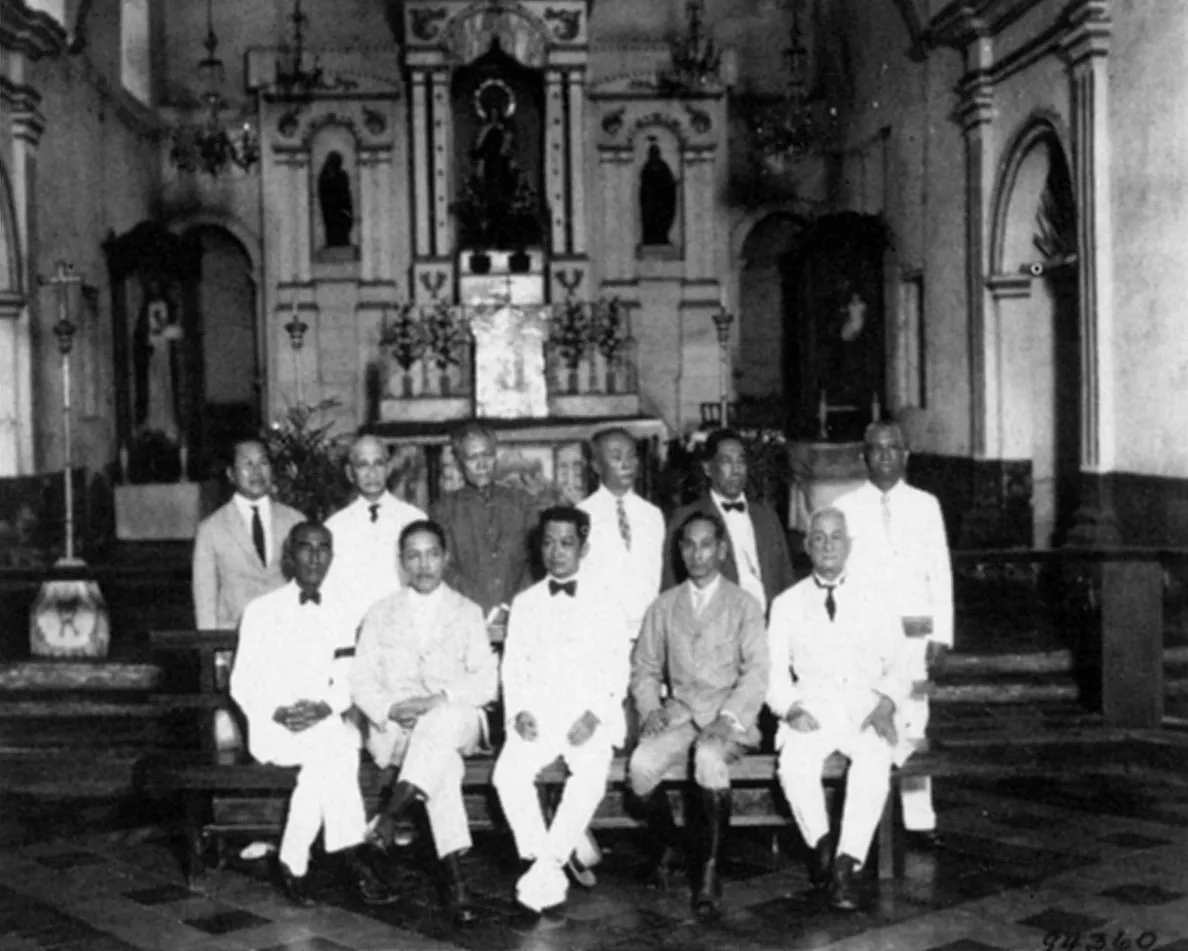
General Emilio Aguinaldo (seated, center) with delegates of the First Philippine Republic, the government the United States fought to suppress in the Philippine-American War of 1899-1902. (Wikimedia Commons)
The Philippine-American War and Its Costs
What followed American annexation of the Philippines was not peaceful incorporation into the American sphere. Instead, the islands erupted into what became known as the Philippine-American War—a counterinsurgency conflict whose conventional phase the United States declared over on July 4, 1902, though fighting continued in the southern Moro provinces until 1913. Historians estimate that at least 200,000 Filipinos died — roughly 20,000 of them combatants, the rest civilians, most from the famine and disease the war unleashed. The American acquisition of the Philippines, justified as a humanitarian intervention to liberate Cubans from Spanish colonialism, resulted in a death toll far exceeding the Spanish-American War that had preceded it.
The war involved tactics that violated basic humanitarian norms even by the standards of the early twentieth century. American soldiers employed the water torture technique known as the "water cure," forcing water down prisoners' throats until their bodies swelled and they lost consciousness, sometimes resulting in death. Villages suspected of harboring insurgents were burned. Entire civilian populations were subjected to collective punishment. Crops were deliberately destroyed and infrastructure dismantled to deny supplies to Filipino resistance forces. The American commanding general in Samar, Jacob H. Smith, famously instructed his troops: "I wish you to kill and burn. The more you kill and the more you burn, the better you will please me." When an officer asked Smith what age limit he should observe in killing civilians, Smith replied: "Ten years."
These atrocities became public knowledge during Roosevelt's presidency. In 1902, the Senate Committee on the Philippines published the Gardener Report detailing American abuses. The Anti-Imperialist League released further evidence of war crimes, including officers' testimony about systematic torture and the killing of civilians. Roosevelt received detailed reports of these tactics. But rather than condemn them, he defended them. He justified the war as necessary to bring order and civilization to the islands, to prevent what he saw as chaos and anarchy. He characterized Filipino resistance not as nationalist aspiration but as "treachery and barbarism" requiring harsh suppression. He celebrated the American soldiers who fought and died in the islands as brave servants of civilization.
Prominent Americans opposed the war vehemently. Mark Twain served as a vice-president of the Anti-Imperialist League from 1901 until his death. In “To the Person Sitting in Darkness” (1901), published in the North American Review, he satirized the American campaign in the Philippines as a betrayal of the country’s own principles, likening it to the European imperialism he had condemned in Africa and Asia. Andrew Carnegie, the steel magnate and philanthropist, funded the anti-imperialist movement, believing that Philippine conquest fundamentally contradicted American democratic principles. William Jennings Bryan, three times a presidential candidate, argued that the Philippines could not be ruled as a foreign colony without destroying American republicanism itself. These were not fringe voices. The anti-imperialist movement included some of America's most respected intellectuals, writers, and public figures.
Roosevelt answered these critics in public and in kind. In “The Strenuous Life” (1899) he derided “the over-civilized man, who has lost the great fighting, masterful virtues,” and he cast opposition to expansion as national weakness. In his stated view, expansion and dominion were expressions of national vigor; to oppose them was to shrink from the nation’s duties.
The Philippines remained under American control until 1946, after World War II. The war itself created profound resentment among Filipinos and established a relationship of dominion rather than genuine partnership. The economic policies Americans imposed on the islands—opening markets to American products, establishing favorable terms for American investors—enriched American traders and industrialists while doing little to improve the condition of ordinary Filipinos. Roosevelt did not ignore the question of Filipino self-government; he answered it in the negative, arguing that the islands’ population was unfit for self-rule and that withdrawal would bring chaos. The islands, in his view, were valuable territory, valuable markets, and valuable strategic positions in the Pacific.
Roosevelt's celebration of the Philippine conquest as an achievement of civilization and progress sits uneasily with the historical reality: it was the forcible subordination of a people who desired self-government to foreign rule, justified by racial theories positing superior and inferior peoples. Roosevelt’s language of uplift coexisted with tactics his own government’s Senate investigation documented in 1902; both are part of the record.
The Roosevelt Corollary and the Policing of Latin America
Roosevelt's imperial vision extended well beyond the Philippines. In 1904, he articulated what became known as the Roosevelt Corollary to the Monroe Doctrine. The original Monroe Doctrine, issued by President James Monroe in 1823, had warned European powers against further colonization or interference in the Western Hemisphere. It was a defensive doctrine, establishing a line: you Europeans stay out of our hemisphere. Roosevelt transformed it into an offensive doctrine, a charter for American intervention. According to Roosevelt's reinterpretation, if any Latin American nation became unstable, experienced civil strife, or defaulted on its debts to foreign creditors, the United States had not merely the right but the responsibility to intervene to impose order and stability. In Roosevelt's view, chronic instability and default invited European intervention. Therefore, American intervention was necessary to keep Europeans out—and to ensure that American economic and strategic interests were protected.
This doctrine became the justification for repeated American military interventions throughout the Caribbean and Central America: in Cuba, where American troops remained to oversee "stable" governance; and in the Dominican Republic, where the United States took over customs collection in 1905 to ensure debt repayment. Later presidents extended the Corollary’s logic much further — Nicaragua (1912), Haiti (1915) — interventions carried out under Taft and Wilson on the doctrine Roosevelt had articulated. In each case, American marines landed, American military governors imposed American rule and American order, and American investments flowed in to extract resources and profit—timber, minerals, agricultural products, and commercial opportunities.
Roosevelt presented these interventions as civilizing work, as the necessary imposition of order on disordered places, as protection of American strategic interests and the security of the hemisphere. The language was always about stability, efficiency, and civilization. Latin Americans, however, experienced these interventions as foreign domination, as humiliating violations of national sovereignty, as imperialism in its most obvious form. A Haitian or Dominican or Nicaraguan watching American marines land, watching American officers take control of government functions, watching American businessmen sign favorable contracts while their own governments had no voice in the decisions: they saw occupation, not civilization.
The Roosevelt Corollary would poison American relations with Latin America for generations. The memories of American military intervention, American occupation, American financial control—these became deep sources of resentment and nationalist grievance in Latin America. Anti-American sentiment that arose in this period persisted for decades. Roosevelt, however, believed he was acting in the best interests of the entire hemisphere. He saw himself as the guardian of order and progress. He did not view these interventions as violations of sovereignty; rather, he believed sovereignty was something that had to be earned through the demonstration of stability, good governance, and fiscal responsibility according to American standards. Nations that defaulted on debts or experienced internal disorder had forfeited their claim to be treated as equals. This logic justified unlimited American intervention.

“Hands Off!” — Louis Dalrymple’s 1904 cartoon shows Roosevelt invoking the Monroe Doctrine to bar European powers from the Dominican Republic, asserting a U.S. right to police Latin America. (Judge magazine, Harvard University)
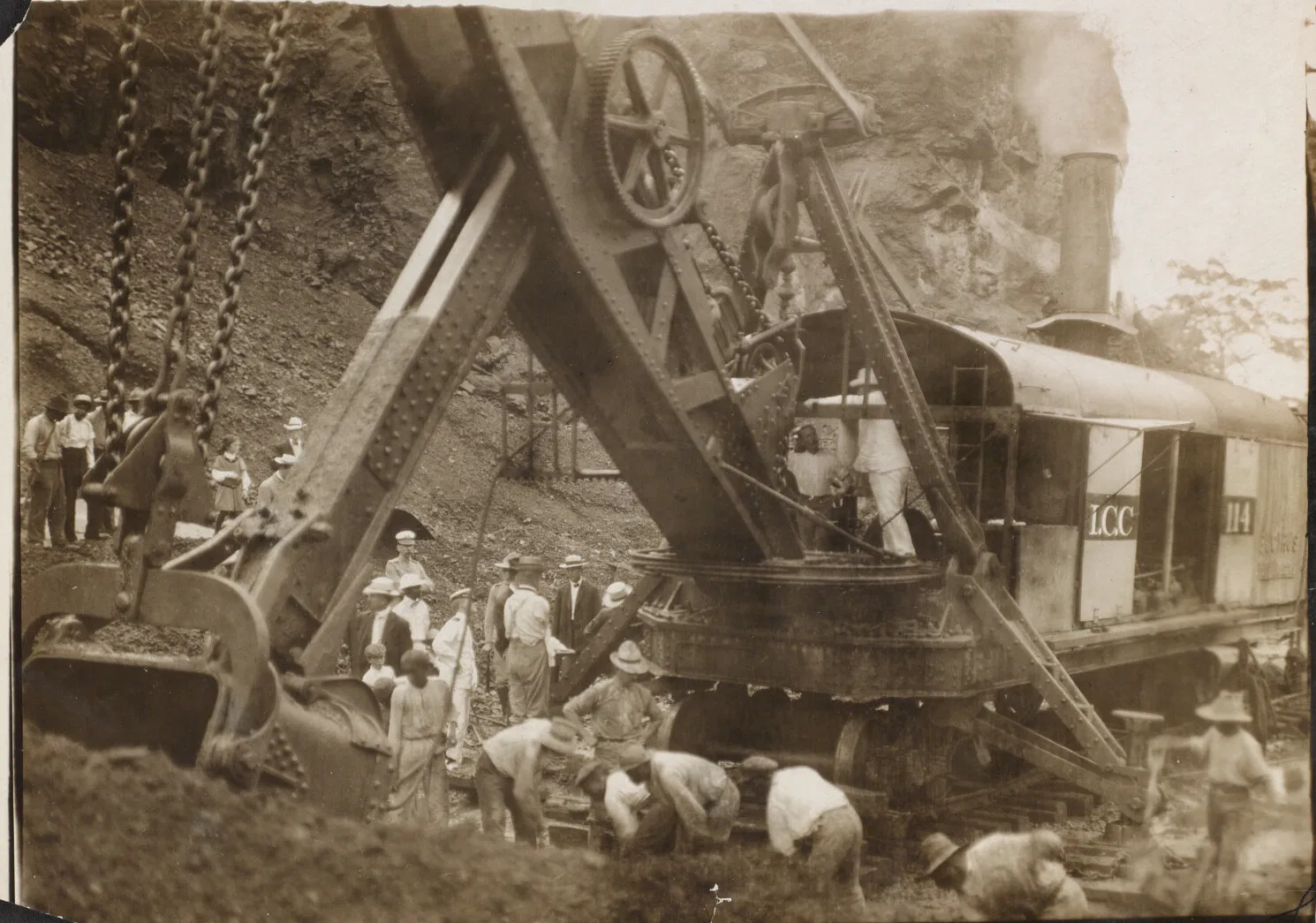
Workers and an inspection party at an Isthmian Canal Commission steam shovel cutting through Culebra Cut, in the Panama Canal Zone the United States secured after backing Panama's 1903 secession from Colombia. (Library of Congress)
Panama: Engineering Regime Change
Roosevelt's most audacious exercise of imperial power involved Panama. In early 1902, the Senate faced a choice between two canal routes: Nicaragua or Panama. The Isthmian Canal Commission recommended Nicaragua, the conventional choice. But Roosevelt preferred Panama, despite—or perhaps because of—its shorter route and lower projected costs. There was an obstacle: the treaty terms offered by Colombia, which held sovereignty over the Isthmus, were not favorable to American interests. The Colombian government demanded significant payments and control over the canal zone. Roosevelt judged these terms unacceptable.
At that moment, separatist sentiment existed in Panama, which had rebelled against Colombian authority dozens of times in previous decades, though never successfully. Roosevelt determined that this was the moment to support Panamanian independence. American naval vessels were strategically positioned near the Isthmus. When Panama declared independence in November 1903, Colombian troops attempting to suppress the movement found their passage blocked by American warships. The United States recognized Panamanian independence almost immediately. Days later, Secretary of State John Hay negotiated a canal treaty with the new Panamanian government that granted the United States far more favorable terms than Colombia had offered: perpetual control over a ten-mile-wide Canal Zone.
Roosevelt later described his role in his own words. In a March 1911 speech at the University of California, Berkeley, he was reported in press accounts as saying: “I took the Isthmus, started the canal and then left Congress not to debate the canal, but to debate me.” The wording varies somewhat across the newspaper reports of the speech; the claim of personal responsibility does not. Roosevelt was in effect saying: I determined that American strategic interests required the canal; I faced Colombian obstruction; I responded by supporting regime change to remove that obstruction. The constitutional and political legitimacy of this action was questionable even in 1903. American naval intervention to prevent Colombia from retaking its own territory was an act of imperial power, exercised against a nation that posed no threat to the United States. But Roosevelt did not doubt his actions. In his view, American power should be deployed to advance American interests, and questions of national sovereignty and self-determination by other peoples were secondary considerations.
Roosevelt was not the only American official involved in this operation. French engineer Philippe Bunau-Varilla, who represented French interests and stood to profit enormously from a successful Panama Canal deal, engaged in active lobbying—and it was Bunau-Varilla, a Frenchman, who signed the Hay–Bunau-Varilla Treaty granting the United States the Canal Zone, with no Panamanian present. American corporate lawyer William Nelson Cromwell, who represented the French Panama Canal Company, lobbied Congress vigorously. But it was ultimately Roosevelt's decision to position naval vessels and to recognize Panamanian independence immediately that made the difference. Without American military backing, the Panamanian independence movement would have remained what it had been for decades: a perpetually thwarted aspiration.
The Panama Canal became one of Roosevelt's great achievements, a feat of American engineering and ambition, connecting the Atlantic and Pacific oceans and reducing shipping time dramatically. It remains one of the world's most strategically important waterways, and its construction was a remarkable engineering accomplishment. But its acquisition was built squarely on American imperial power exercised against a sovereign nation that had committed no aggression against the United States. Colombia never attacked America; it never threatened American security. It simply declined to accept the terms the United States demanded. For this refusal, it lost control of its territory. This was the face of American imperialism: the subordination of smaller nations' sovereignty to American strategic interests and commercial ambitions.
The Ideology of Anglo-Saxon Destiny
Underlying Roosevelt's imperialism was a comprehensive racial and civilizational ideology. He believed in the superiority of Anglo-Saxon civilization—not merely as a historical accident or the result of different circumstances, but as a reflection of inherent racial superiority. He believed in the capacity and the destiny of Anglo-Saxon peoples to dominate, civilize, and govern other parts of the world. This belief was so fundamental to his worldview that he rarely felt the need to argue it; it seemed to him self-evident, as obvious as the laws of nature.
This was not a fringe view in Roosevelt's era. The doctrine of Anglo-Saxon or Aryan racial superiority was mainstream thinking among intellectuals, politicians, businessmen, journalists, and academics across the political spectrum in the early twentieth century. It appeared in serious academic works, in progressive journals, in political speeches. But Roosevelt expressed it with characteristic vigor and eloquence, and he put it into practice with characteristic aggressiveness.
Roosevelt believed that American power should expand because American civilization was demonstrably superior and would inevitably benefit the peoples brought under American rule, regardless of their own wishes in the matter. He believed that resistance to American expansion was irrational, born of ignorance, barbarism, or treachery. He believed that American investors, American military officers, American governance represented the highest forms of progress and civilization. The question of whether Filipinos, Panamanians, Cubans, or Dominicans themselves might have legitimate claims to self-determination was, in his worldview, beside the point. These were "uncivilized" or "semi-civilized" peoples incapable of self-government. They had no legitimate right to refuse American dominion if that dominion was exercised in the name of civilization and progress.
Roosevelt also believed that American expansion was not merely permissible but morally necessary. The "strenuous life"—the constant striving, the willingness to use force, the embrace of struggle—was not just personal virtue but the measure of national and racial health. Nations and races that did not expand, that did not strive, that did not dominate, were in decline. This belief merged racial ideology with a vision of international relations as a struggle for dominance. American expansion was therefore both inevitable and necessary, both the expression of American greatness and the mechanism by which American greatness would be preserved and extended.
This ideology was not unique to Roosevelt, but he gave it eloquent and forceful expression. His writings on imperialism and expansion, his speeches celebrating the "strenuous life," his defense of American actions in the Philippines and Panama—these articulated a vision of American power and American destiny that many Americans found compelling and inspiring. The ideology shaped American foreign policy for decades. Even as later generations came to regret specific imperial adventures, many Americans retained the basic belief in American superiority and the right of American power to shape world events.

Victor Gillam's 1899 cartoon “The White Man's Burden” shows Uncle Sam and Britain's John Bull hauling caricatured colonized peoples toward “civilization,” a visual expression of the era's Anglo-Saxon destiny ideology. (Judge magazine, 1899)
The Anti-Imperialist Response: A Road Not Taken
It bears noting that Roosevelt's imperialism faced serious opposition from thoughtful Americans. Mark Twain's anti-imperialism was not the position of a weak or decadent man, but of one of America's greatest writers and moral voices. William Jennings Bryan's arguments that American democracy could not be extended to distant peoples without fundamentally compromising American principles were serious political and philosophical contentions. Andrew Carnegie's anti-imperialism flowed from genuine concerns about American power and American character.
These critics lost the argument in Roosevelt's time. American imperialism proceeded, built on ideologies of racial superiority and civilizational destiny. But the anti-imperialist critique remained alive. The Philippines became independent in 1946; the racial theories that had justified annexation were abandoned by the scholarship that once endorsed them.
The record carries its own endpoints. In 1921 the United States paid Colombia $25 million under the Thomson–Urrutia Treaty, settling claims arising from the loss of Panama. Panama assumed full control of the Canal in 1999 under treaties signed in 1977. The Philippines became independent on July 4, 1946.
Continue Reading
- Roosevelt's Complex Legacy — Understanding the contradictions in Roosevelt's life and thought
- Native Americans and Conservation — The cost of Roosevelt's conservation achievements to Indigenous peoples
- The Presidency — Roosevelt's executive actions and their global consequences
Primary Sources at the TR Center
Explore Roosevelt's own words on American imperialism and foreign policy in the Theodore Roosevelt Center Digital Library.
- Roosevelt's Foreign Policy — Essays on American imperialism, naval power, and international diplomacy
- Roosevelt's Writings on Power and Civilization — His philosophical justifications for American imperial expansion
From the Archives
Explore original photographs, documents, and illustrations related to this topic in the Theodore Roosevelt Center Digital Library.
Recommended Reading
- The True Flag by Stephen Kinzer (2017). ISBN: 9781627792165
- The Imperial Cruise by James Bradley (2009). ISBN: 978-0-316-03966-6
- Honor in the Dust by Gregg Jones (2012). ISBN: 9781101575123
- Colonel Roosevelt by Edmund Morris (2010). ISBN: 978-0-679-60415-0