
The Roosevelt Family Roots
From New Amsterdam to New York: The Dutch Arrival (1640s)
Long before Theodore Roosevelt became the 26th President of the United States, his family was already weaving itself into the fabric of New York. The Roosevelt family story began with Dutch settlers arriving in New Amsterdam—the future New York City—in the 1640s. The Roosevelt name itself carries the story: van Rosenvelt in Dutch means "of the rose field"—a pastoral origin that seems almost poetic now, given that the family would eventually build itself into one of New York's most powerful and influential dynasties. The family line traces back to Claes Maartenszen van Rosenvelt, a farmer who arrived in New Amsterdam around 1649. We know little about him beyond the basics: he farmed, he had a wife named Jannetje, and according to the records of the day, he was called "Kleytjen"—little Claes.
What's remarkable isn't Claes himself, but what his descendants would build over the next two centuries. Generation after generation, the Roosevelt family consolidated land, accumulated mercantile interests, and positioned themselves at the center of Manhattan's merchant class. While other colonial families faded or scattered, the Roosevelts stayed, grew roots, married strategically, and built wealth. It wasn't the flashy rise of a robber baron; it was the steady, deliberate climb of people who understood that respectability and property were the foundations of influence.

The Roosevelts trace to Claes Martenszen van Rosenvelt, who sailed from the Netherlands to Dutch New Amsterdam in the 1640s — making them one of New York's oldest families. (Wikimedia Commons)

By TR's day the family had prospered for generations in New York commerce — most recently through Roosevelt & Son, the plate-glass importing firm that made them rich. (The Metropolitan Museum of Art)
Roosevelt & Son: The Glass-Importing Legacy
By Theodore Roosevelt's father's generation, the family was established as merchants and bankers of considerable standing. Theodore Roosevelt Sr. was a partner in Roosevelt & Son, the family's glass-importing firm located at 94 Maiden Lane in lower Manhattan. But here's what made the Roosevelts different: they didn't just make money. They believed that men of wealth had obligations to their community—what Theodore Sr. called "Muscular Christianity," the conviction that moral vigor and physical strength had to accompany Christian virtue.
The family lived comfortably in a townhouse at 28 East 20th Street, adjoining that of Theodore's uncle Robert B. Roosevelt. It was a fashionable address, centrally located, with easy access to the cultural institutions that were making New York the nation's intellectual and commercial heart.
The Dutch Tradition of Civic Duty
The Roosevelt family's wealth came with clear expectations. Your fortune wasn't just for your own enjoyment; it was a platform for doing good. When the American Museum of Natural History needed founding, Theodore Sr. helped establish it—an institution that would become central to his son's childhood. When the Metropolitan Museum of Art was being dreamed into existence, Roosevelt money and Roosevelt commitment were essential. The Children's Aid Society, institutions for orphans and the poor—these weren't distant charitable concerns but causes that drew Theodore Sr.'s personal attention and energy.
This expectation of public service as a duty of wealth wasn't unique to the Roosevelts, but they embodied it with particular seriousness. Young Theodore would inherit not just money but this moral framework—the idea that a man of privilege was obligated to serve his city, his nation, and those who had less than he did. It was baked into the Roosevelt DNA.

With wealth came a Dutch-rooted sense of obligation. TR's father embodied it, giving lavishly of his time and fortune to the city's poor. (Wikimedia Commons)

The family split into two branches — Theodore's at Oyster Bay and a cousin's at Hyde Park — that would produce two presidents and a first lady, Eleanor. (Library of Congress)
The Two Branches: Oyster Bay and Hyde Park
By Theodore Jr.'s time, the Roosevelt family had split into recognizable branches over the generations. There was the Oyster Bay branch—Theodore's line—and there was the Hyde Park branch, the two lines having diverged from brothers several generations earlier in the eighteenth century. The two branches occupied different social positions, pursued different interests, and would eventually follow different political paths. The Oyster Bay Roosevelts tended toward Republican politics, business leadership, and active participation in New York civic life. The Hyde Park Roosevelts, located up the Hudson River in Dutchess County, were also wealthy and prominent, but they operated somewhat outside of New York City's direct sphere of influence. The Roosevelt family network extended through elaborate networks of kinship and marriage that would shape American political history.
Theodore's Hyde Park cousins, for instance, included the parents of Franklin Delano Roosevelt, who would become Theodore's fifth cousin and eventually the 32nd President of the United States. And Eleanor Roosevelt—Franklin's wife—was Theodore's own niece, the daughter of his younger brother Elliott; Theodore would give her away at her wedding to Franklin in 1905. The Roosevelt family network was so extensive and so interconnected that it contained the future of American politics, though no one could have predicted it at the time.
For now, though, the family was unified by shared values: Dutch ancestry, Manhattan property holdings, merchant respectability, and a conviction that civic virtue was as important as commercial success. The Roosevelts weren't the flashiest family in New York. They were something more enduring: people who understood that money had to mean something beyond itself.
The Children of Privilege With a Sense of Purpose
By the 1850s, when Theodore Jr. was born, the Roosevelt family was firmly established as one of New York's leading merchant families. They occupied a townhouse at 28 East 20th Street in Manhattan, a fashionable address in a neighborhood of other prominent families. The house was substantial and well-appointed, but not ostentatiously grand—it reflected the Roosevelt philosophy that wealth was real and important, but that its value lay in what it could accomplish, not in how visibly it could display itself.
The Roosevelt household of Theodore Sr. and Mittie was one where serious values were taken seriously. Theodore Sr. was not a man of exceptional wealth compared to some of the robber barons of his era, but he was a man of considerable standing and influence. He used his position and his resources to advance causes he believed in. His partnerships in Roosevelt & Son generated the wealth that made other things possible—the support of cultural institutions, the investment in charitable works, the ability to participate meaningfully in the life of his city.
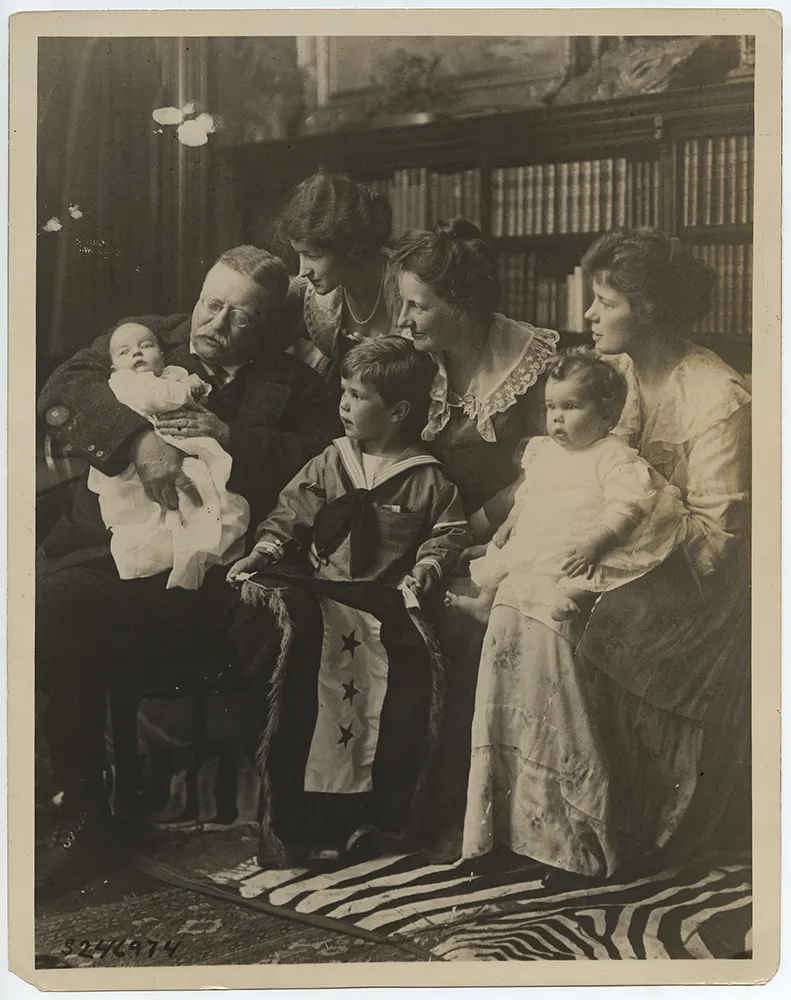
Raised amid privilege but taught that much was expected of them, the Roosevelt children were bred to see public service not as an option but as a duty. (Wikimedia Commons)
A Family Philosophy Takes Shape
As Theodore Jr. grew up in this household, he absorbed the Roosevelt creed without needing it to be explained. Work was honorable—not work for its own sake, but work that accomplished something meaningful. Duty was non-negotiable—you did what needed to be done, and you did it thoroughly. Physical vigor and moral courage were linked—you couldn't have one without the other. The poor and vulnerable deserved your attention and your action, not just your sympathy. And a man, ultimately, would be judged not by the size of his bank account but by how he'd used it to improve the lives of others.
These weren't abstract ideas in the Roosevelt household. They were lived, modeled, and expected. Theodore Sr. would embody them fully during Theodore Jr.'s childhood, and when he died—a loss that would devastate his son—young Theodore would spend his life trying to live up to the standard his father had set. The Roosevelt family roots ran deep in New York soil, and they nourished a particular kind of American: privileged but serious, comfortable but committed to something larger than comfort. That combination would shape everything Theodore Roosevelt would become.
Continue Reading
- Theodore Roosevelt Sr.: The Man Who Shaped a President — The patriarch who embodied Roosevelt civic values
- Martha "Mittie" Bulloch Roosevelt — How Southern traditions merged with Dutch mercantile values
- Theodore Roosevelt's Birthplace — The 28 East 20th Street townhouse and its significance
- The Roosevelt Family Tree — Exploring the branches and connections within the dynasty
- The Roosevelt Family Abroad: Grand Tour and Nile Adventure — How privilege translated into worldly education
From the Archives
Explore original photographs, documents, and illustrations related to this topic in the Theodore Roosevelt Center Digital Library.
Recommended Reading
- Mornings on Horseback by David McCullough (1981). ISBN: 0-7432-1738-1
- Theodore Roosevelt Volume One: The Formative Years 1858–1886 by Carleton Putnam (1958)
- Growing Up Roosevelt by Nina Roosevelt Gibson (2023). ISBN: 9781438495132