
Eleanor Roosevelt: The Legacy of Uncle Theodore
The Daughter of a Failure
Eleanor was born in 1884 to Elliott Roosevelt and Anna Rebecca Hall. Her childhood was marked by the knowledge that her father was not the man he claimed to be, or wanted to be. He was charming when sober, but unreliable. He made promises he could not keep. He was absent more often than present. He told her stories about honor and duty while living a life that contradicted those stories at every turn. The experience created in young Eleanor a sense of profound loneliness and a determination that she would learn to rely only on herself.
Her mother died when Eleanor was eight years old. Her father died when she was nine. Before her tenth birthday, Eleanor had experienced the death of both her parents and had lived a childhood marked by emotional instability and the knowledge that the adults around her were fallible, unreliable, and often unable to meet the needs of those who depended on them. She was taken in by her maternal grandmother and raised in a household that was respectable but not particularly warm, proper but not particularly affectionate.
In this context of loss and uncertainty, Eleanor's relationship with her Uncle Theodore became of enormous importance. Theodore was everything her father was not: reliable, principled, consistent, genuinely interested in her welfare. He represented stability and moral seriousness. He represented a vision of what a person of privilege could be if they were willing to commit themselves to service and principle.

Eleanor Roosevelt as a small child with her father, Elliott. Orphaned by ten, she grew up shy and lonely in her grandmother's care. (Wikimedia Commons)

Eleanor in her wedding gown, 1905. Her uncle, President Theodore Roosevelt, gave her away when she married her distant cousin Franklin. (National Archives)
Uncle Theodore's Influence
Theodore Roosevelt took his role as uncle seriously. He was interested in Eleanor's education and her development. He took time to speak with her about books and ideas. He modeled for her what a serious engagement with the world's important questions could look like. Most significantly, he demonstrated through his own life that a person of privilege and power could use those advantages in service of something larger than personal gratification.
Theodore's progressivism—his commitment to reform, to conservation, to the rights of working people, to economic justice—all of this influenced Eleanor deeply. She absorbed from her uncle not just his political ideas, but his fundamental belief that those with advantages have obligations to those without them. This became the animating principle of her entire life.
When Eleanor came of age and was presented to society as a young woman of good family, Theodore gave her away at her wedding to her cousin Franklin Delano Roosevelt in 1905. It was a symbolic moment—the uncle who represented principle and duty delivering his niece to the man who would become the first Roosevelt president of the twentieth century. Theodore perhaps did not fully realize in that moment that Eleanor would eventually become the most politically active First Lady in American history, or that she would use her position to advance causes and principles that went far beyond what most of her contemporaries would have imagined possible for a woman in that role.
Translating Theory into Practice
Eleanor Roosevelt took her Uncle Theodore's ideas about service and obligation and lived them out in ways that were both continuous with his vision and distinctly her own. Where Theodore had preached the "strenuous life" and had lived that philosophy through physical vigor, political activism, and energetic engagement with the world, Eleanor lived the strenuous life through relentless work on behalf of the dispossessed, the marginalized, and the forgotten.
She worked as a social worker in the slums of New York City, seeing firsthand the conditions under which poor people lived. She became involved in labor activism and reform movements. She took stands on racial justice and civil rights at a time when such stands were unpopular and costly. She used her position as First Lady not to retreat into ceremonial duties, but to advocate forcefully for causes she believed in. She wrote newspaper columns, gave speeches, held press conferences, traveled the country, and made it clear that a First Lady could be a political actor and not merely a ceremonial presence.
In all of this, Eleanor was living out principles that Theodore had taught—not through explicit instruction, but through the example of his own life. She believed, as Theodore believed, that a person's life should mean something, should contribute to something beyond the self. She believed that courage and principle mattered more than comfort or security. She believed that injustice should be resisted and that those with power had an obligation to use that power on behalf of those without it.

As First Lady from 1933, Eleanor remade the role — holding press conferences, writing a daily column, and championing the poor and disenfranchised. (Wikimedia Commons)

Franklin and Eleanor with two of their children, 1908. Their partnership became one of the most consequential in American political history. (Wikimedia Commons)
Partnership with Franklin
Eleanor's marriage to Franklin Roosevelt was complex and by no means a love match in the traditional sense. Franklin was unfaithful. Eleanor knew about his infidelity and accepted it with the understanding that theirs was primarily a political partnership rather than a romantic one. What made the partnership work was that Eleanor and Franklin shared similar commitments to progressive reform and social justice. Franklin provided the political position and the executive power; Eleanor provided the moral passion and the willingness to push beyond conventional boundaries.
Together, they transformed the presidency and the role of First Lady in ways that would have been impossible for either of them alone. Franklin depended on Eleanor's judgment, her connections, and her willingness to advocate for causes that he could not openly support. Eleanor used her position to advance her own agenda and to amplify the voices of those who had no platform. Their marriage was a political partnership of extraordinary significance.
The United Nations and Human Rights
After Franklin's death in 1945, Eleanor could have retired from public life. She was already in her sixties. She had accomplished enough for two lifetimes. But instead, she accepted an appointment as a delegate to the United Nations and became the chair of the commission that drafted the Universal Declaration of Human Rights. This document, adopted by the United Nations in 1948, stands as one of the most important statements of human dignity and human rights ever composed.
Eleanor's role in the creation of the Universal Declaration was crucial. She fought for language that would protect the rights of all people, regardless of national boundaries or political systems. She insisted on the inclusion of civil and political rights, and on economic and social rights as well. She refused to allow Cold War politics to undermine the document's universal commitment to human dignity. In this work, she was translating her Uncle Theodore's progressive vision into a global framework for human rights that would outlast both of them.
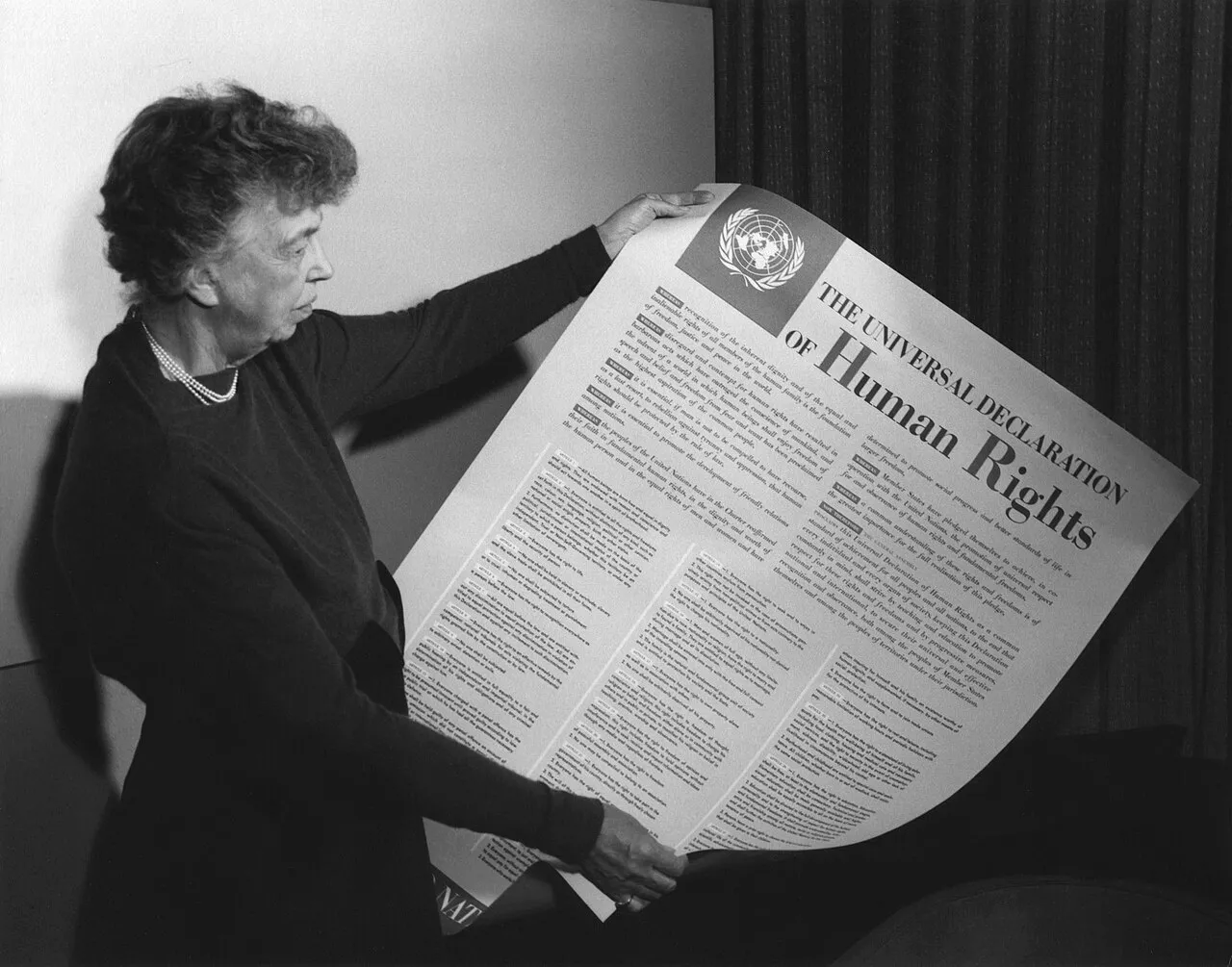
As chair of the UN commission, Eleanor guided the 1948 Universal Declaration of Human Rights — the achievement she considered her most important. (Wikimedia Commons)

Eleanor Roosevelt at the United Nations. 'First Lady of the World,' she remained a moral force until her death in 1962. (Wikimedia Commons)
A Life of Extraordinary Achievement
Eleanor Roosevelt lived until 1962, passing away at the age of seventy-eight. She had lived through the Great Depression, two world wars, and the beginning of the Cold War. She had witnessed enormous changes in American society and in the world. And throughout all these changes, she had remained committed to the principles that had animated her life: that privilege carries obligations, that injustice should be resisted, that a person's life should mean something, should contribute to something beyond the self.
What is remarkable about Eleanor is that she took the lesson of her Uncle Theodore's life—the idea that a person of privilege and power should use those advantages in service of something larger than themselves—and lived it out not just for a moment, not just in a particular arena, but across an entire lifetime and across the entire range of human experience. She worked for civil rights, for economic justice, for women's rights, for the rights of working people, for human dignity in all its forms.
In doing so, she became arguably the most significant woman in American history in the twentieth century. Her influence extended far beyond her lifetime. The Universal Declaration of Human Rights that she helped create became a touchstone for human rights activism around the world. Her example of how a woman could use power and position to advance justice inspired generations of activists and reformers. Her writings and speeches remain widely read and widely quoted.
The Circle Completed
Eleanor Roosevelt's life completes a kind of circle in the Roosevelt family story. Her father Elliott failed to live according to the principles that the Roosevelt family claimed to embody. But Eleanor, the daughter of that failure, took the pain of his failures and transformed it into a lifelong commitment to the principles he had abandoned. She showed that the Roosevelt philosophy—that those with advantages have obligations to use them for the common good—was not just the passionate assertion of one remarkable man, but a principle that could animate an entire life, could shape an entire legacy, could change the world.
She was the niece and spiritual heir of Theodore Roosevelt. But she was also something more: she was the woman who took her uncle's vision and pushed it further than he had imagined, who made it more inclusive, who made it truly universal. She made the strenuous life not just a matter of individual vigor and action, but a commitment to justice and human rights that could be pursued through patient work, through moral clarity, and through an unwavering belief in the dignity and worth of every human being.
Continue Reading
- Theodore Roosevelt — Eleanor's beloved Uncle Theodore who became her moral guide and mentor
- Elliott Roosevelt — Eleanor's troubled father whose failures shaped her commitment to duty and service
- The Roosevelt Family Tree — Eleanor's place in the broader Roosevelt family network and genealogy
Primary Sources at the TR Center
Explore original documents and resources related to Eleanor Roosevelt in the Theodore Roosevelt Center Digital Library.
- Eleanor Roosevelt Encyclopedia Entry — Comprehensive biographical essay on Eleanor's life and legacy
- Theodore Roosevelt Jr. — Eleanor's other family connections within the Roosevelt dynasty
From the Archives
Explore original photographs, documents, and illustrations related to this topic in the Theodore Roosevelt Center Digital Library.
Recommended Reading
- The Roosevelt Women by Betty Boyd Caroli (1998).