
The Fourth of July with Theodore Roosevelt
Theodore Roosevelt loved the Fourth of July. He set off firecrackers as a boy, spoke to a crowd of cowboys in Dickinson, spent one Fourth in the trenches in Cuba and, as President, sent a message around the world in twelve minutes. At Sagamore Hill, the family Fourth became a tradition of picnics and fireworks.
Key Facts
| Dakota oration | Orator at Dickinson's first Fourth of July celebration, held Monday, July 5, 1886, because the Fourth fell on a Sunday |
|---|---|
| 1898 | In the trenches outside Santiago, Cuba, three days after the charge at Kettle Hill and the San Juan Heights |
| The Pacific cable | On July 4, 1903, from Oyster Bay, he opened the Commercial Pacific Cable and sent a message around the world in twelve minutes |
| At home | Rowboat picnics and fireworks parties at Sagamore Hill, a tradition the papers followed for years |
| His last Fourth | 1918, at the head of a loyalty parade in Passaic, New Jersey |
Firecrackers and "great great greacion torpedos"
T.R.'s boyhood diaries show a kid who took the Fourth seriously. On Sunday, July 4, 1869, the Roosevelts were on a long trip abroad, and T.R. and his father had gone to Hastings, England. They went to church and walked on the cliffs, "and coming back we made a feeble attempt at cheering the 4th of July," the 10-year-old wrote.
The next year, home again, he had more to work with. His diary for July 4, 1870, in his own spelling: "Whew! Did not we have fun. We cracked torpedos etc etc. Our cousin Johney and Maud Elliott came. We had a fight of soildiers using the great great greacion torpedos at them. Fireworks."
In 1872, writing to his aunt from Dobbs Ferry, New York, he reported, "We had the most splendid fun on the fourth of July." Rain pushed the fireworks to the next evening. His summary of the whole affair: "We each got his fair share of burns."
Orator of the Day in Dickinson
In the summer of 1886, the 27-year-old rancher from the Little Missouri was invited to give the Fourth of July oration in Dickinson, Dakota Territory. July 4 fell on a Sunday that year, so the town celebrated on Monday, July 5. It was the first Independence Day celebration Dickinson had ever held.
The St. Paul Daily Globe ran a dispatch dated that day: "To-day was the most noted in the history of Dickinson, being the first Fourth of July celebration held in the town. It brought together the largest crowd ever assembled in this county." There were races in the afternoon and fireworks in the evening.
T.R. summed up the day in a letter home: "Today I went down to Dickerman to make the Fourth of July speech to a great crowd of cowboys and rangers, and after, stayed to see the horse races between the cowboys and Indians." (The text as printed reads "Dickerman," a slip for Dickinson.) Hermann Hagedorn's 1921 book Roosevelt in the Bad Lands prints a long version of the speech, built around the idea that the rights of citizens come with duties.
The Fourth in the Trenches, 1898
Twelve years later, T.R. spent the Fourth on the San Juan Heights outside Santiago, Cuba, three days after the charge at Kettle Hill. The day before, he wrote to Henry Cabot Lodge from the "Trenches outside Santiago": "For three days I have been at the extreme front of the firing line; how I have escaped I know not; I have not blanket or coat; I have not taken off my shoes even; I sleep in the drenching rain, and drink putrid water."
A truce followed the demand for Santiago's surrender. In The Rough Riders, T.R. wrote that he had planned to send sharpshooters out the next day, but the truce came first. When his baggage finally reached the front during the truce, he wrote, "I celebrated its advent by a thorough wash and shave."

Colonel Roosevelt and his Rough Riders at the top of the hill they captured, Battle of San Juan, 1898. William Dinwiddie, photographer. (Library of Congress)

T.R. speaking from a flag-draped platform, 1903. T. Y. Gildersleeve, Huntington, N.Y. (Library of Congress)
Around the World in Twelve Minutes
The Fourth of 1903 was a full day. That afternoon the President and Mrs. Roosevelt crossed by the navy yacht Sylph to Huntington, Long Island, where he spoke at the town's 250th-anniversary celebration. The Library of Congress holds a 1903 Biograph film titled "Pres. Roosevelt's Fourth of July oration."
That night, the last splice of the Commercial Pacific Cable was made at Honolulu. At about 10:50 p.m., from Oyster Bay, T.R. sent the first message over the completed line to Governor Taft at Manila: "I open the American Pacific cable with greetings to you and the people of the Philippines." Taft's reply arrived within half an hour.
Then he tried something new. At 11:23 p.m. he sent a message westward around the world to Clarence H. Mackay, president of the cable company, who was with him at Oyster Bay, the Associated Press reported. It arrived at 11:35 p.m., twelve minutes later. Mackay's reply went around the other way in nine and a half minutes.
A Speech for the Neighbors
As Governor of New York in 1899, T.R. came home to give the Oyster Bay Fourth of July oration. The New-York Tribune reported that "seldom has the little town of Oyster Bay… held at one time so many people." Booths sold "Roosevelt buttons, Roosevelt photographs and the like," and every clergyman in the village sat on the stand. Afterward, the paper said, he greeted one small boy with "Hullo, Rough Rider."
As President he spoke at Schenley Park in Pittsburgh in 1902, using his Fourth of July oration to press for commercial freedom for Cuba. In 1906 he spoke to his Oyster Bay neighbors for an hour, "half of it in a driving rain," the Tribune reported, then went home for dry clothes and hosted the family's annual fireworks party.
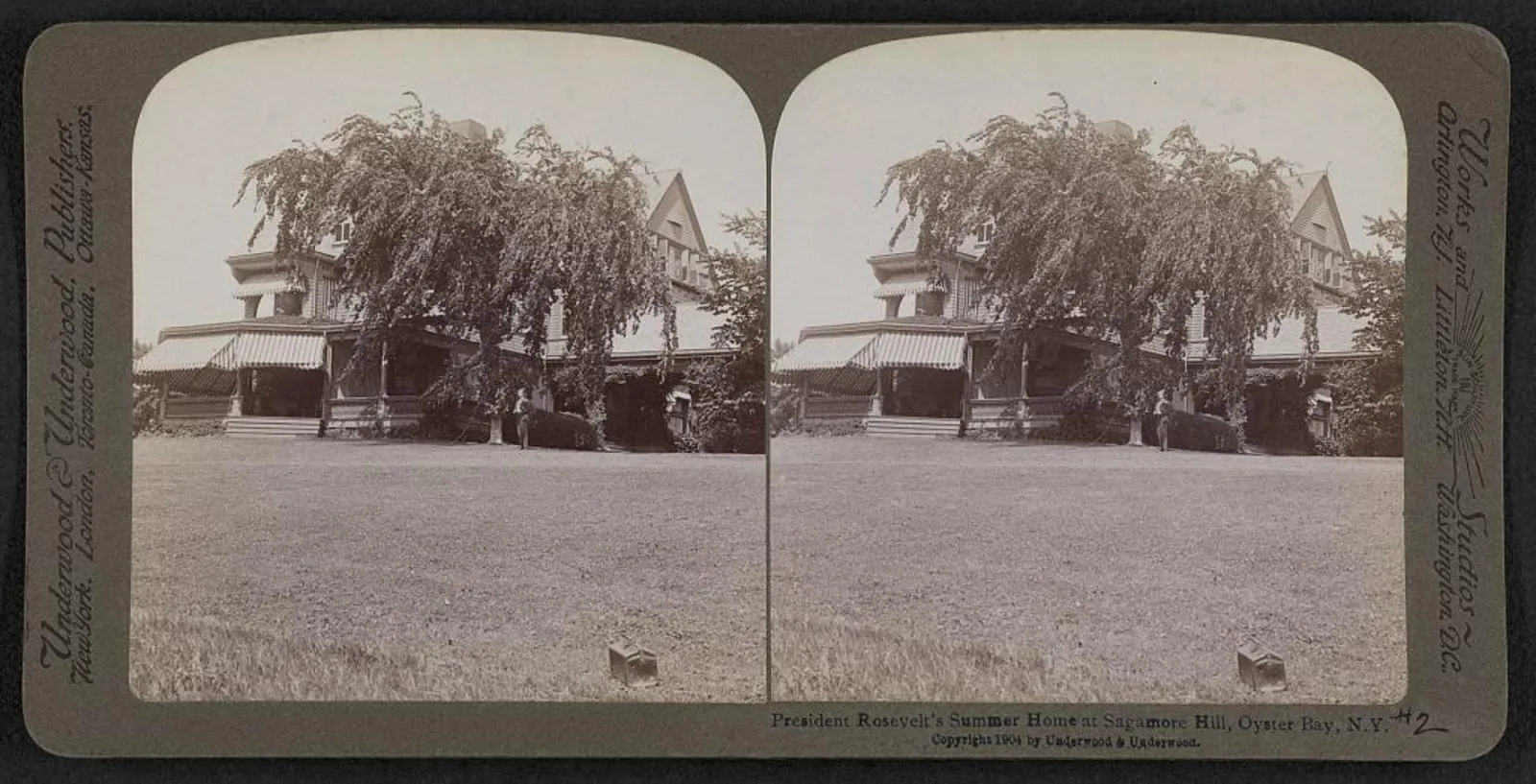
"President Roosevelt's summer home at Sagamore Hill, Oyster Bay, N.Y." Underwood & Underwood stereograph, c1904. (Library of Congress)

"Setting 'em off," Puck cover by Frank A. Nankivell, June 26, 1907: "Every day is Fourth of July with Theodore." (Library of Congress)
Fireworks at Sagamore Hill
At home, the Fourth belonged to the children. In his Autobiography, T.R. remembered the family dog Sailor Boy, who "loved firearms and fairly reveled in the Fourth of July celebrations--the latter being rather hazardous occasions, as the children strongly objected to any 'safe and sane' element being injected into them, and had the normal number of close shaves with rockets, Roman candles, and firecrackers."
In a July 1893 letter to his sister Anna (later Anna Roosevelt Cowles), he reported: "The children loved the fireworks—silly Kermit remarking, with an eye to edibles, that perhaps he might 'eat the firecrackers!'" When T.R. was away on the Fourth of 1896, the children held "a kind of mild party and belated Fourth of July celebration" later in the month, he told his sister Anna in a letter of July 19. "Nobody was burned," he wrote, "and they all seemed to enjoy themselves hugely."
By 1904 the New-York Tribune was describing a day of rowing to a picnic spot near Cold Spring Harbor, then fireworks and "a country dance." "After many years the Roosevelt Fourth of July has become as much of a fixture in Oyster Bay as the planting and harvesting of the shell fish," the paper said. In 1905 the fireworks waited: Secretary of State John Hay had died, and the President left Oyster Bay on the Fourth for his funeral in Cleveland.
Wartime Fourths
The last Fourths came in wartime. On July 4, 1917, T.R. gave an Independence Day address at Station Square in Forest Hills Gardens, Queens, calling for undivided loyalty to the country. The Library of Congress holds a typescript of the speech.
On July 4, 1918, he rode at the head of a loyalty parade in Passaic, New Jersey. The Sun reported that more than 75,000 people turned out, with 20,000 marchers "representing thirty-seven different nationalities." "We must not be contented until our army in France is larger than the French and British armies combined," he told the crowd, the New-York Tribune reported. That same day, newspapers listed his son Quentin among the American flyers in combat over the Château-Thierry front. Quentin was killed ten days later, on July 14.
Did He Really…?
Speak in Dickinson on July 4, 1886? Not quite. The Fourth fell on a Sunday, and Dickinson held its celebration on Monday, July 5. Many retellings give the date as July 4, and Hagedorn's own narrative has him setting out "on the morning of the Fourth."
Give his "first major public speech" in Dickinson? No. By 1886 he had already served three terms in the New York Assembly and been a delegate to the 1884 Republican National Convention.
Hear a prediction that he would become President, on the train home from Dickinson? That story comes from Arthur T. Packard, who told it to Hagedorn decades later. Packard said he could not remember exactly how T.R. answered. It is a later recollection, not a documented event.
Send a message around the world in nine and a half minutes? His westward message took twelve minutes. The nine-and-a-half-minute trip was Clarence Mackay's reply, which went the other direction. The two figures are often swapped.
Send it from Sagamore Hill? The newspapers of the day said Oyster Bay. According to the Atlantic-Cable history site, a Sagamore Hill curator has said the room in a well-known photograph of the event is not in the house.
Explore More
Timeline of T.R.’s Fourths of July
Where he spent the Fourth, from Hastings to Dickinson to Passaic.
Labor Day with Theodore Roosevelt
A Chicago picnic, a square deal at Syracuse and a rainy Labor Day in Fargo.
Primary Sources
- Theodore Roosevelt’s Diaries of Boyhood and Youth (1928)
- The Rough Riders (1899)
- An Autobiography (1913)
- Chronicling America (Library of Congress)
From the Archives
Letters, speeches and photographs about the Fourth of July from the Theodore Roosevelt Center’s digital library.
Recommended Reading
- Roosevelt in the Bad Lands, Hermann Hagedorn (1921)