
Mount Rushmore: Why Roosevelt Is Carved in Stone
Gutzon Borglum's Vision and Roosevelt's Selection
Mount Rushmore, the colossal monument carved into the Black Hills of South Dakota, features four presidents: George Washington, Thomas Jefferson, Abraham Lincoln, and Theodore Roosevelt. The monument was envisioned and executed by sculptor Gutzon Borglum, who began carving in 1927 and died in 1941 with the work still in progress. The selection of these four presidents was not accidental. Each was chosen to represent a distinct phase of American history and achievement.
Borglum's vision was explicit. Washington represented the founding and the birth of the nation. Jefferson represented expansion and the acquisition of new territory—the Louisiana Purchase and the opening of the West. Lincoln represented preservation—holding the nation together through the Civil War. Roosevelt represented development—the conservation of natural resources, the building of the Panama Canal, the emergence of America as a world power.


The Symbolic Meaning: Development and Progress
Roosevelt's inclusion on Mount Rushmore was justified primarily by his conservation legacy and his role in transforming America into a world power. Borglum and others argued that Roosevelt had fundamentally reshaped the American presidency and had positioned America for leadership in the twentieth century. His conservation efforts had preserved vast tracts of public land and established the principle that natural resources belonged to the nation, not to private individuals.
Roosevelt's election to Mount Rushmore also reflected his popularity and his cultural impact. He had been president in the early twentieth century, close enough to the time of the monument's construction that his legacy was still being actively debated and discussed. Some historians and critics argued that Lincoln or Jefferson deserved the spot more than Roosevelt. Others defended Roosevelt's selection based on his achievements in conservation, trust-busting, and foreign policy.
The Conservation Achievement: The Core Justification
The primary justification for Roosevelt's inclusion was his conservation legacy. During his presidency (1901-1909), Roosevelt protected approximately 230 million acres of public land. He created fifty-one federal bird reserves, four national game preserves, five national parks, and established the U.S. Forest Service. He signed the Reclamation Act, which led to irrigation projects in the arid West. He promoted the idea that natural resources—forests, minerals, water—belonged to the nation and should be managed for the common good.
This conservation achievement was unprecedented. No president before Roosevelt had attempted such comprehensive protection of natural resources. No president after him would surpass his acreage protected (though later presidents have added to the protected lands). Roosevelt had demonstrated that federal government had a responsibility not just to current citizens but to future generations. This idea—that we hold the land and resources in trust for our descendants—became foundational to American environmental policy.


The Panama Canal and American Power
Another significant achievement cited in defense of Roosevelt's Mount Rushmore placement was the Panama Canal. Roosevelt recognized that American commerce and military power would be enhanced by a canal connecting the Atlantic and Pacific. He maneuvered to support Panamanian independence from Colombia and then ensured that the United States received the right to build the canal. The canal was completed after his presidency but was initiated during his administration. It became one of the great engineering feats of the age and a symbol of American technological prowess and global ambition.
The canal construction demonstrated Roosevelt's willingness to act decisively and to pursue American interests on the world stage. It also had lasting consequences for American-Latin American relations, some positive and some deeply problematic. But there was no question that the canal represented a transformative achievement—both for America and for global commerce.
Trust-Busting and the Square Deal
Roosevelt's domestic legacy of trust-busting and progressive reform was also cited as justification for his Mount Rushmore inclusion. His administration had initiated more than forty antitrust suits during his presidency, challenged the power of big business, and promoted the idea that corporations needed to be regulated in the public interest. He had also advocated for labor protections, including limits on working hours and restrictions on child labor. These efforts represented a new conception of federal government responsibility.
Roosevelt's Square Deal—his promise of fair dealing among all classes—became a defining concept of early twentieth-century American politics. It represented the idea that government should actively intervene to protect workers, consumers, and the public from exploitation by powerful private interests. This conception of government power was revolutionary at the time. Its influence can be traced through the rest of the twentieth century.
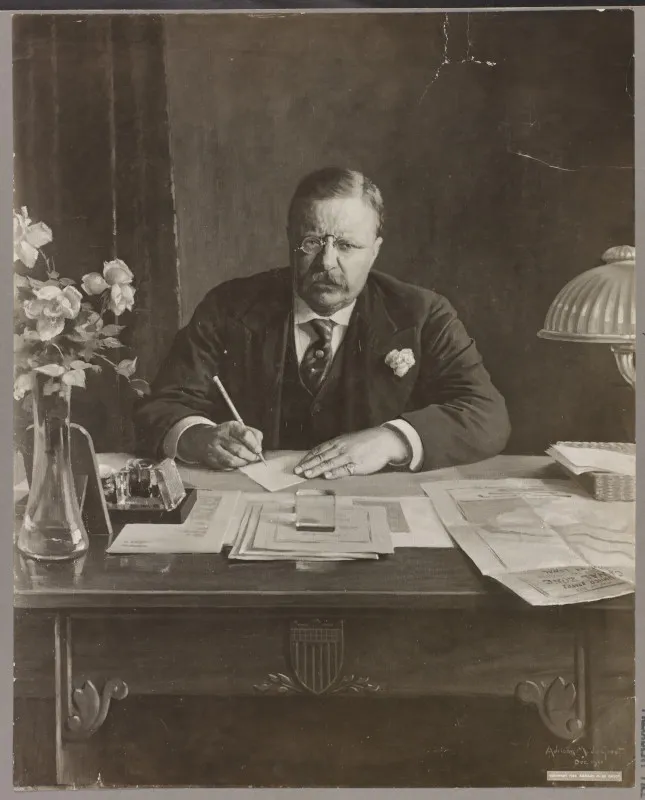

The Controversy: Should Roosevelt Be There?
Roosevelt's placement on Mount Rushmore has generated periodic controversy. Some historians and critics have argued that other presidents—Franklin Roosevelt, Theodore Roosevelt's fifth cousin who led the country through the Great Depression and World War II, for example—had greater impact. Others have questioned whether Theodore Roosevelt's achievements, while significant, truly placed him in the same category as Washington, Jefferson, and Lincoln.
Defenders of Roosevelt's selection point out that he was a transformative figure who fundamentally reshaped the presidency and positioned America for twentieth-century global leadership. They argue that his conservation legacy alone justifies the honor. Critics respond that conservation, while important, may not rise to the level of founding a nation (Washington), expanding it dramatically (Jefferson), or preserving it through civil war (Lincoln).
What cannot be disputed is that by the 1920s, when Borglum was selecting the presidents to carve, Roosevelt was considered one of the greatest American presidents and one of the most significant figures of the late nineteenth and early twentieth centuries. Whether one agrees with his placement on Mount Rushmore, there is no question that he profoundly influenced American history, politics, and culture.
The Monument's Ongoing Significance
Mount Rushmore has become one of the most visited and recognized monuments in the world. The presence of Roosevelt's face on the mountain has shaped public memory of his presidency. For millions of Americans and international visitors, Mount Rushmore serves as a visual representation of American greatness and presidential achievement. Whether one approves of Roosevelt's selection or not, the monument has secured his place in the pantheon of great American presidents.
The monument also raises important questions about how we remember historical figures. Borglum carved these four presidents into stone in the 1920s and 1930s, when certain interpretations of their legacies were dominant. As historical understanding evolves—as we grapple more honestly with the problematic elements of these presidents' records, including their racism and imperialism—Mount Rushmore becomes a more complex symbol. It represents achievement, but also the selective memory and mythology we create around our leaders.
To learn more about Roosevelt's presidency and legacy, visit the Theodore Roosevelt Center.
Continue Reading
- Theodore Roosevelt Biography — More on TR
- TR's Legacy — More on TR
Primary Sources at the TR Center
Explore original documents and resources related to this topic in the Theodore Roosevelt Center Digital Library.
- TR Center Digital Library — Primary source collection
From the Archives
Explore original photographs, documents, and illustrations related to this topic in the Theodore Roosevelt Center Digital Library.
Recommended Reading
- Theodore Roosevelt: A Strenuous Life by Kathleen Dalton (2007). ISBN: 978-0-307-42968-1
- The Rise of Theodore Roosevelt by Edmund Morris (1979). ISBN: 978-0-307-77782-9