
Words and Phrases TR Popularized: A Verbal Legacy
The Bully Pulpit: A President's Platform
One of Roosevelt's most enduring contributions to American vocabulary is the phrase "bully pulpit." Roosevelt believed that the presidency was not merely an office for executing laws and conducting routine government business. It was a platform from which a president could speak directly to the American people, persuading them toward his vision and goals. The "pulpit" was the presidency itself. "Bully" (meaning excellent or wonderful, in Roosevelt's era) expressed his enthusiasm for the platform.
Roosevelt used the presidency as a "bully pulpit" to advocate for his policies, criticize opponents, and inspire public support. He spoke frequently, gave interviews, and put forth his views publicly. This approach was revolutionary at the time. Previous presidents had been more reserved and formal. Roosevelt's willingness to speak directly and frequently to the public made the presidency more visible and made the president a more prominent force in American public life.
The phrase has endured precisely because it captures an important truth about the modern presidency. The president is not merely an executive implementing laws. The president is also a communicator, an inspirer, a persuader. The "bully pulpit" remains one of the president's most significant powers.

Roosevelt coined "bully pulpit" for the presidency’s unmatched power to command public attention, here addressing a crowd from a speaker’s platform. (Library of Congress)
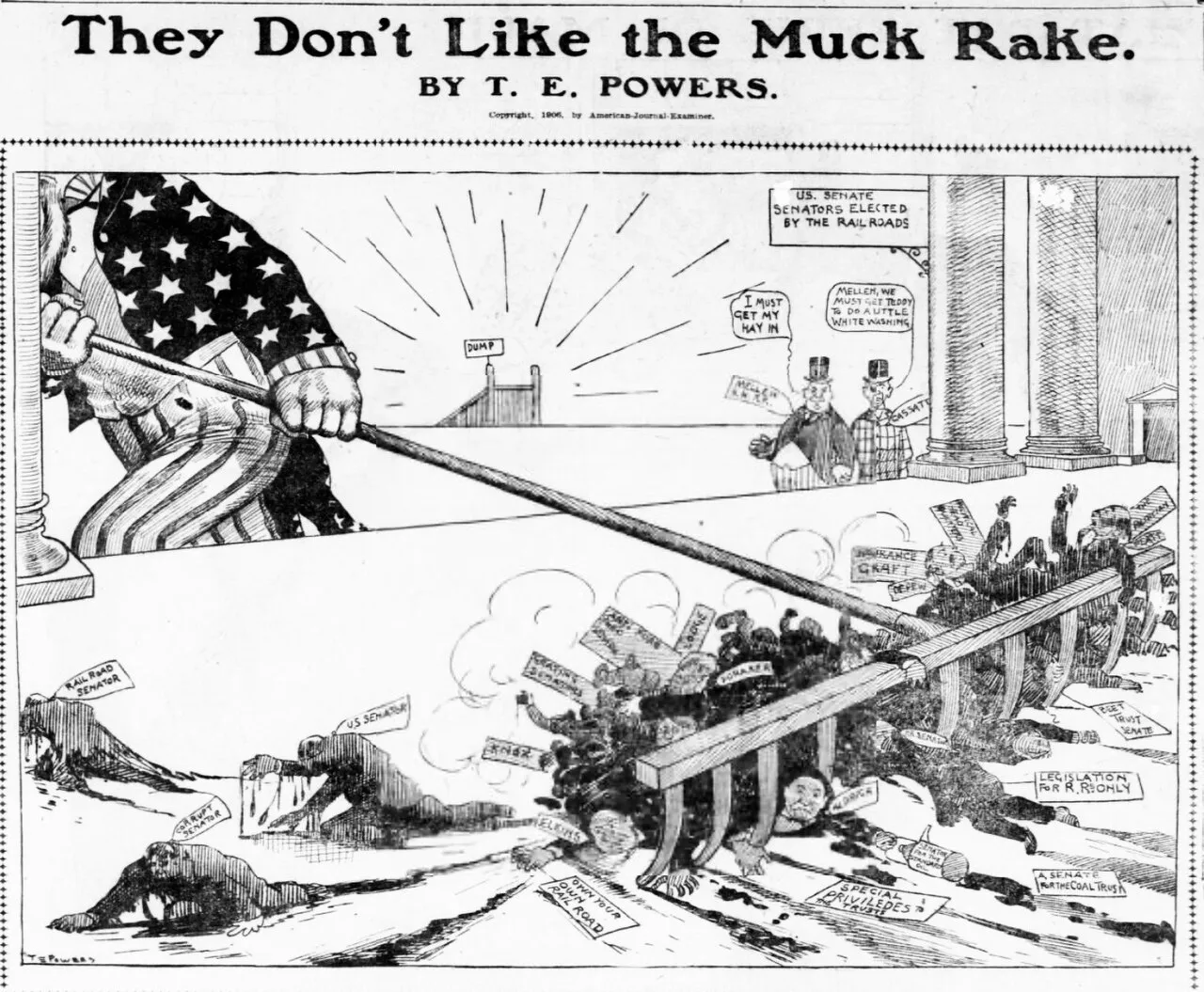
Roosevelt drew "muckraker" from Bunyan for journalists who expose corruption; this 1906 cartoon, "They Don’t Like the Muck Rake," plays on the phrase. (Salt Lake Herald)
The Muckraker: Journalists Who Expose Corruption
Roosevelt introduced the term in his speech "The Man with the Muck-Rake," delivered in Washington on April 14, 1906, to describe journalists and writers who exposed corruption, exploitation, and misconduct in business and government. The term came from John Bunyan's "Pilgrim's Progress," where a character with a muck rake focuses only on the filth at his feet rather than the celestial crown above him. Roosevelt's usage was not entirely complimentary—he believed some muckrakers sensationalized stories or overlooked positive achievements in their focus on wrongdoing. Yet he also recognized that muckraking served an important purpose in exposing real abuses.
The term became permanently associated with investigative journalism. Ida Tarbell's investigation of Standard Oil, Upton Sinclair's "The Jungle" exposing meatpacking conditions, and Lincoln Steffens's articles on urban corruption were all called muckraking. These journalists were not just reporting news; they were advocating for reform by exposing scandals and abuses. The term "muckraker" continues to be used for investigative journalists today.
The Lunatic Fringe: Extremists on the Margins
Roosevelt used "lunatic fringe" to describe extremists and ideological purists who, in his view, pursued their causes with fanatical intensity and were willing to damage the broader movement for the sake of ideological purity. The term was not complimentary. Roosevelt believed that practical politics required compromise and pragmatism. Those unwilling to compromise—ideological purists and radical extremists—were part of the "lunatic fringe."
Roosevelt's use of the term reflected his contempt for what he saw as impractical idealism. His own approach was pragmatic—achieve what you can within the realm of political possibility, rather than demanding perfect solutions that could not be realized. The term has endured as a way to describe extremists of any ideology who are seen as rigid and unwilling to compromise.

Roosevelt popularized "lunatic fringe" to describe the zealots and extremists he saw clinging to the margins of every reform movement. (Library of Congress)

When Roosevelt declared his "hat in the ring" in 1912, he led the Progressive "Bull Moose" ticket with running mate Hiram Johnson, at right. (Library of Congress)
Hat in the Ring: Entering a Political Race
In 1912, when Roosevelt decided to challenge President Taft for the Republican nomination, he announced his intention with the phrase "my hat is in the ring." The metaphor came from boxing—in boxing rings, fighters would throw their hats into the ring to indicate they were ready to compete. Roosevelt, with his love of boxing and combat sports, adopted the phrase to announce his political challenge.
The phrase captured the combative nature of Roosevelt's political approach. He was not reluctant or defensive about his ambitions. He threw his hat in the ring aggressively and publicly.
The Square Deal: Fair Treatment for All
Perhaps Roosevelt's most important political phrase was "the Square Deal"—his promise to American citizens that government would ensure fair dealing among all classes. Capital would have its rights, but labor would have protections. Business would be regulated, but not destroyed. The vulnerable would be protected from exploitation. It was a vision of justice, fairness, and balance.
The Square Deal became the signature of Roosevelt's presidency. It promised equal treatment under law, protection of the weak from the strong, and punishment of corporate wrongdoing. Though the phrase has faded somewhat from modern political vocabulary, its underlying concept—that government has a responsibility to ensure fairness—remains influential in American politics.

Roosevelt’s "Square Deal" pledged fair treatment for labor, business, and the public alike — the phrase that came to define his domestic agenda. (Library of Congress)

A serious naturalist, Roosevelt coined "nature faker" to ridicule popular writers who sentimentalized and misrepresented the behavior of wild animals. (Library of Congress)
Nature Faker: Writers Who Anthropomorphize Animals
Roosevelt's criticism of "nature fakers" emerged from his dispute with nature writers who attributed human emotions and intentions to animals. Jack London and Ernest Thompson Seton wrote popular books that portrayed animals as either noble and virtuous or villainous and cruel, in ways that Roosevelt considered dishonest and misleading. Roosevelt insisted on scientific accuracy in nature writing. Animals should be portrayed based on observation and fact, not romantic imagination.
The controversy reflected Roosevelt's commitment to intellectual honesty and scientific accuracy. He was willing to attack even popular writers when he believed they were being dishonest. The phrase "nature faker" is less common today, but the underlying concern—distinguishing honest nature writing from sentimental or inaccurate accounts—remains relevant.
Mollycoddle: A Weak or Excessively Coddled Man
Roosevelt used "mollycoddle" to describe men he saw as weak, soft, or overly indulged. The term reflected his contempt for softness and his belief that men should be vigorous and tough. A mollycoddle was the opposite of the ideal American man Roosevelt promoted—physically vigorous, morally courageous, willing to face challenge.
The term was often used in Roosevelt's disputes with critics and opponents. Those who opposed his policies were sometimes dismissed as "mollycoddles" unwilling to face the hard realities of politics and national life. The term is less common today, but it captures Roosevelt's disdain for what he saw as weakness and overcaution.

An apostle of the strenuous life, Roosevelt used "mollycoddle" to scorn soft, overly pampered men who shrank from vigorous effort. (Library of Congress)

Roosevelt popularized "weasel words" for evasive language that quietly drains a statement of meaning, as a weasel empties an egg through a small hole. (Library of Congress)
Weasel Words: Deceitful or Ambiguous Language
Roosevelt criticized what he called "weasel words"—language that sounded good but was deliberately ambiguous or misleading. A weasel, in Roosevelt's view, was a sneaky creature that killed animals by stealth. "Weasel words" were similarly deceptive—they appeared to say something but actually concealed meaning. Roosevelt valued clear, direct language and was contemptuous of what he saw as political double-speak.
The phrase has endured in modern political discourse. "Weasel words" remain a criticism leveled at politicians and others who use ambiguous language to avoid taking a clear position. Roosevelt's insistence on clarity and directness resonates with modern sensibilities skeptical of political evasion.
Good to the Last Drop: Maxwell House Coffee
There is a persistent claim that Roosevelt popularized the slogan "Good to the Last Drop," which became famous through Maxwell House coffee advertising. The claim is that Roosevelt tasted Maxwell House coffee and praised it with this phrase, which the company then adopted as its slogan. However, the attribution is disputed by historians. The phrase may have been created by the advertising agency rather than Roosevelt himself. But the claim became popular enough that it is often associated with him.
Whether or not Roosevelt actually created the phrase, its association with his name reflects his significance in American popular culture and advertising. Companies wanted their products to be associated with Roosevelt's vigor and approval. The false attribution to him demonstrates his cultural authority and appeal.

Legend credits Roosevelt with pronouncing a cup of Maxwell House coffee "good to the last drop," a phrase that became a famous advertising slogan. (Library of Congress)
Roosevelt's Linguistic Legacy
What is striking about Roosevelt's verbal legacy is that his phrases continued to be used and understood long after his death. They entered the vocabulary of American political discourse. Some, like "bully pulpit" and "square deal," remain widely used and understood. Others, like "mollycoddle" and "nature faker," are less common but still recognized. Roosevelt's vivid, direct language and his skill at creating memorable phrases contributed to his political and cultural influence.
Roosevelt understood the power of language. He was a prolific writer who published thousands of articles and dozens of books. He was a powerful speaker who gave hundreds of speeches. He used words to persuade, inspire, criticize, and explain. His linguistic legacy is one measure of his broader cultural impact. The words and phrases Roosevelt popularized remain part of American English, carrying with them his views and values.
Explore Roosevelt's speeches and writings at the Theodore Roosevelt Center's Digital Library.
Continue Reading
- Bibliography — More on TR
- TR's Legacy — More on TR
Primary Sources at the TR Center
Explore original documents and resources related to this topic in the Theodore Roosevelt Center Digital Library.
- TR Center Digital Library — Primary source collection
From the Archives
Explore original photographs, documents, and illustrations related to this topic in the Theodore Roosevelt Center Digital Library.
Recommended Reading
- Theodore Roosevelt: A Literary Life by Thomas Bailey and Katherine Joslin (2018). ISBN: 9781512602593
- The Wisdom of Theodore Roosevelt by Donald J. Davidson (2010)