
The Newlands Reclamation Act: Bringing Water to the Arid West
The Aridity Problem and Roosevelt's Answer
The American West had a problem that no amount of courage or hard work could overcome: it didn't have enough water. Vast territories—stretches of Nevada, Utah, Arizona, California, Colorado—received barely enough rain to sustain sagebrush and rattlesnakes. Settlers could file homesteads and try to farm, but without irrigation, the land was useless for agriculture. The soil itself was often good. But water made all the difference between prosperity and abandonment.
For centuries, Native Americans had lived in the arid West, developing sophisticated irrigation systems to manage the scarce water. But the vast influx of settlers in the late 1800s—people with dreams of owning farms and building towns—needed a different approach. They needed the federal government to build dams and canals to bring water from rivers to the dry land. They needed an investment of capital and engineering on a scale that no private individual or company could muster. In 1902, Theodore Roosevelt signed legislation that would transform the American West: the Newlands Reclamation Act.

President Theodore Roosevelt in 1904. His administration made reclaiming the arid West through federal water projects a signature cause. (Library of Congress)

Senator Francis G. Newlands of Nevada, whose 1902 Reclamation Act launched the federal program to irrigate the arid West. (Library of Congress)
Senator Newlands and the Logic of Reclamation
The Newlands Reclamation Act, signed on June 17, 1902, was one of Roosevelt's first major legislative victories. Named after Senator Francis Newlands of Nevada, the bill represented a comprehensive federal approach to solving the aridity problem. Here was the logic: the federal government owned vast territories in the arid West (the public domain). The government sold this land to settlers, generating revenue. The Newlands Act said: let's take that revenue and use it to build irrigation systems that will make the land worth something.
It was a brilliant solution to a genuine problem. In 16 western states, the federal government would use revenue from public land sales to fund irrigation projects. Dams would be built. Canals would carry water to dry fields. Deserts would bloom. Settlers could build farms, towns, and prosperity. The land that had seemed worthless became productive. It was progress written in water and engineering.
Roosevelt embraced reclamation enthusiastically. He saw it as a perfect example of how the federal government could use its resources and power to develop the West, create opportunities for settlers, and maximize the productive capacity of public lands. It fit perfectly with his philosophy that the natural landscape should be managed actively and scientifically for public benefit. If that meant building massive dams and canals, so be it.
The Reclamation Service: Building the West's Water Infrastructure
The Newlands Act created the U.S. Reclamation Service (which later became the Bureau of Reclamation). This agency's mission was straightforward: plan, design, and build irrigation projects across the arid West. Between 1902 and the end of Roosevelt's presidency, the Reclamation Service initiated 24 reclamation projects. These were enormous undertakings—engineering marvels of their day.
The most famous was the Roosevelt Dam in Arizona, literally named after the president. Built on the Salt River and dedicated by Roosevelt himself in March 1911, two years after he left office, the Roosevelt Dam was one of the highest earth dams in the world when constructed. It stored water from the Salt River during wet seasons, making it available for irrigation during dry seasons. Farmers downstream could rely on steady water supplies year-round. Towns could grow. The desert became cultivated land.
Other projects dotted the West: dams on the Colorado River, the Rio Grande, the Snake River, the Milk River, and others. Reclamation projects brought water to Nevada, Utah, California, Idaho, Montana, North Dakota, South Dakota, Kansas, Nebraska, New Mexico, Colorado, and Wyoming. They transformed the landscape and enabled a population boom in regions that previously could support only ranching or mining.
"The reclamation of the public lands will be of more direct benefit to the general public than any other public improvement," Roosevelt declared, reflecting his confidence that federal water management was essential to western development.
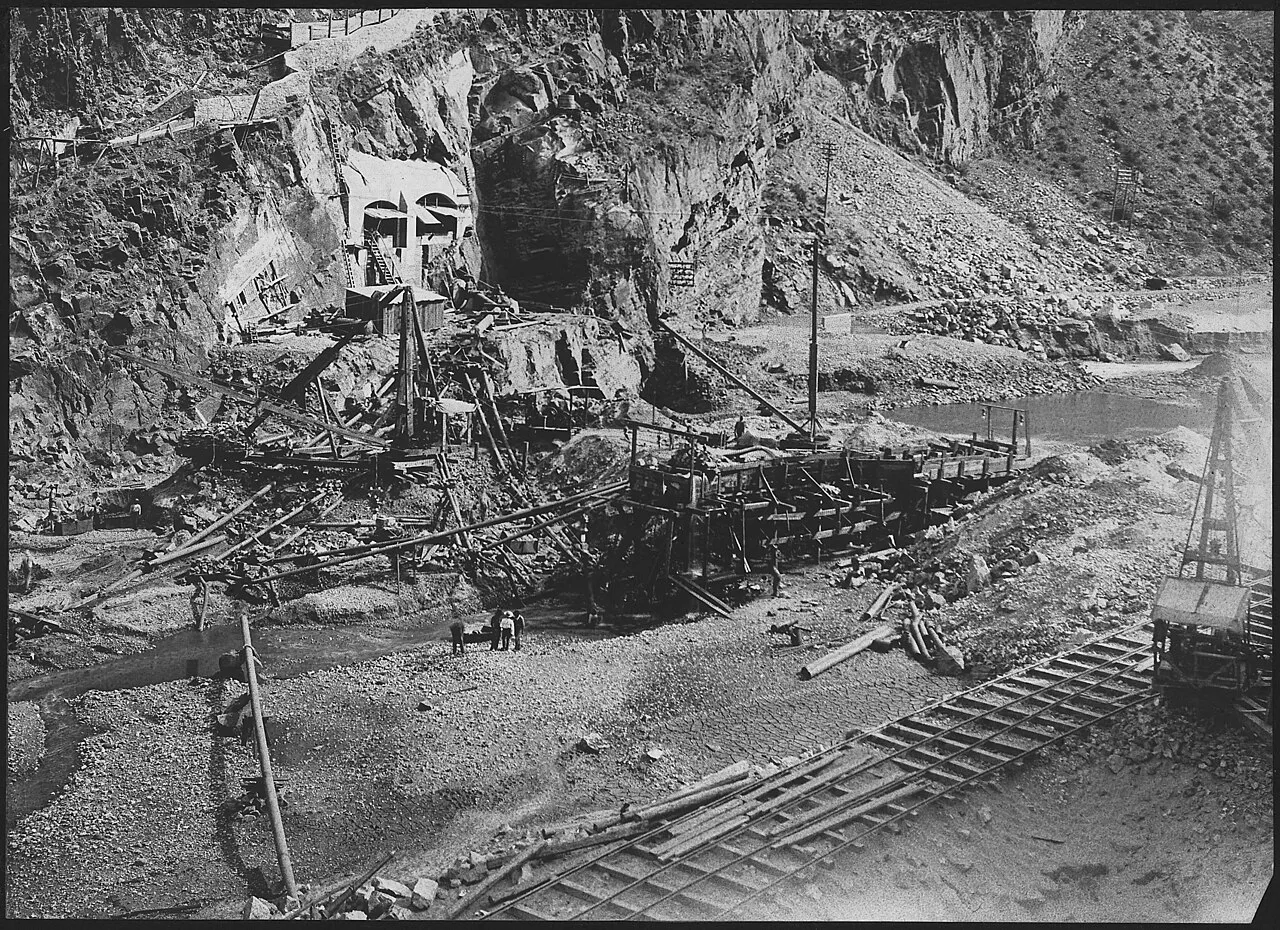
Construction of Roosevelt Dam on Arizona’s Salt River, an early flagship project of the U.S. Reclamation Service, circa 1906. (National Archives)

Derby Dam channels the Truckee River into a canal on Nevada’s Newlands Project — the first irrigation project authorized under the 1902 Reclamation Act. (National Archives)
The Complicated Legacy: Development and Disruption
The Newlands Act and the Reclamation Service enabled the settlement and agricultural development of the arid West. Millions of acres that were previously marginal became productive. Populations grew. Crops were harvested. Towns flourished. From a strictly economic perspective, the reclamation projects were successful. They generated prosperity and opportunity.
But the legacy was complicated, and some of the complications are still playing out today. The rivers that the Reclamation Service dammed and diverted had been part of ecosystems for thousands of years. Fish migrations were disrupted. Wetlands dried up. Native plants that depended on seasonal flooding disappeared. Wildlife populations that depended on those plants vanished or declined. The Colorado River, one of the West's mightiest waterways, was reduced to a trickle in its lower reaches because so much of its water was allocated to agricultural irrigation and urban development.
And then there were the Native Americans. The rivers and waterways had sustained Native peoples for centuries—the Colorado River tribes, the Paiute, the Ute, and many others. When the federal government allocated river water to settlers and farms, it reduced the water available to Native American communities. Water rights disputes that began in Roosevelt's time continue to dominate western politics to this day. Many Native American tribes today argue that the Newlands Act and reclamation projects subordinated their water rights to those of white settlers.
The Unintended Consequences of Engineering Nature
Reclamation projects also had effects no one fully anticipated. Dams trapped sediment that rivers had historically carried downstream. Downstream deltas became starved for the nutrients that sediment brought. Soils in reclaimed lands sometimes became saline and waterlogged when subjected to heavy irrigation, requiring expensive drainage systems. Some reclamation projects proved more costly than anticipated. Settlers found that farming in the semi-arid West, even with irrigation, was harder and less profitable than expected.
The federal government had to adjust its initial business model. Roosevelt and the Reclamation Service had expected that revenue from public land sales would fund the projects. But land sales generated less revenue than anticipated. The projects cost more than expected. By around 1906, the Reclamation Service was running short of money. Congress had to appropriate additional federal funds to continue the program. What had been conceived as a self-financing enterprise became another federal program funded by taxpayer dollars.
None of this would have surprised careful observers. Engineering massive landscape changes is always more complicated than it first appears. But Roosevelt and the Reclamation Service proceeded with confidence and optimism. They believed that science and engineering could solve the aridity problem. And in many ways, they did. But in other ways, they created new problems that society is still grappling with.
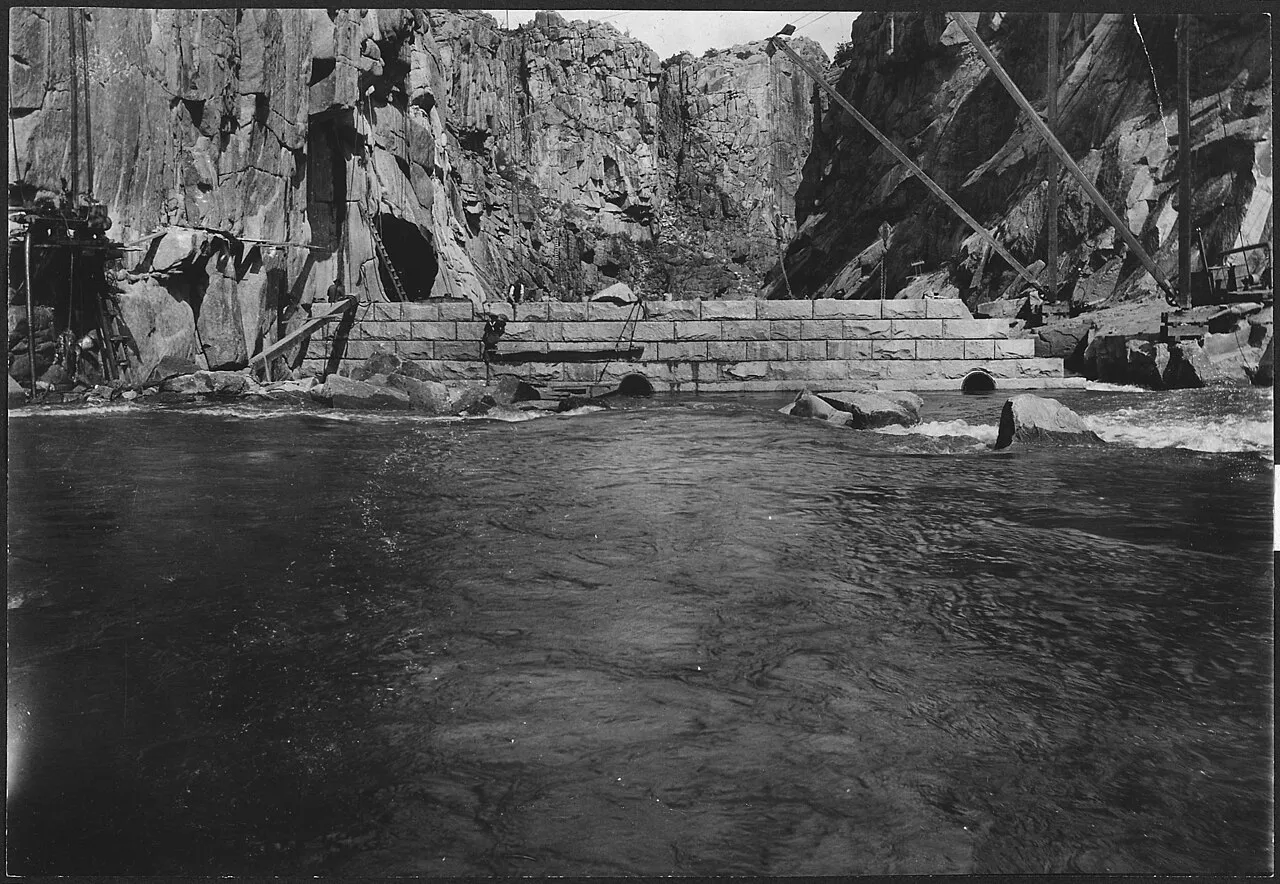
Pathfinder Dam on Wyoming’s North Platte River, 1907 — one of the massive structures the Reclamation Service raised to re-engineer Western rivers. (National Archives)
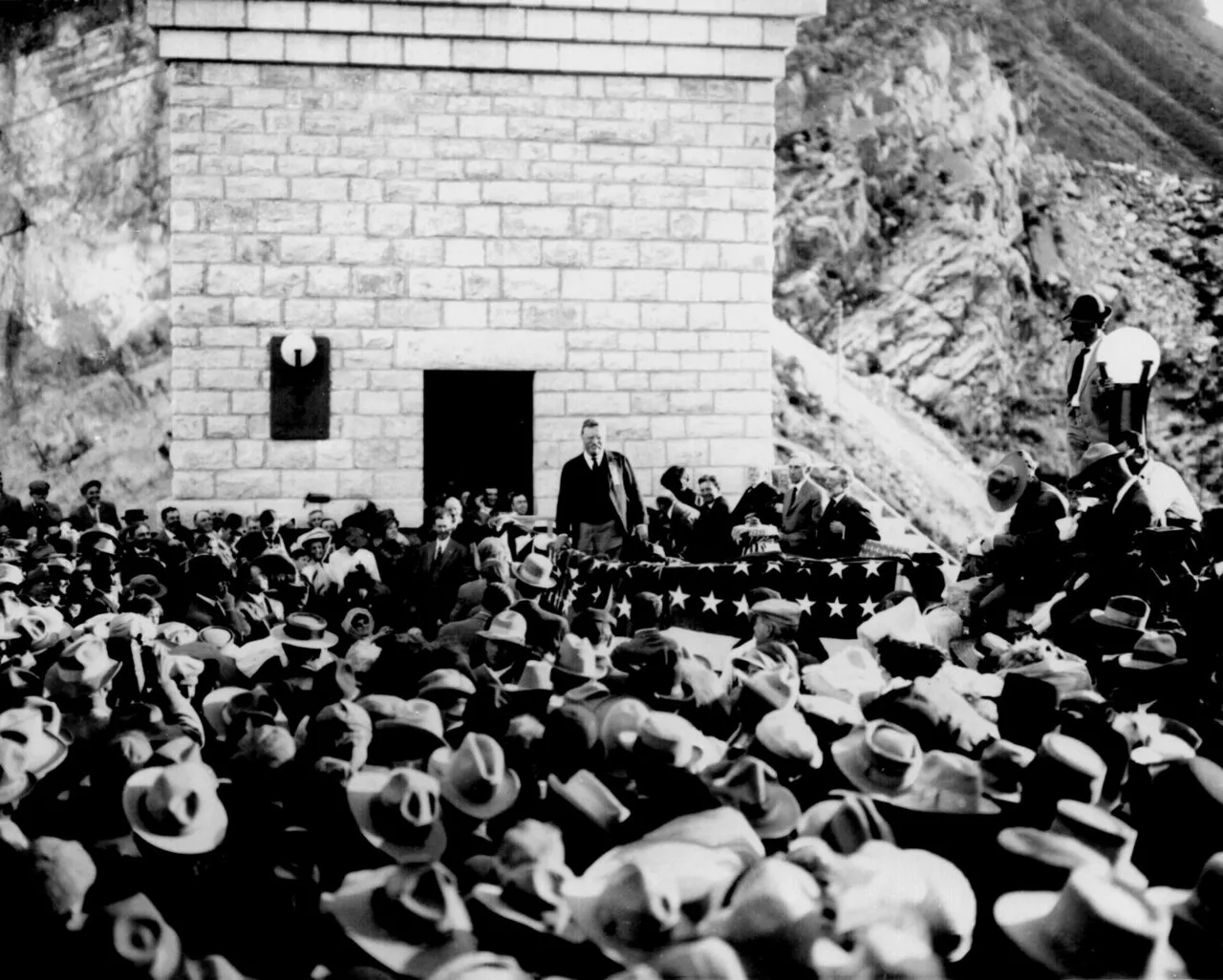
The completed Roosevelt Dam on the Salt River, dedicated in 1911 and then the tallest masonry dam in the world. (National Archives)
A Monument to Ambition and Its Costs
The Roosevelt Dam itself stands as a monument to the ambitions and the costs of the reclamation era. It enabled the growth of Phoenix and surrounding agricultural communities. It provided water security for millions of people. It's still generating electricity. By any measure, it's a successful engineering project and a testament to federal capability and determination.
But it also blocked the Salt River, transformed the landscape, disrupted fish populations, and subordinated the water rights of downstream tribes to the demands of farmers and urban dwellers. It's an engineering success and an environmental and social disruption, all at once. That duality runs through all the reclamation projects of the Roosevelt era.
Roosevelt's Philosophy in Action: "Use the Land for the Greatest Good"
From Roosevelt's perspective, the Newlands Act and the reclamation projects embodied his entire conservation philosophy. The federal government owned the public lands. Its job was to manage them for the greatest benefit of the people. If that meant building dams and irrigation systems to convert desert to farmland, so be it. Nature should be shaped by human will and engineering for human benefit.
This philosophy differed sharply from John Muir's idea of preservation—the belief that some places should be left wild and untouched. Roosevelt's reclamation represented the opposite: the deliberate, large-scale transformation of nature through government action to maximize human benefit. It was conservation, but conservation understood as "wise use"—which meant using everything nature provided for human purposes, but doing so rationally and sustainably rather than wastefully.
The Newlands Reclamation Act became law because Roosevelt and Congress agreed that federal power should be used to develop the West. Reasonable people could and did debate whether massive dams and irrigation were wise uses of federal authority and natural resources. But in 1902, the consensus was clear: yes. The West needed water. The federal government could provide it. Progress required bold action.
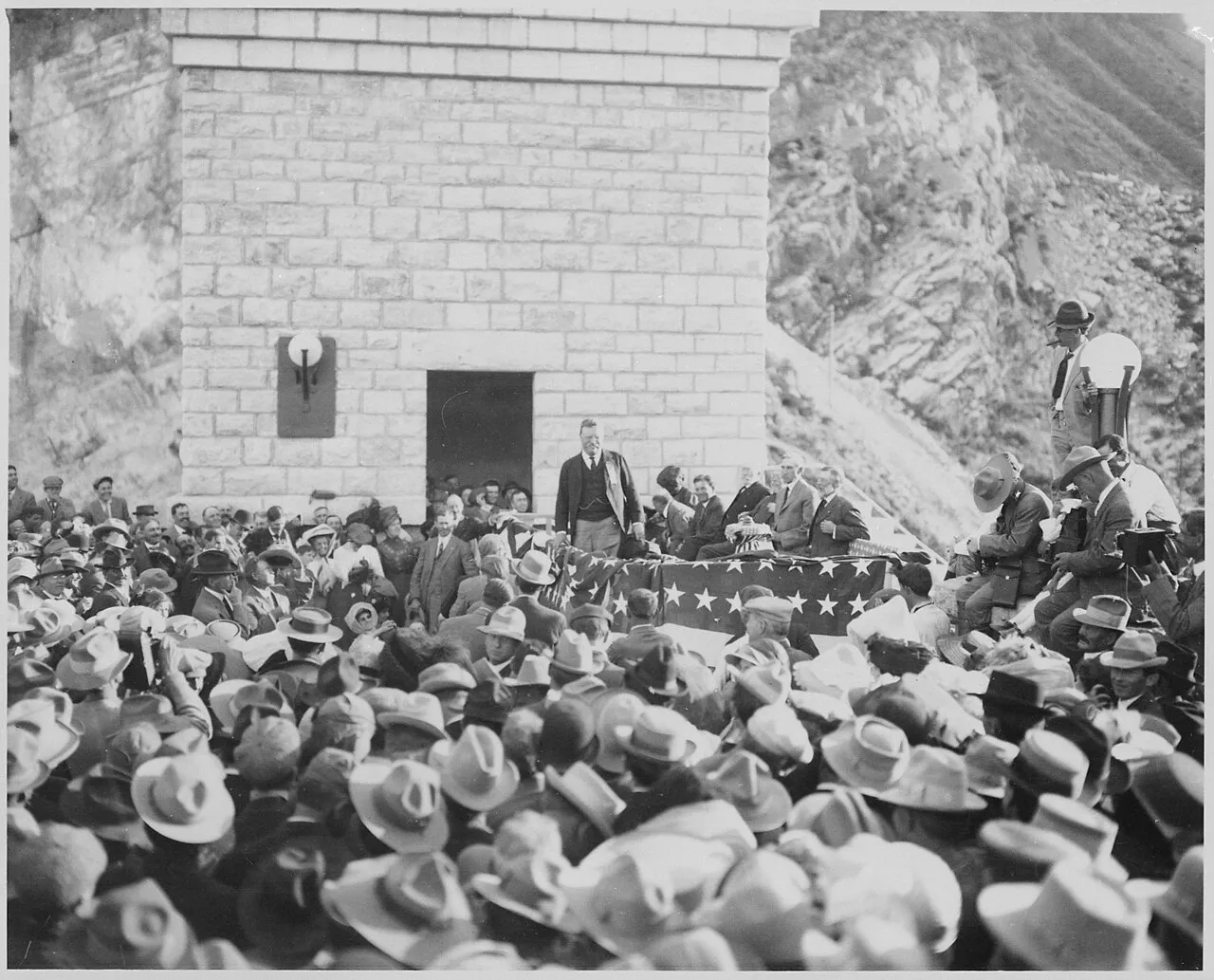
Theodore Roosevelt addresses the crowd at the dedication of Roosevelt Dam, March 18, 1911, embodying his creed of using the land for the greatest good. (National Archives)
The Legacy in Modern Times
More than a century later, the reclamation projects Roosevelt initiated continue to shape western life. The water they made available supports agriculture, cities, and industry across the region. The Bureau of Reclamation still manages dams and irrigation systems. But we now understand ecological costs that Roosevelt's generation didn't fully recognize or prioritize. Native American tribes assert water rights that the Newlands Act initially subordinated to settler needs. Environmentalists worry about depleted aquifers and rivers reduced to trickles.
The Newlands Reclamation Act demonstrates both the power and the limits of Roosevelt's conservation philosophy. It showed that the federal government, through coordinated action and engineering, could physically transform the landscape. It created opportunity and prosperity for millions of people. But it also shows that grand schemes to manage nature, even when well-intentioned, have unintended consequences. The water that made the desert bloom also dried up ecosystems, subordinated Native American water rights, and created dependence on federal engineering that society has struggled to manage ever since.
It's a legacy written in water, engineering, and ambition—and also in complicated tradeoffs that we're still trying to understand and navigate.
Continue Reading
- Roosevelt's Conservation Legacy — The broader conservation philosophy
- National Forests — Multiple-use land management strategy
- Gifford Pinchot — Roosevelt's chief conservationist
Primary Sources at the TR Center
Explore original documents and resources related to this topic in the Theodore Roosevelt Center Digital Library.
- Reclamation of Land — Documents on water development and reclamation projects
- Conservation Programs — Roosevelt's approach to resource management
From the Archives
Explore original plans, photographs, and documents from Roosevelt's reclamation projects in the Theodore Roosevelt Center Digital Library.
Recommended Reading
- Teddy Roosevelt: The Wilderness Warrior by Douglas Brinkley (2009). ISBN: 978-0060565312
- Rivers of Empire: Water, Aridity, and the Growth of the American West by Donald Worster (1985). ISBN: 978-0394739182
- Cadillac Desert: The American West and Its Disappearing Water by Marc Reisner (1986). ISBN: 978-0140119267