
Pure Food and Drug Act: Protecting the American Table
Upton Sinclair's Shocking Revelation
Upton Sinclair wrote “The Jungle”—serialized in 1905 and published as a book in February 1906—intending to expose the brutal conditions faced by immigrant workers in American meatpacking plants. He had taken up residence in Packingtown, the stockyard district of Chicago, and spent seven weeks observing the plants from the inside. He wrote vivid scenes of exploitation, of children working alongside their parents in disease-ridden factories, of workers mangled by machinery with no compensation, of wages so small that families could barely survive. The book was indeed shocking—but not for the reason Sinclair expected. What appalled readers more than the treatment of workers was what Sinclair had revealed, almost incidentally, about what they were eating.
Sinclair described meatpacking plants where contaminated meat was processed in filthy conditions, where diseased animals were slaughtered and their meat sold to unsuspecting consumers, where chemicals and preservatives of unknown composition were added to hide spoilage. He revealed that workers sometimes fell into meat-grinding machinery and their remains were processed along with the carcasses—their bodies literally became part of the product sold to American families for their dinner tables. He described meat “dosed with borax” to hide spoilage and preserve color, chemicals added not for safety but to deceive consumers into purchasing meat that had already begun to rot. Readers of “The Jungle” were nauseated not primarily by labor exploitation, as Sinclair had intended, but by the revelation of what was in their hamburger, their sausage, their canned meat products.
Roosevelt read “The Jungle” with horror and disgust. He was no radical—Sinclair was a socialist whose work attacked capitalism as such—but Roosevelt separated the book's radical socialist economics from its factual revelations about food safety. The factual claims seemed damning and needed investigation. Were American meatpacking plants truly as filthy and dangerous as Sinclair described? Did contaminated meat truly reach American tables? Were chemicals truly being used to hide spoilage? Roosevelt was a man of science and fact. He would determine the truth through investigation. This consumer protection imperative was central to his broader Square Deal philosophy—the conviction that government had a responsibility to protect ordinary people against exploitation and fraud.

Upton Sinclair, whose 1906 novel “The Jungle” exposed conditions in Chicago’s meatpacking plants. (Library of Congress)

Dressing beef at Swift’s packing house, Chicago, 1906 — the kind of operation Roosevelt’s investigators examined. Stereograph. (Library of Congress)
The Neill-Reynolds Report
Roosevelt authorized a confidential investigation of meatpacking plants by Charles P. Neill, Commissioner of Labor, and James Bronson Reynolds, a social worker and reformer. These two men of unquestionable integrity visited meatpacking facilities across the country, observed operations in detail, and interviewed workers and managers. Their report, transmitted to Congress on June 4, 1906, was even more damning than Sinclair's account. The investigators found filth beyond description: meat stored in rooms where workers routinely spit on floors, where rats infested storage areas and gnawed at carcasses, where chemical preservatives of unknown safety and toxicity were added to conceal spoilage and mask rot.
The investigators also described chemically doctored meat—product treated with borax, formaldehyde, and other chemical preservatives to mask spoilage and artificially restore color to decaying products. These preservatives were added not for legitimate safety purposes but deliberately to deceive consumers into purchasing meat that had already begun to decompose. The Neill-Reynolds report confirmed that contaminated meat was indeed reaching American tables, sold under brand names that consumers trusted with their families' health. Meat so fouled that it would have been rejected as inedible was being chemically treated and sold as fresh product.
Roosevelt sat on the Neill-Reynolds report initially, using it as leverage in negotiations with Congress. He made clear that if Congress did not pass food safety legislation immediately, he would release the report publicly and let American citizens see what their government investigators had found. He knew that public outrage would be overwhelming—that mothers across America would demand protection when they learned what the report contained. The threat proved devastatingly effective. Congress, horrified by the prospect of the report's public revelation and pressured by constituents who had read “The Jungle,” moved with unprecedented speed to pass food safety legislation. Roosevelt had weaponized science and public health as political tools to force Congressional action on an issue the industry wanted to avoid.
The Meat Inspection Act and Pure Food and Drug Act
On June 30, 1906, Roosevelt signed two landmark bills: the Meat Inspection Act and the Pure Food and Drug Act. Both represented a revolutionary federal assertion of authority over interstate commerce in foodstuffs and pharmaceuticals. The Meat Inspection Act required mandatory federal inspection of all meat shipped in interstate commerce, established stringent sanitary standards for meatpacking plants, and created mechanisms to seize and destroy contaminated products that failed inspection. The Pure Food and Drug Act prohibited the manufacture, sale, or transportation of adulterated or misbranded drugs and foods, and assigned the Bureau of Chemistry within the Department of Agriculture—forerunner of the modern Food and Drug Administration—to enforce these prohibitions and investigate violations. The act capped a decades-long pure-food campaign led by Dr. Harvey W. Wiley of the Bureau of Chemistry, while Senator Albert Beveridge authored the companion meat inspection amendment.
The legislation was revolutionary in scope and principle. For the first time in American history, the federal government was asserting direct authority over the contents of food and drugs. Manufacturers could no longer sell products with unknown or harmful ingredients hidden from consumers. They could not deceive consumers about what they were purchasing. They could not disguise spoilage and rot through chemical additives that made dead meat appear fresh. This represented a fundamental assertion that the federal government possessed the authority and responsibility to police the nation's food supply for public health. Government was stepping between consumers and the profit motive of manufacturers to protect the public.
The legislation provoked fierce opposition from food and pharmaceutical manufacturers, who had profited from the absence of regulation. Business groups and conservative newspapers denounced the Pure Food and Drug Act as confiscatory and socialistic, claiming that manufacturers should be free to produce and sell whatever consumers would accept, that the market would punish dishonest producers. Roosevelt was completely unmoved by these arguments. He believed that while consumers theoretically had some capacity for self-protection, they could not realistically investigate the chemical composition of every food product or pharmaceutical they consumed. They relied on manufacturers' honesty and on government oversight. If manufacturers would not be honest voluntarily, government must coerce honesty in the interest of public health. The alternative was to allow poisoning of the food supply in the name of free commerce.

President Theodore Roosevelt, 1904. On June 30, 1906 he signed both the Meat Inspection Act and the Pure Food and Drug Act. (Pach Bros. / Library of Congress)
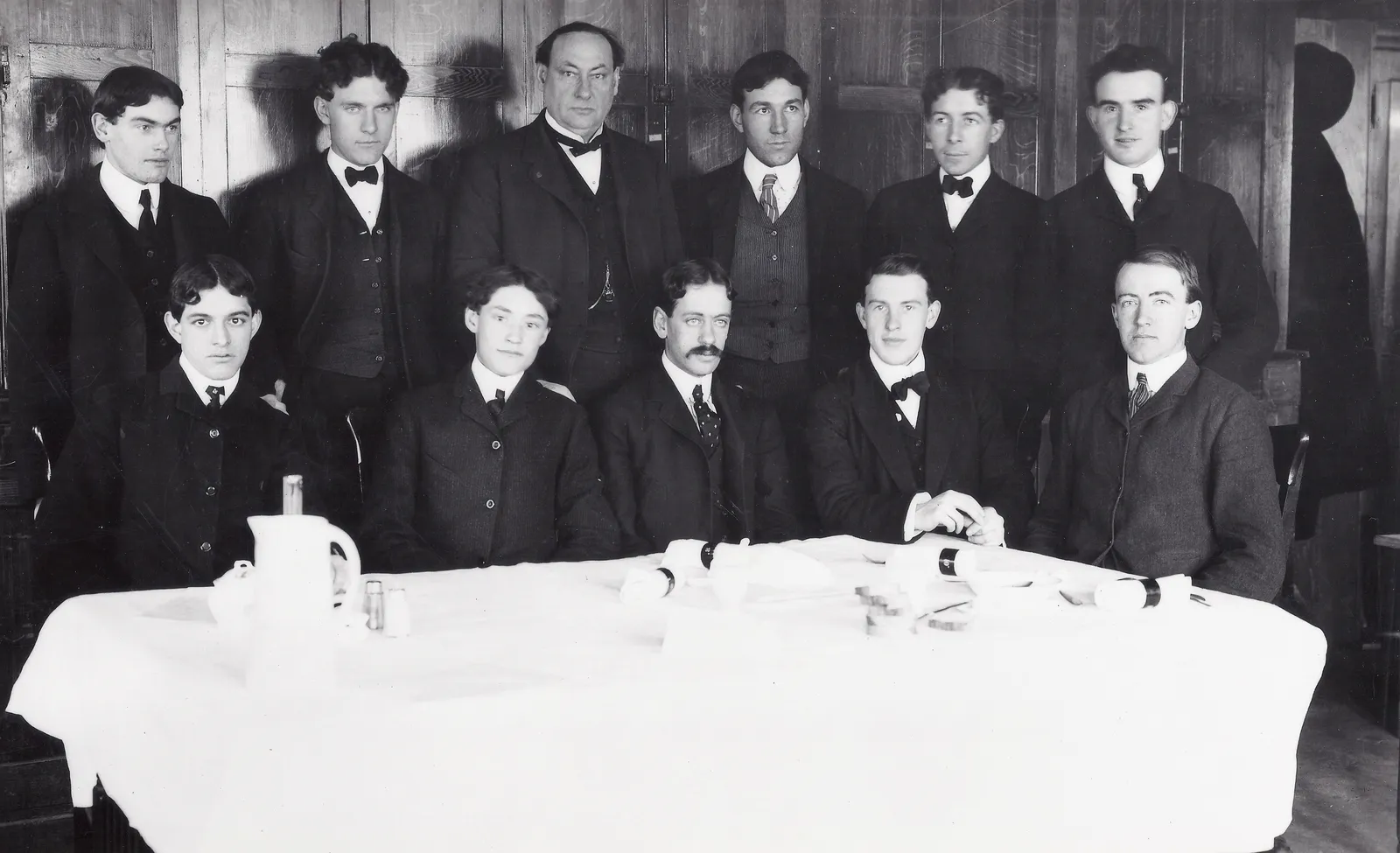
Dr. Harvey Wiley’s “Poison Squad” — Bureau of Chemistry volunteers who tested food preservatives on themselves. (U.S. Food and Drug Administration)
Dr. Harvey Wiley and the "Poison Squad"
The Pure Food and Drug Act's enforcement depended fundamentally on Dr. Harvey Wiley, the chemist who headed the Bureau of Chemistry and who would become the de facto first leader of the Food and Drug Administration. Wiley had been documenting food adulteration for years, and he seized the opportunity the new law provided. He established laboratory standards for analyzing foods, trained inspectors to identify contaminants and adulterants, and brought prosecutions against manufacturers who violated the law. He also conducted daring experiments that captured public imagination: the famous "Poison Squad" tests in which Wiley and volunteer participants ate foods containing known adulterants to document their effects on human health. These experiments provided scientific evidence of the harm caused by unregulated food additives.
Wiley understood that enforcement required science. Manufacturers could be prosecuted only if government chemists could prove, through rigorous analysis, that specific products contained harmful substances. Wiley invested heavily in laboratory capacity, in training, and in developing standardized methods for analyzing foodstuffs. The FDA's legacy of rigorous scientific testing began with Wiley's conviction that protecting consumers required understanding the chemical composition of what they consumed. Wiley's willingness to conduct experiments on human subjects—something that would be ethically unacceptable today—yielded powerful evidence of the dangers manufacturers were imposing on an unsuspecting public.
The Scope of Food Safety Regulation
The Pure Food and Drug Act covered not only meat but all foods shipped in interstate commerce: grain products, dairy products, fruits, vegetables, canned goods, patent medicines. The breadth of coverage was striking. Every manufactured food product had to meet federal standards. Patent medicines—often pure frauds containing alcohol, opiates, or cocaine marketed as cure-alls—now had to disclose their ingredients on the label. Manufacturers could no longer sell a nostrum claiming to cure cancer, arthritis, or sexual dysfunction without evidence.
The pharmaceutical provisions proved particularly important. In the nineteenth and early twentieth centuries, patent medicines were largely unregulated. Manufacturers added whatever they wished, made false claims about effectiveness, and faced no federal oversight. The Pure Food and Drug Act required accurate labeling of ingredients and prohibited false therapeutic claims. While the law was not perfect—the FDA's authority to determine what claims were "false" remained contested—it represented the first systematic federal oversight of pharmaceuticals.

“Death’s Laboratory,” Collier’s, 1905. The magazine’s patent-medicine exposé built public pressure for the Pure Food and Drug Act. (Collier’s Weekly)

A 1906 Puck cartoon casts entrenched monopolies as a Bluebeard guarding the new Meat Inspection, Pure Food, and anti-trust laws. (Puck, Aug. 15, 1906)
The Industry Backlash and Roosevelt's Resolve
The meat and pharmaceutical industries fought the Pure Food and Drug Act with every tool at their disposal. Trade associations denounced it as an unconstitutional infringement on commerce. Manufacturers claimed compliance would be prohibitively expensive and would reduce the industry's profitability. Conservative newspapers aligned with business interests warned of catastrophic economic consequences. But Roosevelt stood firm. He believed that public health transcended private profit. He made clear that the government would keep telling the public exactly what its inspectors found, and he refused to compromise or water down enforcement. This confrontation illustrated Roosevelt's willingness to use his bully pulpit to mobilize public opinion against business resistance.
The dispute over food safety revealed a fundamental conflict about the proper role of government. Manufacturers argued that government should not interfere in commerce, that consumers should make their own judgments about products, that the market would eventually punish dishonest businesses. Roosevelt rejected this logic entirely. He insisted that in modern industrial society with complex products beyond consumer understanding, government had a duty to ensure safety. The market alone could not be trusted to protect consumers against exploitation or fraud. Government must stand between citizens and those who would endanger them for profit.
Legacy and the Birth of the FDA
The Pure Food and Drug Act of 1906 established the fundamental principle that would guide twentieth-century food and drug regulation: the federal government possessed authority and responsibility to protect consumers by ensuring the safety of food and pharmaceuticals. This principle would expand over time. The Food and Drug Administration, which evolved from the Bureau of Chemistry, would eventually require pre-market testing of drugs, would establish standards for dietary supplements, and would regulate countless other consumer products. The FDA became one of the most important regulatory agencies in American government, touching nearly every consumer's daily life.
The Pure Food and Drug Act was not perfect. Enforcement was inconsistent; some unscrupulous manufacturers found ways to circumvent regulations. The standards themselves were sometimes arbitrary or scientifically unsound. Over a century later, debates continue about whether the FDA is too strict or too lenient, whether regulations should be expanded or curtailed. But the basic achievement endured: government could regulate commerce in foodstuffs and pharmaceuticals; consumers had a right to know what they were consuming; manufacturers could not poison the public with impunity. This represented a permanent transformation in the relationship between government and commerce that reflected Roosevelt's conviction that modern industrial society required active government protection of citizens.
Roosevelt's handling of the food safety issue revealed his sophisticated political skill. Rather than merely signing legislation that Congress passed, he had strategically released the Neill-Reynolds report to pressure Congress. He understood that public opinion—outraged by Sinclair's vivid descriptions of contaminated meat—could be mobilized through revelation of government findings. He weaponized science and public health as political tools to force Congressional action on food safety. This dynamic between executive action, public outrage, and legislative response became a template for Progressive Era reform.
Continue Reading
- The Square Deal — Roosevelt's governing philosophy of fairness for workers, businesses, and consumers
- Trust-Busting — Breaking up monopolies to protect competition and consumers
- The Bully Pulpit — How Roosevelt used the presidency to mobilize public opinion for reform
- Railroad Regulation — Federal oversight of private enterprise to protect consumers and shippers
- Executive Power and Constitutional Limits — How Roosevelt expanded federal authority to regulate commerce
Primary Sources at the TR Center
Explore Roosevelt's consumer protection initiatives and food safety advocacy through the Theodore Roosevelt Center Digital Library.
- Pure Food and Drug Act Encyclopedia Entry — Detailed information on Roosevelt's consumer protection legislation
- Dr. Harvey Wiley Encyclopedia Entry — The chemist who led the fight for food safety regulation
- Roosevelt's Writings — His speeches and articles defending food and drug safety regulation
- Politics and Government Encyclopedia — Essays on Roosevelt's regulatory philosophy and consumer protection
From the Archives
Explore original photographs, documents, and illustrations related to this topic in the Theodore Roosevelt Center Digital Library.
Recommended Reading
- The Jungle by Upton Sinclair (1906). ISBN: 978-0812968735
- The Golden Age of Quackery by Stewart H. Holbrook (1959)
- Dr. Wiley's Food and Drug Crusades: The Origins of Federal Food Safety Regulation by Oscar E. Anderson Jr. (1986). ISBN: 978-0226019239
- Theodore Roosevelt: A Life by Nathan Miller (2011). ISBN: 978-0061340382