
The Teddy Trail
North Dakota Tourism's Teddy Trail links the places where Theodore Roosevelt ranched, spoke, and protected land. Here is what happened at each stop, drawn from his letters, his books, and the newspapers that covered him.

Elkhorn Ranch from the Little Missouri River, about 1885. Roosevelt took this photograph himself.
Sept. 1883
T.R. steps off a train in the Badlands for the first time
2 ranches
The Maltese Cross and the Elkhorn, both on the Little Missouri
4 tours
Speaking trips back through North Dakota, 1900 to 1912
230 million
Acres of public land he protected as President, per the National Park Service
The Teddy Trail is North Dakota Tourism's statewide guide to the places that shaped Theodore Roosevelt, from his speaking stops in Fargo to the Badlands around Medora. This page adds the history behind each stop. For the trail's interactive map, events, lodging and trip ideas, head to NDTourism.com.
Start at the Library
The trail starts in Medora, at the Theodore Roosevelt Presidential Library. It sits in the buttes a few miles from where Roosevelt ran cattle in the 1880s, and it tells his whole story, from New York to the Badlands to the White House. Get your bearings here, then head out to see the places themselves.

The Theodore Roosevelt Presidential Library in Medora, with the Badlands behind.
The Badlands years
Part one: 1883 to 1887
Medora, Roosevelt's home in North Dakota, anchors the western end of the Teddy Trail. Plan your Medora visit on NDTourism.com.
It was a land of vast silent spaces, of lonely rivers, and of plains where the wild game stared at the passing horseman. It was a land of scattered ranches, of herds of long-horned cattle, and of reckless riders who unmoved looked in the eyes of life or of death.
He came to hunt bison
September 1883 · Little Missouri station
Roosevelt stepped off a Northern Pacific train at the Little Missouri station at about three in the morning on a cool September day in 1883. He was 24, and he had come to hunt bison. He spent what was left of the night at the Pyramid Park Hotel, then hired a local man named Joe Ferris as his guide. The hunt went badly for days, with rain, mud, and bad luck, before he finally got his bull.
He wrote home to his wife, Alice, that same week:
I am now feeling very well, and am enjoying the life very much. I am every day and all day long on horseback, scrambling over the almost inconceivably rocky and difficult hills of the 'bad lands,' or galloping at full speed over the rolling prairie or level bottom.
Letter to Alice Hathaway Lee Roosevelt, September 17, 1883
Before he left, he had bought into a cattle ranch.
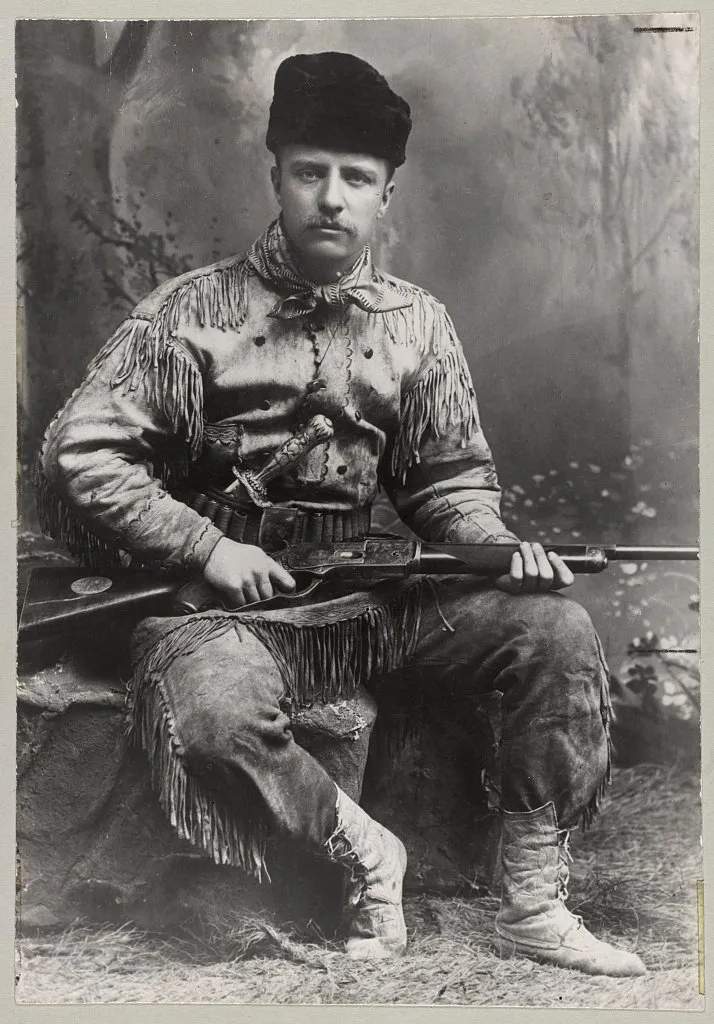
Roosevelt in the buckskin hunting suit of his ranching years, 1885.
Maltese Cross Cabin
1883–84 · Seven miles south of Medora
Roosevelt's partners on the Chimney Butte Ranch, Sylvane Ferris and Bill Merrifield, ran his cattle under the Maltese Cross brand. At his request they built him a cabin of ponderosa pine logs about seven miles south of Medora. It had three rooms, a shingled roof, and a cellar, a real step up from the old dirt-roof shack, which became the stable.
The cabin has traveled farther than most people. It was shown at the 1904 World's Fair in St. Louis and the 1905 Lewis and Clark Exposition in Portland, Oregon, then stood for decades on the State Capitol grounds in Bismarck. In 1959 it came home to the Badlands. Today it stands behind the South Unit Visitor Center of Theodore Roosevelt National Park.

The Maltese Cross cabin on its original site south of Medora.
A town named for a wife
April 1, 1883 · Medora
Medora was only a few months old when Roosevelt arrived. A French nobleman, the Marquis de Morès, founded it on April 1, 1883, across the river from the Little Missouri station, and named it for his wife, Medora. Roosevelt noted it himself in his first book about the Badlands, "for the benefit of the future local historian."
De Morès built a meatpacking plant to ship dressed beef east in refrigerated rail cars, along with a stage line to Deadwood. The packing business collapsed in 1886, and the plant burned in 1907. Its brick chimney still stands in Medora's Chimney Park. The family's 26-room summer home, built in 1883, is now the Chateau de Mores State Historic Site, with many of its original furnishings.

Medora in the winter of 1883–84: the office and company store of the Marquis de Morès.

The Badlands near Medora, with the de Morès house on the bench above the valley.
Joe Ferris's store
1885 · Medora
Joe Ferris, the guide from that first bison hunt, became one of Roosevelt's closest Badlands friends. In 1885, with Roosevelt's backing, he put up a two-story store in Medora and lived upstairs. Roosevelt stayed with Joe and his new wife in the spring of 1886, and Joe kept a room for him upstairs on later trips to town. Joe later served as Medora's postmaster.
The building still stands. Today it's the Ferris Inn, where you can stay upstairs in the same building where Roosevelt kept a room.

Joe Ferris’s store in Medora, now the Ferris Inn.
Elkhorn Ranch
1884–85 · About 35 miles north of Medora
On February 14, 1884, Roosevelt's mother died of typhoid fever in the early morning. His wife, Alice, died that afternoon, two days after giving birth to their daughter. That summer he came back to Dakota and picked a second ranch site far down the Little Missouri, about 35 miles north of Medora by the National Park Service's count.
He brought two woodsmen from Maine, Bill Sewall and his nephew Wilmot Dow, to build the house. They cut cottonwood logs through the winter of 1884–85. In his autobiography Roosevelt repeats Dow's tally of one day's chopping: "Bill cut down fifty-three, I cut forty-nine, and the boss he beavered down seventeen." The finished house had eight rooms and a long porch facing the river, where Roosevelt liked to sit and rock in the shade of the cottonwoods.
Nothing stands at the Elkhorn today except foundation stones. A 0.7-mile path leads to the site, now the Elkhorn Ranch Unit of Theodore Roosevelt National Park. The road in is rough and remote, with no services and no cell signal, so check conditions with the park before you go.

The Elkhorn porch, hung with elk antlers. Roosevelt took this photograph.
The boat thieves
March 24 – April 11, 1886 · Little Missouri River to Dickinson
On March 24, 1886, three men stole Roosevelt's boat from the Elkhorn. Roosevelt was a deputy sheriff for the northern end of Billings County, so he went after them. Sewall and Dow built a new boat in three days, and on March 30 the three of them pushed off downriver through ice and bitter cold. On April 1 they caught up with "Redhead" Mike Finnegan, Edward Burnstad, and Chris Pfaffenbach and took them without a shot.
An ice jam held everyone in place for nearly a week. With no way out by water, Roosevelt hired a wagon and walked behind it, guarding his prisoners all the way to Dickinson. He wrote that the overland trip "took us two days and a night," and that he stayed awake for thirty-six hours. For his trouble he collected deputy's fees and mileage, "a total of some fifty dollars." Finnegan and Burnstad were convicted that August.

Dow and Sewall in the boat they built, loaded with the thieves’ gear. Roosevelt took the picture during the chase.
A cattleman's rise and a hard winter
December 19, 1884 · Winter of 1886–87
Roosevelt took ranching seriously. When the ranchers of the Little Missouri organized a stockmen's association in Medora on December 19, 1884, they elected him chairman.
Then came the winter of 1886–87. Cattle froze and starved across the range. The National Park Service estimates Roosevelt lost about 60 percent of his herd. "The loss among the cattle has been terrible," he wrote to Sewall. He began selling out, and in 1898 he sold the Elkhorn to Sylvane Ferris.
Rough Riders Hotel and Theodore's Dining Room
1884 · Medora
The Rough Riders Hotel went up in 1884, during the de Morès boom, as the Metropolitan Hotel. It was later renamed for the regiment Roosevelt led in Cuba in 1898. Theodore's Dining Room, inside the hotel, is named for him too.

The Rough Riders Hotel in 1919. In the 1880s it was the Metropolitan.
Places he spoke
Part two: 1886 to 1912
Roosevelt kept coming back. He gave a Fourth of July oration as a local rancher in 1886, then crossed the state by train as the Republican candidate for vice president in 1900, as President in 1903, as a former President in 1910, and as the Progressive Party's candidate in 1912. On the 1903 trip his refrain was "twenty-three years ago," his own count of how long he had known the state.
North Dakota Tourism's Teddy Trail maps the towns where he spoke. Here's what happened at each.
Dickinson
Monday, July 5, 1886 · Dickinson
Dickinson held its first Independence Day celebration on Monday, July 5, 1886, since the Fourth fell on a Sunday. Roosevelt, then a rancher down the line in Medora, rode in on a freight train to serve as orator of the day. As the Dickinson Press printed it:
Like all Americans, I like big things; big prairies, big forests and mountains, big wheat-fields, railroads,—and herds of cattle, too,—big factories, steamboats, and everything else. But we must keep steadily in mind that no people were ever yet benefited by riches if their prosperity corrupted their virtue.
Independence Day oration, Dickinson, Dakota Territory, July 5, 1886
Dickinson was also where he had delivered the boat thieves three months earlier. When he passed through as President in 1903, he told the crowd: "It is just seventeen years ago that I came over here as orator of the day at the Fourth of July celebration. I remember it just as well as can be."
Plan your stop: Dickinson on NDTourism.com
Ellendale and Edgeley
April 6, 1903 · Ellendale and Edgeley
Ellendale was Roosevelt's first North Dakota stop on his 1903 tour of the West, reached over the Milwaukee Road from Aberdeen. His whole speech was four sentences: "Ladies and gentlemen: I am delighted to get back into North Dakota. It is twenty-three years ago that I first came to what was then the Territory of Dakota. I lived for many years here and I am overjoyed to be back with you again."
At Edgeley, around 10:30 that night, the presidential train switched to the Northern Pacific. No speech was planned and Roosevelt had gone to bed. But a band was playing and bonfires were burning, so he dressed, threw a heavy coat over his shoulders, and spoke for about five minutes from the rear platform.
Valley City
1900 · 1903 · 1912 · Valley City
Valley City heard Roosevelt three times. In 1900 bad weather moved his rally indoors. In 1903 he told the town, "I congratulate you upon all you do in wheat growing and stock raising, but above all, in the kind of men and women you grow." In 1912, campaigning for the Progressive Party, he spoke for fifteen minutes from the rear platform of his train. When a boy in the crowd shouted, "Hello Teddy, how are you?" Roosevelt called back, "Fine, fine. How are you?"
Plan your stop: Valley City on NDTourism.com
Jamestown
1900 · 1903 · 1912 · Jamestown
Jamestown knew Roosevelt first as a cattleman passing through at night. Back as President in 1903, he remembered it this way:
At that time the trains I usually passed through 'Jimtown' on were cattle trains. We used to unload and feed the stock here, and I have many associations with working at night here getting the cattle up when they would get down, and then get on the caboose at the last moment, so that I saw as much of your town by night as by day.
Remarks at Jamestown, N.D., April 7, 1903
He also spoke at the opera house in 1900 and from the train to about 2,000 people in 1912.
Plan your stop: Jamestown on NDTourism.com
Bismarck and Mandan
1900 · 1903 · 1912 · Bismarck and Mandan
In 1900 Roosevelt's campaign train stayed overnight in Bismarck. In 1903 he spoke bareheaded from the portico of the old State Capitol to a crowd of several thousand. Across the river in Mandan the same day, he praised the farm country and then turned to the children in the crowd: "But of all your crops I like the children best."
Plan your stop: Bismarck-Mandan on NDTourism.com

President Roosevelt speaking at Mandan, 1903.
Medora
1900 · April 7, 1903 · Medora
In 1900 Roosevelt spent a quiet Sunday hour in Medora with old friends over elk steak. In 1903 the presidential train pulled in after dark, and the whole town was waiting in the town hall, already decorated for a dance. "I first came to Medora twenty years ago, so I am a middling old settler," he told them. "With some of the men I have ridden guard around the cattle at night, worked with them in the round up, and hunted with them, so that I know them pretty well."
He later wrote that "the entire population of the Bad Lands down to the smallest baby had gathered to meet me," and that he only wished he could have stayed three hours.
Plan your stop: Medora on NDTourism.com

“Should auld acquaintance be forgot?” President Roosevelt and his friends in the Town Hall, Medora, April 1903.
Fargo and Island Park
1903 · 1910 · 1912 · Fargo
Mud cancelled his outdoor speech in Fargo in 1903, so he spoke in the opera house. His biggest day came on Labor Day 1910. The night before, with his old ranch partners Joe and Sylvane Ferris in town to meet him, he spoke from the balcony of the Waldorf Hotel. The next morning he laid the cornerstone of the new Carnegie library at Fargo College in a drizzle. That afternoon he gave the Labor Day address in Island Park, where the Fargo Forum counted "fully 30,000 people." A downpour scattered the crowd partway through, and most of them came back.
He returned to Island Park in 1912 for a 45-minute speech on the Progressive campaign.
Plan your stop: Island Park from Fargo Parks, and the Fargo Area Teddy Roosevelt Trail digital passport from Visit Fargo-Moorhead, featured on North Dakota Tourism's Teddy Trail.
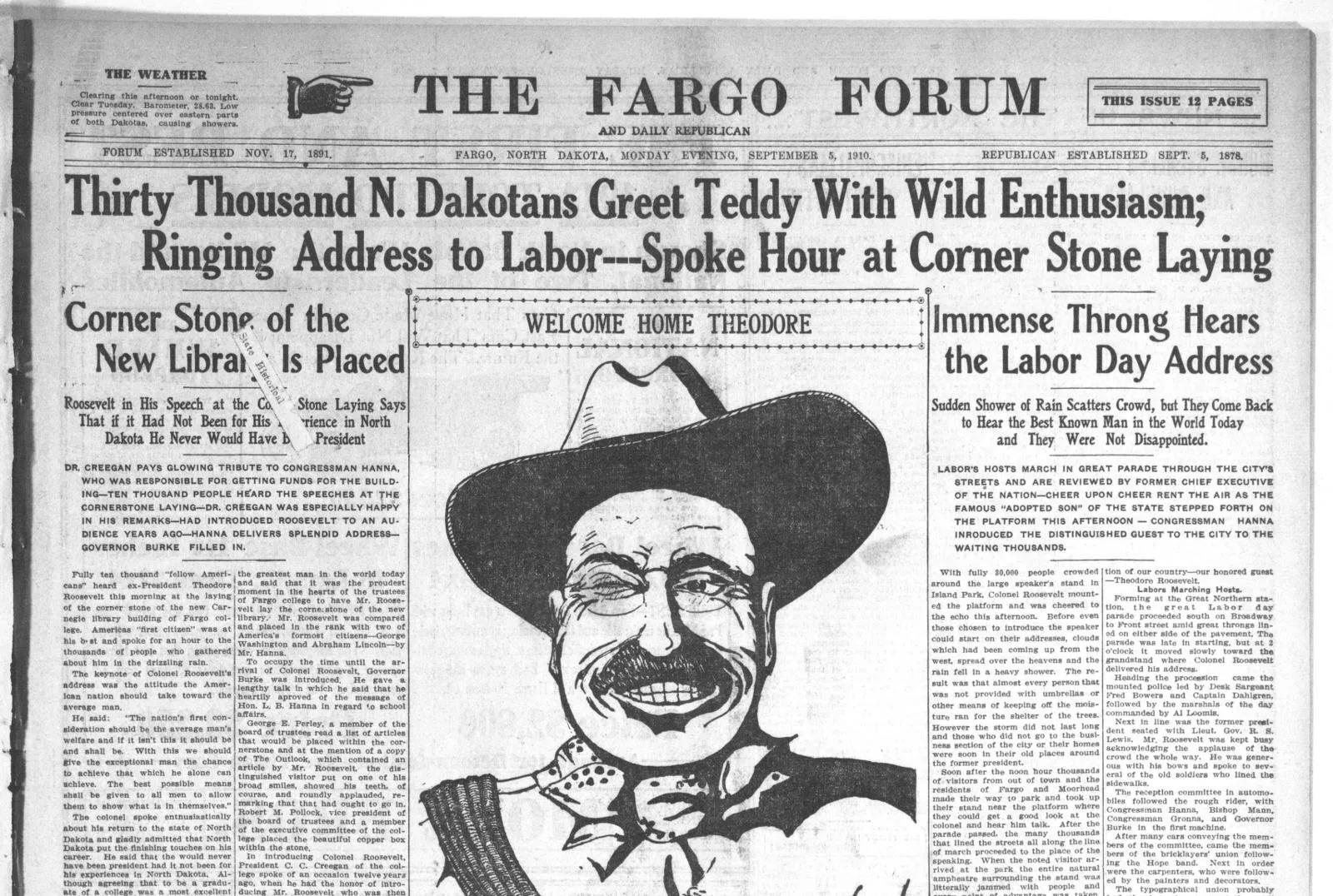
The Fargo Forum’s front page, Labor Day 1910.
Land he protected
Part three: 1904 to today
As President, Roosevelt protected about 230 million acres of public land, according to the National Park Service, including 150 national forests, 51 federal bird reservations, and 5 national parks. Several of those places are in North Dakota, and you can still see most of them.
North Dakota Tourism's Teddy Trail lists these among the places Roosevelt helped conserve.
Stump Lake
March 9, 1905 · Nelson County
Roosevelt's executive order of March 9, 1905, made four tiny islands in Stump Lake a "preserve and breeding ground for birds." It was the third federal bird reservation in the country, after Pelican Island in Florida and Breton Island in Louisiana, and the first in North Dakota. The whole reservation was 27 acres. In 1912 the federal Biological Survey called it the only place in the United States where the white-winged scoter, a sea duck, was known to nest.
Rising water has since covered the islands completely, according to the U.S. Fish and Wildlife Service. The third national wildlife refuge in America now lies underwater.
Chase Lake
August 28, 1908 · Stutsman County
Settlers near Chase Lake used to head out on Sunday afternoons to see how many pelicans they could shoot. A local homesteader, H. H. McCumber, asked Washington to step in. On August 28, 1908, Roosevelt signed an executive order creating the Chase Lake Reservation for native birds, and McCumber became its first warden.
The colony came back. Today Chase Lake National Wildlife Refuge holds one of the largest American white pelican nesting colonies on the continent, nearly a third of the continental population in some years, according to the Fish and Wildlife Service. The nesting islands are closed to protect the birds.

American white pelicans on a nesting island at Chase Lake National Wildlife Refuge.
White Horse Hill
June 2, 1904 · Near Fort Totten
In April 1904 Congress authorized the President to set aside a wooded hill on the south shore of Devils Lake as a public park, and on June 2 Roosevelt proclaimed "Sully's Hill Park." It was one of five national parks created under Roosevelt.
Its life as a wildlife preserve came after he left office. Congress funded a game preserve there in 1914, elk arrived from Yellowstone in 1917, and six bison came from Portland, Oregon, in 1918. In 2019, at the request of the Spirit Lake Tribe, it was renamed White Horse Hill National Game Preserve. Today bison and elk graze along its auto tour route.

Bison at White Horse Hill National Game Preserve.
Fort Abraham Lincoln
March 2, 1907 · South of Mandan
Fort Abraham Lincoln was Lt. Col. George Custer's post from 1873 until the 7th Cavalry rode out for the Little Bighorn in 1876. The Army abandoned it in 1891. On March 2, 1907, Roosevelt signed a law giving about 75 acres of the old fort to North Dakota for its State Historical Society. That land grew into Fort Abraham Lincoln State Park, the oldest state park in North Dakota.
The park also holds On-A-Slant Village, where Mandan families lived in earthlodges along the Missouri for about two centuries. The Civilian Conservation Corps rebuilt earthlodges and blockhouses there in the 1930s, and today you can walk the village, tour the reconstructed Custer House, and camp.

A reconstructed earthlodge at On-A-Slant Village, Fort Abraham Lincoln State Park.
Theodore Roosevelt National Park
1947 · 1978 · Billings and McKenzie counties
Roosevelt didn't create the national park that bears his name. President Truman signed the law establishing Theodore Roosevelt National Memorial Park on April 25, 1947, and a crowd gathered in the Badlands for its dedication in 1949. In 1978 Congress made it a national park. Its three units take in the country Roosevelt rode: the South Unit by Medora, the North Unit near Watford City, and the Elkhorn Ranch between them.
Plan your visit: Theodore Roosevelt National Park on NDTourism.com

The dedication of Theodore Roosevelt National Memorial Park, 1949.
Plan your trail

Theodore Roosevelt National Park
Maltese Cross Cabin, the South and North units, and the Elkhorn Ranch.

Fort Abraham Lincoln State Park
The Custer House, On-A-Slant Village, and camping on the Missouri.

Chateau de Mores
The Marquis's 1883 summer home, a State Historic Site above Medora.

White Horse Hill and Chase Lake
Bison, elk, and pelicans on land Roosevelt protected.


The full Teddy Trail
North Dakota Tourism's interactive trail map and stops statewide.
Go deeper
Read Roosevelt's own letters, diaries, and speeches in the Theodore Roosevelt Center digital library at Dickinson State University, or ask a question of the Library's archive at trlibrary.com/gpt. To map out your own route, start with North Dakota Tourism's Teddy Trail.