
The Theodore Roosevelt Presidential Library: Where Vision Becomes Place
The Badlands Landscape That Changed Everything
Theodore Roosevelt first came to the Dakota Territory in September 1883 at age twenty-four. He returned the next year broken by personal tragedy. His wife Alice had died just two days after giving birth to their daughter; his mother had died on the same morning. Seeking refuge in the vast, unforgiving wilderness, Roosevelt bought a cattle ranch in the region and threw himself into the ranching life. For nearly three years, he rode these Badlands, hunted buffalo and elk, worked cattle drives, served as a deputy sheriff, and lived a life of physical hardship and moral renewal.
The Badlands remade him. The expansive horizons, the raw power of untamed nature, the small community of ranchers and frontiersmen—all of it shifted something fundamental in Roosevelt's worldview. He emerged from the Badlands not as the timid, bookish New York aristocrat he had been, but as a man of action, a man who believed in the power of direct experience, a man who understood viscerally how precious wild America was. When Roosevelt became president, he would protect this landscape and all landscapes like it. His conservation legacy flows directly from these formative years in the Badlands.
The Theodore Roosevelt Presidential Library is located here by design, not accident. To build this institution anywhere else would be to miss the essential point: understanding Roosevelt requires understanding this place.

The rugged Badlands of western North Dakota, the landscape that transformed Theodore Roosevelt during his ranching years.
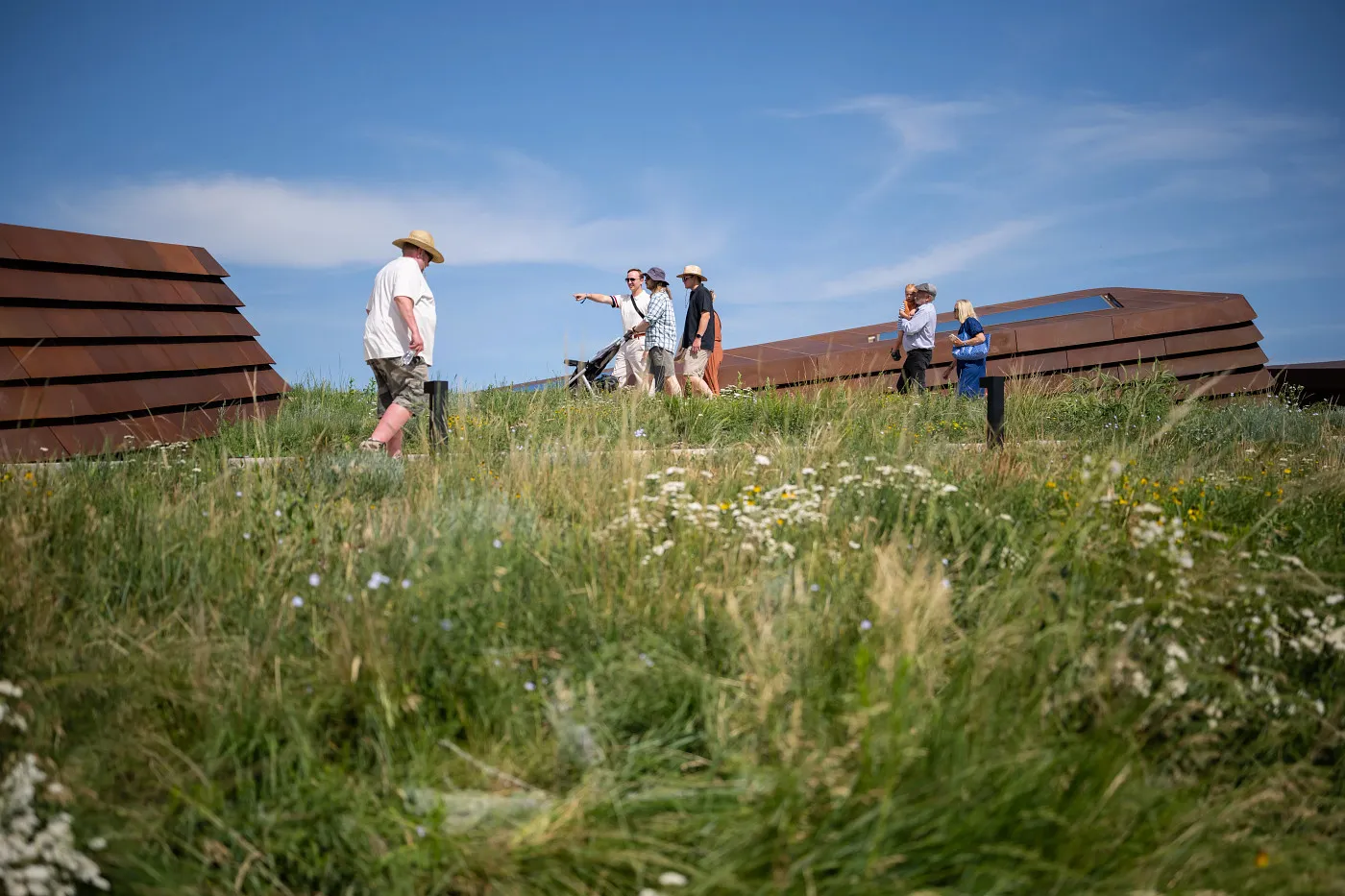
The Library's grass-covered roof, designed by Snøhetta to emerge from the Badlands landscape rather than dominate it. (Theodore Roosevelt Presidential Library)
Designed for the Landscape, Built for the Future
The Library's architecture, created by the internationally acclaimed Norwegian firm Snøhetta, emerges from rather than dominates the Badlands landscape. The design integrates natural features of the site itself—native grasses, the contours of the land, the geological character of the Badlands. Visitors approaching the 96,000-square-foot facility encounter a structure that seems to grow from the landscape rather than assert itself against it. This is intentional and profound: the building embodies Roosevelt's own conservation ethic, the belief that human presence should honor and enhance rather than exploit or degrade.
The Library is pursuing triple sustainability certification, a rare and ambitious goal that demonstrates how Roosevelt's environmental principles guide its operations: Living Building Challenge certification (the most rigorous standard for ecological performance), LEED Platinum certification (the gold standard for energy efficiency and sustainable design), and SITES Platinum certification (recognizing landscape and habitat restoration). The building itself will model the conservation values Roosevelt championed.
What Visitors Will Experience
The Theodore Roosevelt Presidential Library is designed as an immersive encounter with Roosevelt's life and legacy, organized thematically rather than strictly chronologically. Visitors enter into the landscape of Roosevelt's story, experiencing exhibits that explore his transformation through direct engagement.
The core exhibition tells Roosevelt's journey: from the sickly New York boy who remade his body through will and discipline; through his political rise in New York State; to his unexpected ascent to the presidency; his conservation legacy protecting 230 million acres of public land; his Nobel Prize-winning brokering of peace between Russia and Japan; his complex relationship with power, duty, and the "strenuous life" he believed all Americans should embrace.
But the Library does not present a static monument to a distant figure. Instead, it engages visitors in understanding Roosevelt's continuing relevance. What does his conservation vision mean as we face climate change and habitat loss? How do his ideas about presidential power shape current debates about executive authority? What can his life teach us about resilience, reinvention, and the pursuit of purpose? These are not merely historical questions—they are urgent questions that the Library helps visitors grapple with.
The exhibits integrate original artifacts, documents, and correspondence from Roosevelt's life alongside interactive elements that invite active engagement. Visitors encounter Roosevelt's own writings—his diaries, his letters, his published works—not as reverent museum objects but as voices speaking across time. The Badlands themselves serve as the deepest exhibition space; visitors can explore the landscape Roosevelt loved, visiting nearby sites including his Elkhorn Ranch, Theodore Roosevelt National Park, and the Maah Daah Hey Trail.
The Library is designed as an entry point to what is being called the "Theodore Roosevelt Triangle," composed of the Presidential Library, Mount Rushmore (about four and a half hours south), and Yellowstone National Park (about seven hours west). The Library serves as the gateway to understanding these iconic Western American landscapes through the lens of Roosevelt's vision.
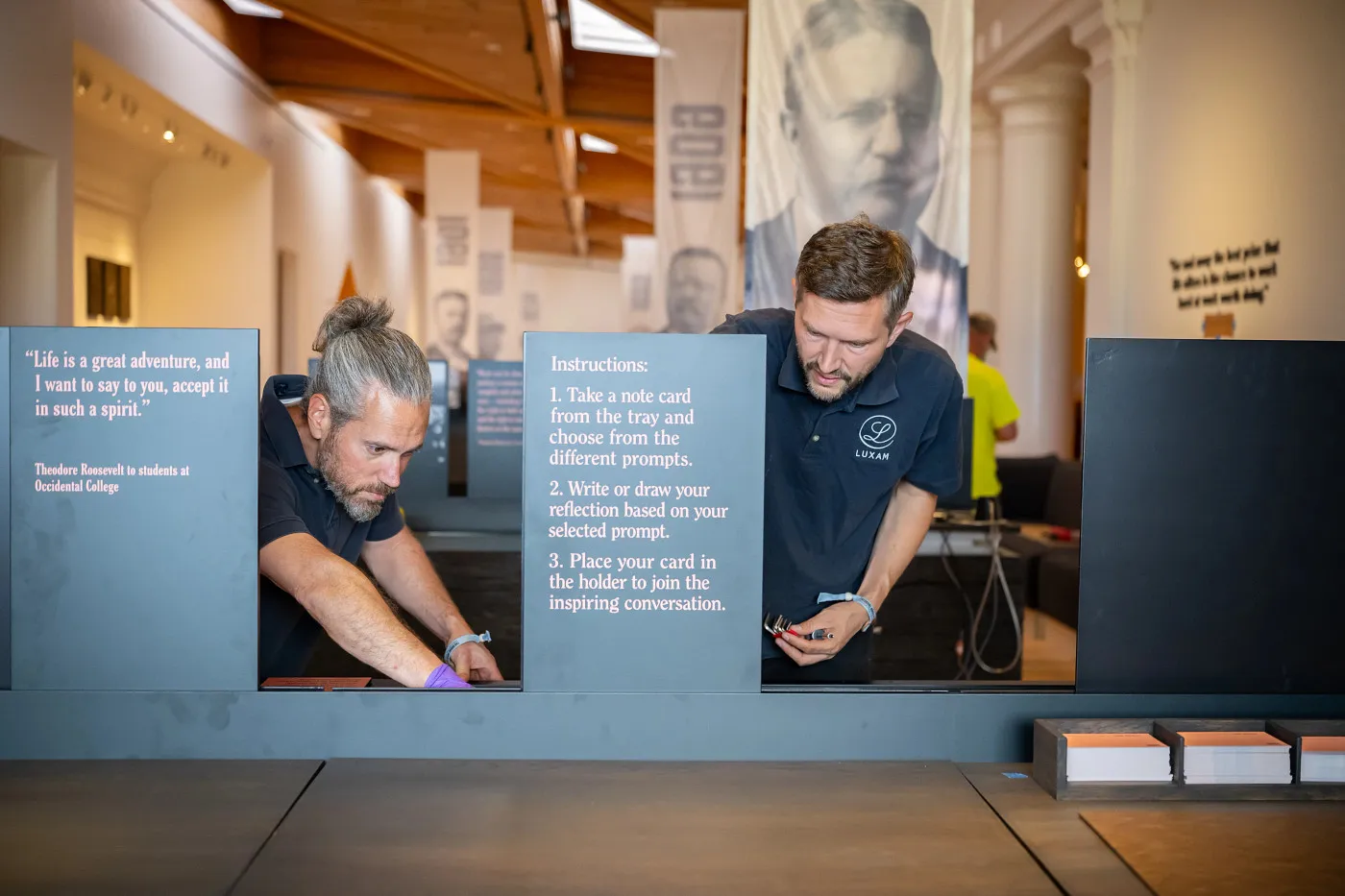
Visitors explore immersive, thematically organized exhibits inside the new Library. (Theodore Roosevelt Presidential Library)
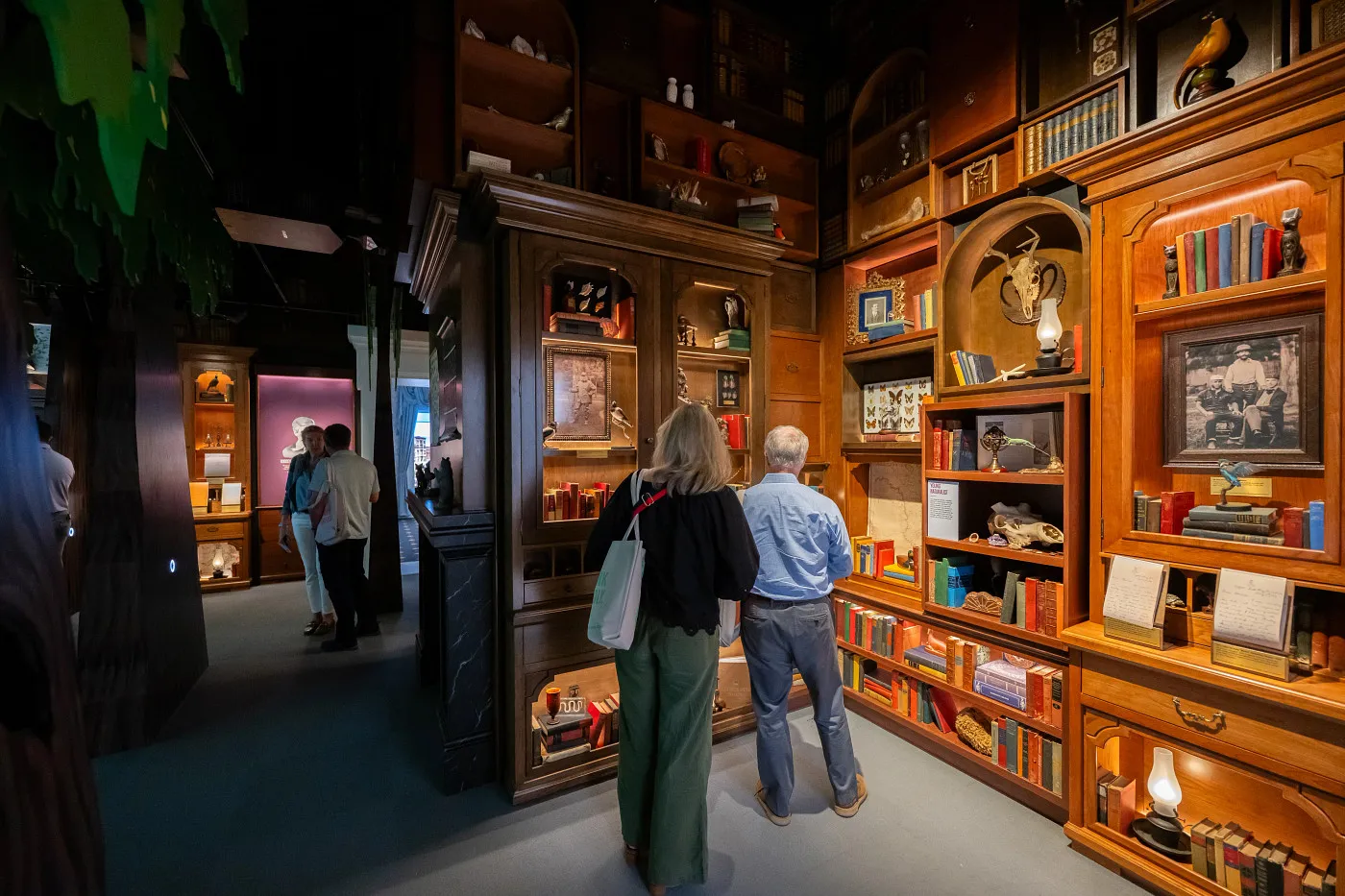
Galleries connect Roosevelt's life and values to the institution built to tell his story. (Theodore Roosevelt Presidential Library)
The Connection Between Roosevelt's Story and the Institution Telling It
The Theodore Roosevelt Presidential Library is remarkable because it doesn't simply preserve Roosevelt's legacy—it embodies it. This is more than clever design, though the architecture is certainly brilliant. Rather, it reflects a deep principle: that institutions should model the values they promote.
Roosevelt believed that nature mattered—not as scenery or resource, but as something sacred in itself that civilization had a duty to protect. The Library's triple sustainability certification puts this principle into practice. Roosevelt believed that democratic institutions should serve ordinary people, not just elites. The Library's exhibition design, its location, its approach to access and interpretation—all reflect a commitment to making Roosevelt's story available and meaningful to everyone, not just scholars. Roosevelt believed that direct experience—encountering something real, grappling with it, learning from it—was more powerful than passive receipt of information. The Library's location in the Badlands, its integration with the landscape, its emphasis on visitor engagement and exploration: all of this honors Roosevelt's own epistemology, his belief in learning through direct encounter with reality.
Roosevelt was a prolific author who understood that great ideas must be written about, debated, and transmitted. The Library houses an extensive research center with Roosevelt's papers and correspondence, attracting scholars from around the world. It also publishes widely, sponsors public forums, and creates digital resources, recognizing that Roosevelt's ideas only remain vital if they are actively engaged with by new generations.
Perhaps most importantly, Roosevelt believed that individuals could change. He transformed himself from a sickly child into a man of vigor, from a New York aristocrat into a Dakota rancher, from a conventional politician into a reform president, from a man of ambition into a man of conscience. The Library invites visitors to reflect on their own capacity for transformation. What challenges do you face? What aspects of yourself need remaking? What landscape—physical, intellectual, spiritual—might transform you? These are Roosevelt's implicit questions to each visitor.
The Gateway to the Western Landscape Roosevelt Loved
The Badlands are not a destination tourists pass through on the way to somewhere else. They are a destination in themselves—stark, beautiful, overwhelming in their vastness. Theodore Roosevelt understood this. He could have spent his grief-stricken years anywhere; he chose to spend them here, working alongside other people for survival, riding across terrain that demanded respect and attention.
The Theodore Roosevelt Presidential Library becomes the threshold to understanding this landscape through Roosevelt's eyes. Visitors arrive to encounter his story and are invited to extend that encounter outward: visit the Elkhorn Ranch where he lived, explore Theodore Roosevelt National Park where he hunted and rode, hike the trails where he walked. The Library contextualizes all of these experiences, helping visitors understand not just who Roosevelt was, but why this particular place changed him forever.
In this way, the Library itself becomes an argument: that to understand American identity, we must understand both the great individuals who shape it and the landscapes that shape those individuals. Roosevelt and the Badlands shaped each other. The Library exists in that reciprocal space, honoring both.
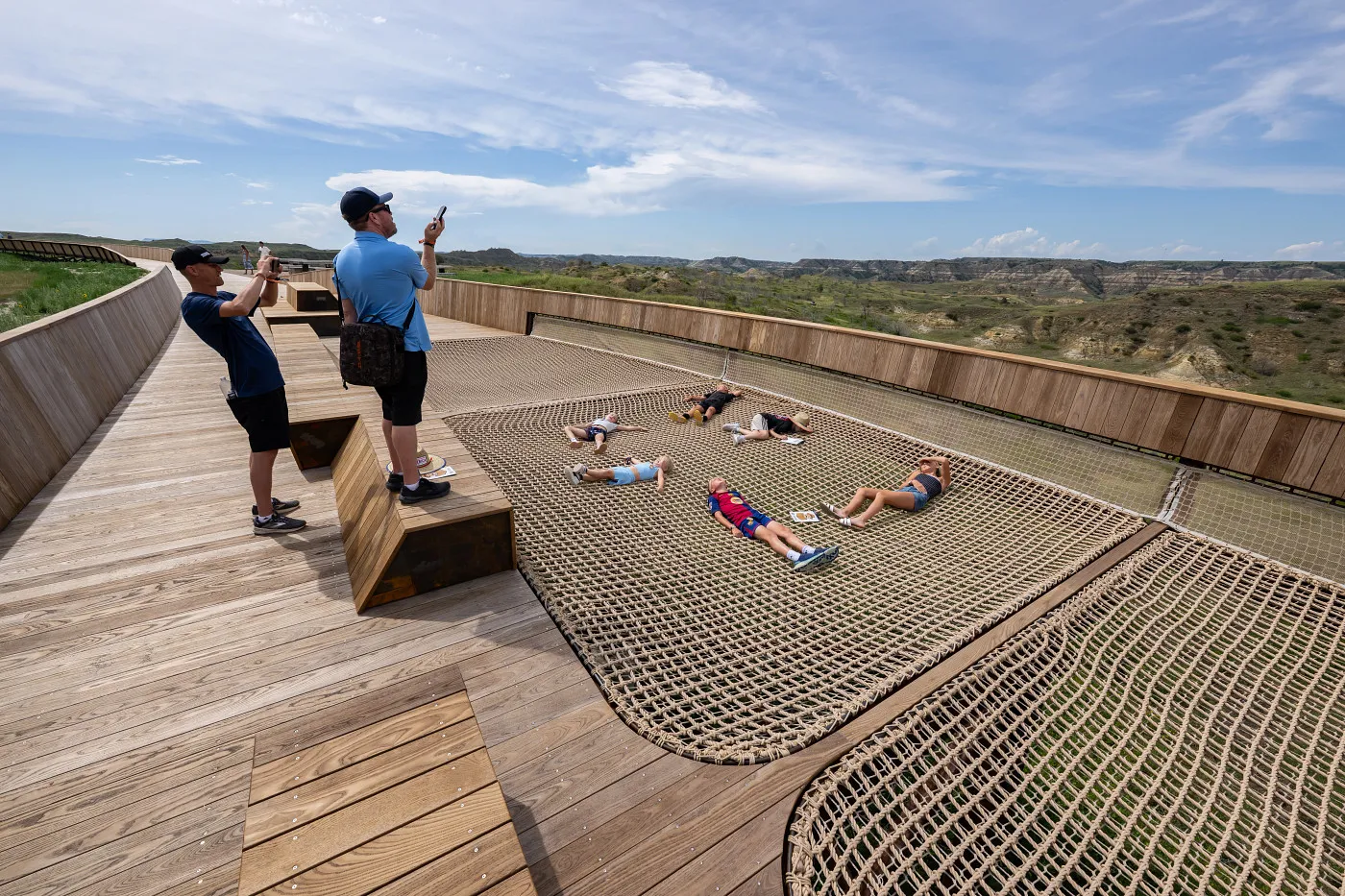
The view from the Library's roof, looking out over the badlands. (Theodore Roosevelt Presidential Library)
Planning Your Visit
The Theodore Roosevelt Presidential Library will open to the public on July 4, 2026, in Medora, North Dakota. The surrounding region swells with visitors during summer months, offering the Medora Musical, historic town experiences, trail riding, and access to Theodore Roosevelt National Park and other outdoor attractions.
The Library is designed to be experienced over multiple visits, with both immersive full-day experiences and shorter interpretive visits possible. Research facilities are available for scholars, students, and serious researchers seeking to engage deeply with Roosevelt's papers and legacy.
Learn more and plan your visit: Visit trlibrary.com
The Theodore Roosevelt Presidential Library awaits. Come understand how a man was transformed by a landscape, and how that transformed man changed a nation.
Continue Reading
- Theodore Roosevelt Biography — More on TR
- TR's Legacy — More on TR
Primary Sources at the TR Center
Explore original documents and resources related to this topic in the Theodore Roosevelt Center Digital Library.
- TR Center Digital Library — Primary source collection
From the Archives
Explore original photographs, documents, and illustrations related to this topic in the Theodore Roosevelt Center Digital Library.
- Pigskin library list — Roosevelt's list of 59 books for his African safari
- Library at Sagamore Hill — Interior photograph of the library at Sagamore Hill
Recommended Reading
- Theodore Roosevelt: A Strenuous Life by Kathleen Dalton (2007). ISBN: 978-0-307-42968-1
- The Language of Cottonwoods by Clay Jenkinson (2021). ISBN: 978-1-64663-100-1