
Bamie, Theodore Roosevelt’s Sounding Board
Anna "Bamie" Roosevelt Cowles never held office, and she never wanted credit. But for most of his life her brother told her what he was thinking, in person and in a lifetime of letters.
"Bothering You with My Affairs"
On February 14, 1884, Theodore Roosevelt lost his mother and his wife on the same day. Bamie, his older sister, took in his newborn daughter, Alice. When he went west to ranch in the Dakota Badlands, she ran his life back East. She oversaw the building of his new house at Oyster Bay, later named Sagamore Hill, and she paid his bills.
His letters from the Badlands show how much he leaned on her. In June 1884 he wrote her from the Little Missouri: "The country is growing on me, more and more; it has a curious, fantastic beauty of its own." By November he was writing from the ranch for blank checks: "Darling old Bysie, as usual I am bothering you with my affairs."
Bill Sewall, who helped run T.R.'s Elkhorn Ranch, had visited the house in the East. Back in Dakota, T.R. overheard him describing Bamie. "And, my, she's smart!" Sewall said. When he arrived, she was standing with a pencil and paper, "overseeing a lot of men; and made 'em tend straight up to business."
A Political Education
Bamie had a head for public affairs from girlhood. As a teenager she studied in France at the school of Marie Souvestre, a teacher with a gift for history and politics. Later, in London, she kept house for her widowed cousin James Roosevelt "Rosy" Roosevelt, a diplomat at the American embassy. In 1895 she married a U.S. Navy officer she met there, William Sheffield Cowles.
Henry Cabot Lodge, T.R.'s closest political ally, was also her friend and correspondent. In March 1897, when T.R. hoped to become Assistant Secretary of the Navy, he wrote Bamie that his chances were slim: "even all dear Cabot's work can not offset this." The appointment came through a few weeks later.
The Vice-Presidency Question
In the fall of 1899 Bamie moved to Washington, where her husband had a post at the Navy Department. She took a house at 1733 N Street NW, near Dupont Circle. T.R., now Governor of New York, kept writing.
That winter Republican leaders wanted to make him Vice President. He told Bamie he did not want the job. "I can see nothing whatever in the Vice-Presidency for me," he wrote on February 2, 1900. "It would be an irksome, wearisome place where I could do nothing." Three days later, answering her letter, he wrote, "Substantially I agree with your view."
Where Bamie herself came down is disputed. Her biographer, Lilian Rixey, writes that she quietly leaned toward Lodge's view that the nomination was the wiser path, while Edith was firmly against it. The historian Kathleen Dalton writes the opposite: that Bamie, like Edith, advised her brother to stay in Albany. The surviving letters, which are his side only, do not settle it.
The convention settled it for them. In June 1900 the Republicans nominated T.R. for Vice President. "The thing could not be helped," he wrote her.
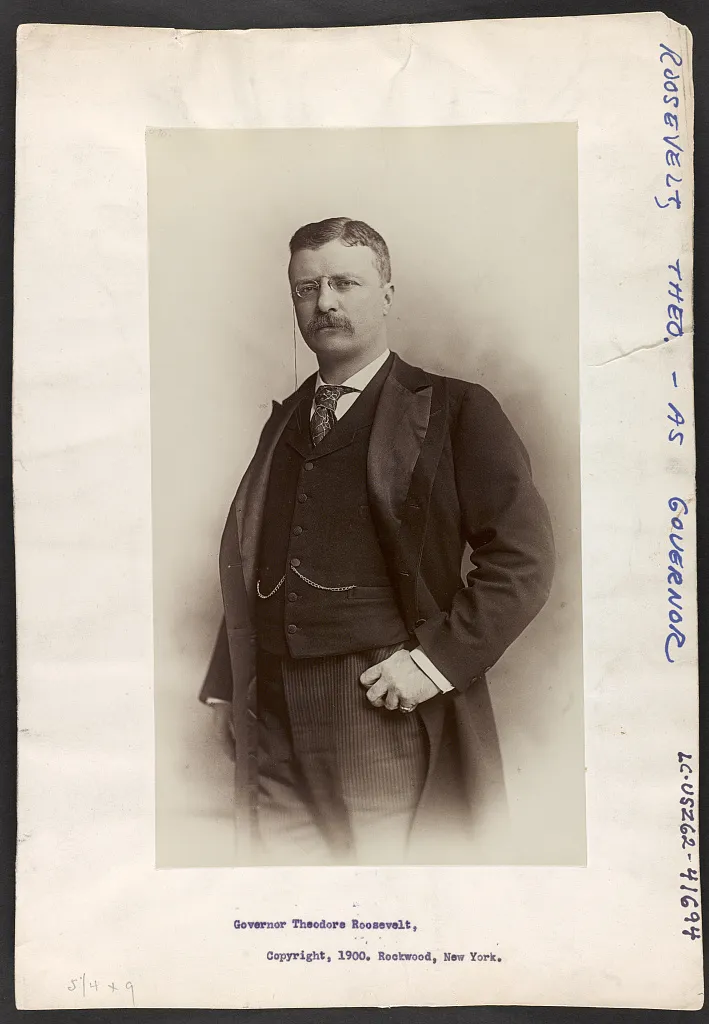
Governor Theodore Roosevelt of New York, in a portrait copyrighted in August 1900, two months after his nomination for Vice President. (George G. Rockwood / Library of Congress)

Senator Henry Cabot Lodge, about 1901, T.R.'s closest political ally and a friend of Bamie's. (J.E. Purdy / Library of Congress)
The Little White House
Bamie's house became T.R.'s Washington base. For his inauguration as Vice President in March 1901 the family gathered there, and he asked her to host a breakfast for a visiting English writer with "Lodge, Hay, Root and probably Long," three Cabinet members and the Senator among them.
Six months later, President William McKinley was dead. T.R. came to Washington as President and stayed at 1733 N Street while Ida McKinley prepared to leave the White House. His first Cabinet meetings were held there. Newspapers called the house "the Little White House," and the name stuck.
The 1924 edition of T.R.'s letters to her records that at the Capitol ceremonies for McKinley, Secretary of State John Hay, an old friend of their father's, turned to her and said, "How strange it seems that I should be here in this position with your father's son."
What the Record Shows
Through the White House years T.R. dropped by N Street to talk things over. His niece Eleanor, who knew the house well, put it this way, as quoted by Rixey: "There was never a serious subject that came up while he was President that he didn't go to her at her home on N Street and discuss it with her, before making his decision." She added, "He may have made his own decision, but talking with her seemed to clarify things for him."
That is the right measure of her influence. She was a sounding board, a channel for messages and a gifted hostess. She was not a hidden hand. In August 1903, when she passed along a message from Whitelaw Reid about a Cabinet vacancy, T.R. replied that the post was already filled, and that "it was idle to press any man upon me for the Cabinet, because I would count it against any man who was so pressed for such a position."
Auntie Bye and Eleanor
To the next generation she was "Auntie Bye." She persuaded Eleanor's grandmother to send the girl to Marie Souvestre's school, by then at Allenswood, near London. Eleanor later remembered those years as among the happiest of her life. When Franklin Roosevelt became Assistant Secretary of the Navy in 1913, he and Eleanor rented the house on N Street from Auntie Bye.
Alice Roosevelt Longworth, the baby Bamie had raised, paid her a famous compliment. "If Auntie Bye had been a man," Alice said, "she would have been President."
Bamie died in Farmington, Connecticut, in 1931. Seven years earlier she had published a selection of her brother's letters to her, about a quarter of those she had kept.
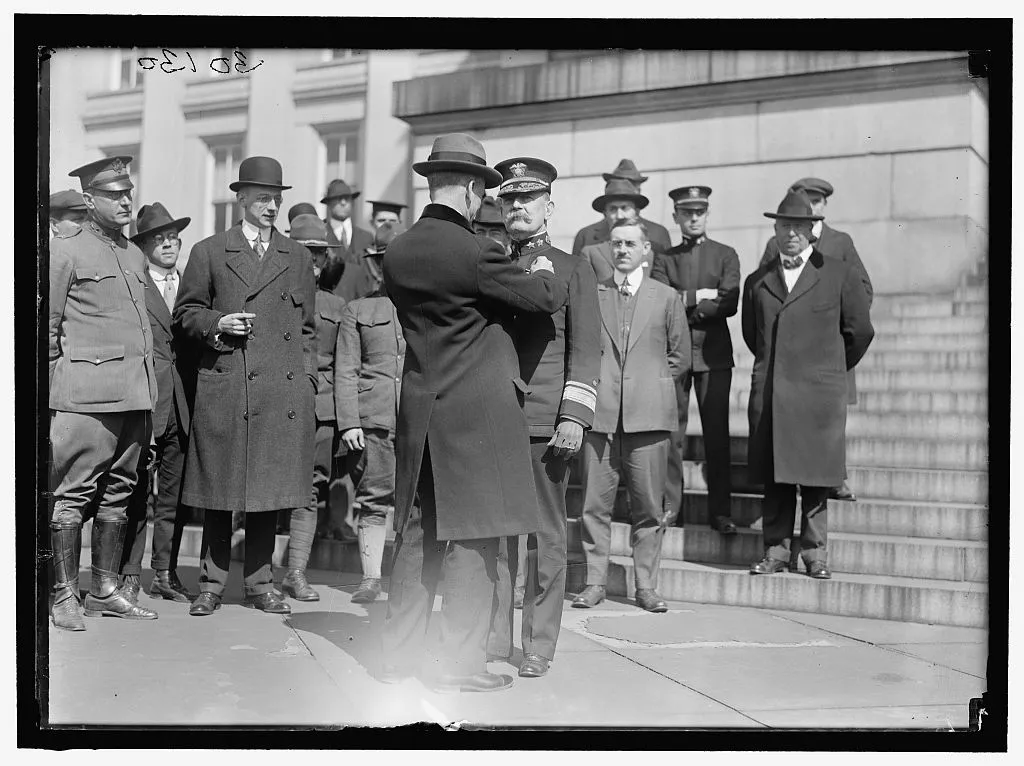
Bamie’s husband, William Sheffield Cowles, retired from the Navy as a rear admiral. Here, in 1919, he receives a medal on the steps of a government building. (Harris & Ewing / Library of Congress)
Continue Reading
- Anna "Bamie" Roosevelt Cowles: The older sister who raised baby Alice and kept the family steady.
- Women of the Roosevelt World: Mothers, sisters, wives and daughters, each in her own right.
- Henry Cabot Lodge: T.R.'s closest friend in politics.
- Alice Roosevelt Longworth: The niece Bamie raised, who became a Washington force herself.
- Eleanor Roosevelt: Another niece who learned Washington at Auntie Bye's table.
- Corinne Roosevelt Robinson: The youngest Roosevelt sibling and her brother's champion.
From the Archives
Explore original photographs, documents, and illustrations in the Theodore Roosevelt Center Digital Library.
Recommended Reading
- Lilian Rixey, Bamie: Theodore Roosevelt's Remarkable Sister (New York: David McKay, 1963).
- Kathleen Dalton, Theodore Roosevelt: A Strenuous Life (New York: Alfred A. Knopf, 2002). ISBN 978-0-679-44663-7
- David McCullough, Mornings on Horseback (New York: Simon & Schuster, 1981). ISBN 978-0-671-22711-1
- Betty Boyd Caroli, The Roosevelt Women (New York: Basic Books, 1998). ISBN 978-0-465-07133-3