
Jacob Riis: The Photographer Who Opened Roosevelt's Eyes
From Denmark to the New York Tenements: Photography as Advocacy
Jacob Riis came to America from Denmark in 1870 with almost nothing — a young man in his twenties fleeing limited opportunities in his home country, determined to seek fortune and freedom in America. Instead, he found himself desperately poor. He worked as a carpenter, a farmhand, a bricklayer, a door-to-door salesman — whatever work he could find. He was poor, genuinely poor, and he understood poverty from direct personal experience. He lived in tenements. He knew what it was to go hungry. He understood the desperation that poverty breeds.
Eventually, through intelligence and determination, Riis became a journalist, covering police and crime for the New York Tribune and other papers. As a police reporter, he walked the streets of New York's poorest neighborhoods — the same streets where criminals were arrested, where poverty bred desperation and crime, where tenements housed entire families in single rooms with no running water, no adequate ventilation, no sanitation, no light. He saw the reality of urban poverty that most wealthy New Yorkers never witnessed and deliberately ignored.
In the 1880s, Riis began using photography to document tenement life. This was pioneering work — flash photography was a new technology, invented in the 1880s, and Riis was one of the first to pioneer its use in investigative journalism. He would arrive at tenements unannounced, often at night, and photograph families in their homes — the darkness, the crowding, the lack of basic sanitation. Where earlier reformers had written detailed descriptions of poverty, Riis could show it visually. His photographs were often stark, uncomfortable, and emotionally powerful. They made it nearly impossible for viewers to maintain the comfortable ignorance that had previously allowed well-to-do society to ignore the existence and conditions of the urban poor.

Jacob Riis, the Danish immigrant whose photographs of New York's tenements awakened the nation to how the other half lived. (Library of Congress)
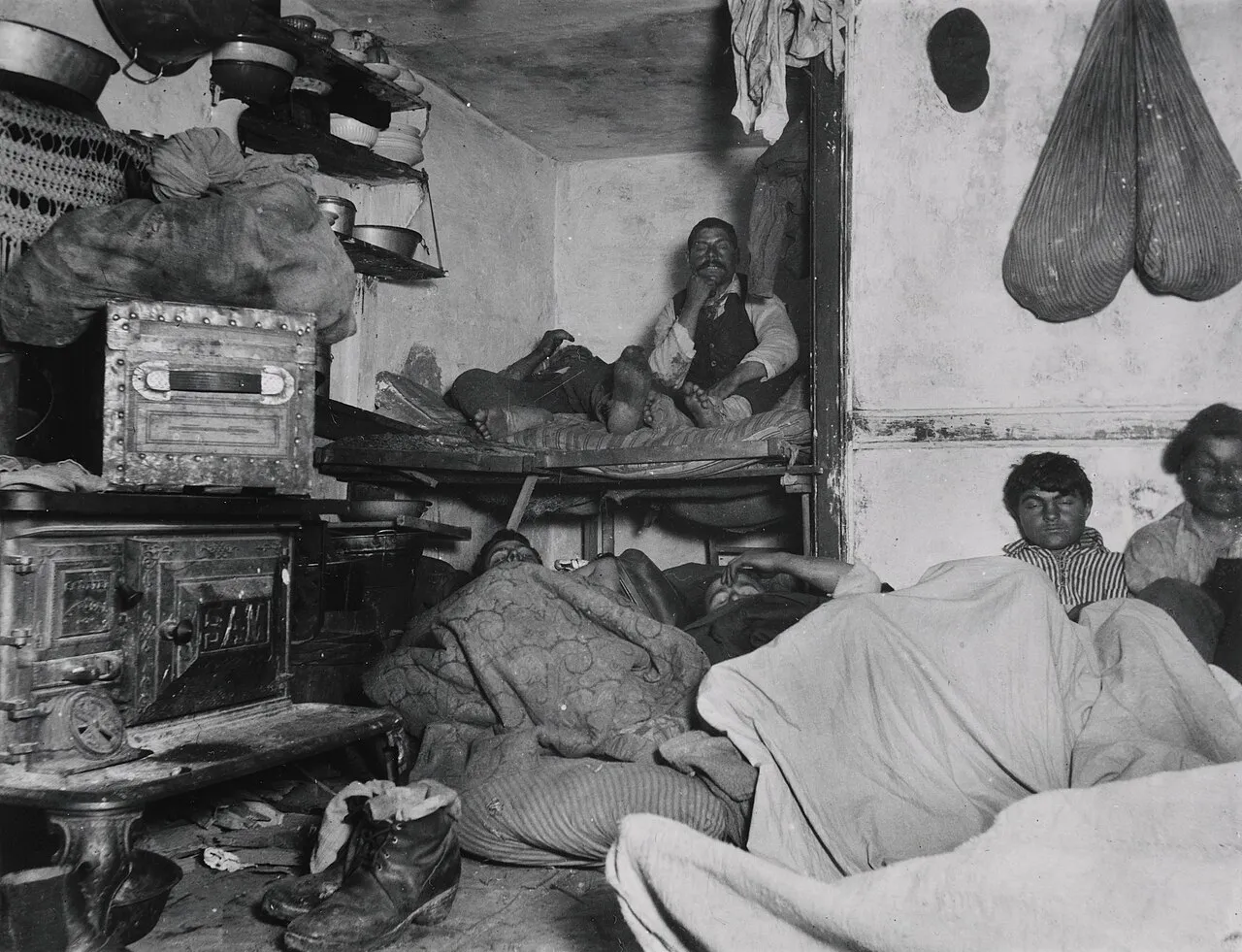
'Five Cents a Spot': lodgers packed into a Bayard Street tenement, from Riis's How the Other Half Lives (1890). (Wikimedia Commons)
How the Other Half Lives
In 1890, Riis published How the Other Half Lives, a collection of photographs and essays documenting life in New York's poorest neighborhoods. The book became an immediate sensation. It was the first time many middle-class New Yorkers had seen photographs of tenement life. Riis's images — mothers nursing babies in dark corners, children playing in alleys, families crowded into suffocating rooms — created an emotional impact that statistics alone could never achieve.
The book found an eager reader in Theodore Roosevelt, then a U.S. Civil Service Commissioner in Washington; on reading it he left a card at Riis's office that said simply, "I have read your book, and I have come to help." Their partnership deepened when Roosevelt became Police Commissioner in 1895. Roosevelt was already interested in reform and cleanup efforts in the city. But How the Other Half Lives did something more than provide him information — it changed his emotional understanding of the problem. Through Riis's photographs, Roosevelt could see the human reality behind the statistics about poverty.
Midnight Walks Through the Slums
One of the most remarkable aspects of the Roosevelt-Riis relationship was their habit of taking midnight walks through the tenement neighborhoods. Roosevelt, energetic and curious, wanted to see conditions firsthand. Riis, who knew these neighborhoods intimately, took him there. They would arrive unannounced at police stations in poor neighborhoods, at tenement buildings, at the places where New York's poorest citizens struggled daily. Roosevelt would ask questions, observe conditions, and let Riis explain what he was seeing.
These midnight walks were unusual. Here was the Police Commissioner of New York — a man of wealth and education — walking through the poorest parts of the city in the middle of the night with a journalist and a camera. Roosevelt didn't come as a tourist or a condescending visitor. He came as someone genuinely trying to understand. Riis appreciated this; he believed that until people with power truly understood poverty, reform would remain superficial.

Bandit's Roost off Mulberry Street, 1888 — the kind of alley Riis led Roosevelt through on their midnight walks. (Wikimedia Commons)

Theodore Roosevelt as New York City police commissioner, the post from which he acted on Riis's reporting. (Library of Congress)
Roosevelt's Praise and Practical Reform
Roosevelt called Riis "the most useful citizen of New York." It was high praise, and it reflected Roosevelt's genuine respect for what Riis was doing. More importantly, Roosevelt acted on what he learned from Riis. As Police Commissioner, he pushed for tenement reforms — better lighting, improved ventilation, sanitation requirements. As Governor of New York and later as President, he supported progressive housing legislation. The policies weren't always as sweeping as Riis might have wanted, but they moved in the direction that Riis's work demanded — toward acknowledging that poverty was not simply a moral failing of individuals but a structural problem requiring institutional solutions.
The relationship between Riis and Roosevelt shows how reform actually happens sometimes. It's not enough to pass laws or make speeches. Someone has to make people see the problem, feel it emotionally, understand that real humans are suffering. Riis did that through photography. Roosevelt then used his political power to address some of what Riis had revealed.
Beyond New York: A National Influence
Riis's influence extended far beyond his relationship with Roosevelt. How the Other Half Lives became a blueprint for reform movements across the country. Other photographers and journalists followed Riis's example, using cameras to document social problems. The muckraking movement of the early twentieth century owed a significant debt to Riis's pioneering work. He showed that journalism wasn't just about reporting facts; it could be about creating moral urgency around social problems.
Riis also demonstrated the power of photography itself as a tool for social change. Before Riis, photography was often seen as a neutral recording device. Riis understood that photographs could be composed to create emotional impact, that the choice of what to photograph and how to frame it was itself a form of argument. This insight — that the camera could be a tool for advocacy — became foundational to twentieth-century documentary photography and social reform journalism.

A crowded Lower East Side street of pushcarts and tenements — the immigrant New York Riis documented for a national audience. (Wikimedia Commons)
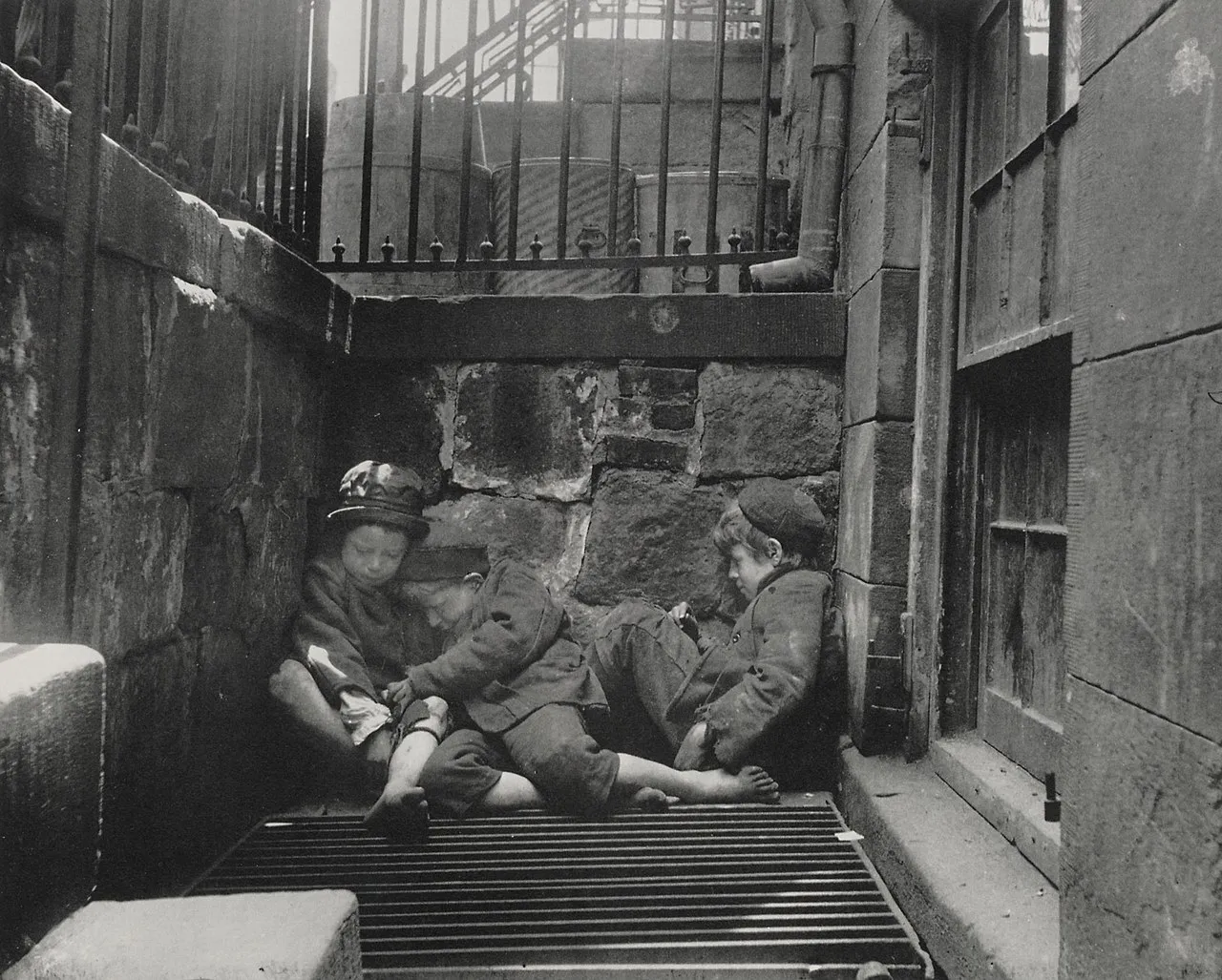
Homeless boys asleep over a street grating — Riis's photographs of children did the most to move readers and lawmakers. (Wikimedia Commons)
The Limits and Legacies
It's important to note that Riis, like many Progressive reformers of his era, sometimes viewed the poor through a lens shaped by the prejudices of his time. His writings occasionally contain ethnic and racial stereotypes. His vision of reform sometimes included elements of paternalism — the idea that middle-class reformers knew what was best for poor immigrants. Yet his fundamental insight was powerful: you cannot reform what you refuse to see, and seeing the human reality of poverty is the necessary first step toward justice.
The Roosevelt-Riis partnership demonstrates that political leaders sometimes do respond when shown the reality of human suffering by someone they respect and who has the evidence to back up their claims. Roosevelt wasn't naturally inclined toward tenement reform until Riis made it impossible for him to ignore. That's not a criticism of Roosevelt; it's a recognition of how change happens — through individuals willing to see difficult truths and through leaders willing to act on what they learn.
A Lasting Partnership for Reform
The relationship between Riis and Roosevelt shows how substantive social reform actually happens in practice. It's not enough to pass laws or make speeches. Someone has to make people truly see the problem, feel it emotionally, understand that real humans — vulnerable children, exhausted mothers, desperate fathers — are suffering. Riis did that through pioneering photojournalism. Roosevelt then used his political power and his position as Police Commissioner to address some of what Riis had revealed — improving ventilation in tenements, requiring better lighting, establishing sanitation standards, pushing for housing reform legislation.
When Roosevelt later became Governor of New York and then President, he continued to champion housing reform and progressive welfare policies that addressed the conditions Riis had documented. Riis's phrase about calling Roosevelt "the most useful citizen of New York" was reciprocated by Roosevelt's unwavering support for housing reform and his recognition that poverty was not merely a moral failing of individuals but a structural problem requiring institutional solutions and government action.
Continue Reading
- Roosevelt as Police Commissioner — His years of reform work in New York City
- Rise to Power Overview — Roosevelt's early political career shaped by reformers like Riis
- The Roosevelt Presidency — How early reform ideals influenced his national policies
- Roosevelt in the Badlands — Exploring other formative influences on his character
- Henry Cabot Lodge — Another key ally in Roosevelt's rise to power
- Early Life Overview — Understanding the influences that shaped Roosevelt's values
Primary Sources at the TR Center
Explore the Theodore Roosevelt Center's Digital Library for photographs, documents, and essays about urban reform and social conditions in Roosevelt's era.
- Politics and Government Encyclopedia — Essays on Roosevelt's reform efforts and political philosophy
- Family and Friends Section — Information on Roosevelt's relationships with reformers and advisors
- Race, Ethnicity, and Gender Encyclopedia — Context on Progressive reform movements of Roosevelt's time
- Timeline of Roosevelt's Life — Chronological context for his years as Police Commissioner
- Bibliography and Research Resources — Scholarly works on muckraking, reform journalism, and progressive era
From the Archives
Explore original photographs, documents, and illustrations related to this topic in the Theodore Roosevelt Center Digital Library.
Recommended Reading
- How the Other Half Lives by Jacob Riis (1890)
- Jacob Riis: A Life of Reforming Photography by Bonnie Yochelson and Daniel Czitrom (2007)
- Colonel Roosevelt by Edmund Morris (2010). ISBN: 978-0-679-60415-0