
NYC Police Commissioner: Midnight Walks and Radical Reform (1895-1897)
The Midnight Rambles: Catching Corruption Red-Handed
Within weeks of taking office, Roosevelt began a practice that would define his tenure and become legendary in New York: the midnight ramble. Armed with a walking stick and accompanied by Jacob Riis, the photographer and social reformer famous for exposing the horrors of tenement life in his book How the Other Half Lives, Roosevelt would walk the streets of the poorest neighborhoods at odd hours. Sometimes he would venture out at midnight, sometimes at 2 a.m., sometimes at 3 in the morning—times when officers were supposed to be vigilant but when corruption was most obvious. He personally observed whether police officers were at their posts and doing their duty. What he found appalled him utterly. Officers sleeping peacefully on duty, their uniforms unbuttoned, their weapons within reach but their minds far away. Officers drinking in saloons instead of patrolling the streets, abandoning their posts for the comfort of alcohol. Officers in open league with criminals, accepting bribes, turning blind eyes to robbery and assault. He would emerge from the darkness with Riis at his side and demand to know what they were doing. "Who are you?" officers would stammer when confronted by this intense, glaring man in the darkness. "I am the Police Commissioner," he would respond, watching their faces blanch as they realized they had been caught, that their negligence and corruption had been documented by the most powerful man in the department.
The midnight rambles became legendary throughout New York, the subject of newspaper headlines and street gossip. Reporters followed Roosevelt, eager to document his investigations and his encounters with corrupt officers. Jacob Riis, the famous photographer and social reformer, became Roosevelt's closest collaborator on these nocturnal expeditions. Riis documented Roosevelt's reform efforts in vivid newspaper articles and photographs that brought the reality of police corruption into American parlors. The publicity was relentless and strategic. Roosevelt understood, even in his early thirties, that reform required not just enforcement but public attention—the newspaper had to tell the story of corruption so that ordinary citizens would demand change. He used the press as his tool, turning the spotlight of public attention on officers who had operated in darkness and secrecy for years. The midnight rambles became Roosevelt's signature reform tactic: direct action combined with publicity, enforcement combined with transparency.
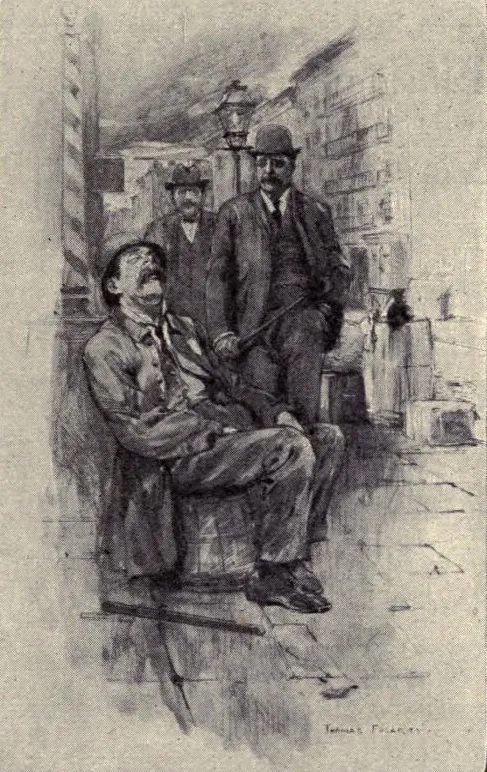
Roosevelt prowled the city after midnight with reporter Jacob Riis, catching patrolmen asleep or away from their posts — and shaking up a force grown comfortable with graft. (Jacob Riis, “The Making of an American,” 1901)

As board president, Roosevelt promoted officers on merit rather than political connection, striking at the Tammany machine's grip on the department. (Theodore Roosevelt Collection, Harvard College Library)
Merit-Based Appointments and Breaking the Machine
Roosevelt moved quickly to reform how police officers were hired and promoted. The old system distributed police jobs through political patronage—connections to the right politician or the right party meant advancement. Roosevelt established a merit-based examination system. New recruits would be tested physically and mentally. Promotion would be based on performance, not politics. He deliberately hired men from different ethnic backgrounds and removed the requirement that officers belong to the political party in power. He made a point, he said, of neither knowing nor wanting to know the political beliefs of any man on the force: politics would have no place in the department.
This was radical. It meant that police officers could no longer rely on party connections for advancement. It meant that the police force would no longer function as an arm of the party machine. It meant that a man could be a good police officer regardless of his ethnic background or his political affiliation. It was exactly what the department needed, and it generated exactly the kind of resistance Roosevelt had expected from politicians who benefited from the old system.
The Sunday Closing Law: Popular Opposition and Principle
One of Roosevelt's most controversial decisions involved enforcing the Sunday Excise Law—a state statute that prohibited the sale of alcohol on Sundays. This law had been on the books for years but was systematically ignored by previous police commissioners, who accepted bribes from saloon keepers to permit Sunday operations. Roosevelt determined to enforce the law uniformly and without exception. If the law was unjust, he believed, it should be repealed—but until it was repealed, it should be enforced. Whether a law was popular or not, he declared, was no concern of his; his business was to enforce it.
The decision was enormously unpopular. The German-American community of New York viewed beer gardens and saloon culture as central to their social life. Sunday drinking was a cherished tradition. German-American families would gather at beer gardens for social occasions. Roosevelt's enforcement threatened these customs. Voters were angry. Even fellow Republicans urged him to back down. He refused. He understood that he was sacrificing political support for the principle that the law must be obeyed. It was a characteristic Roosevelt choice: principle over popularity. This commitment to enforcing laws regardless of popularity would later define his approach to his work with reformers like Jacob Riis, who documented the urban conditions Roosevelt was determined to improve.
"I do not deal with public sentiment. I deal with the law."
— Theodore Roosevelt on the Sunday-closing fight, 1895
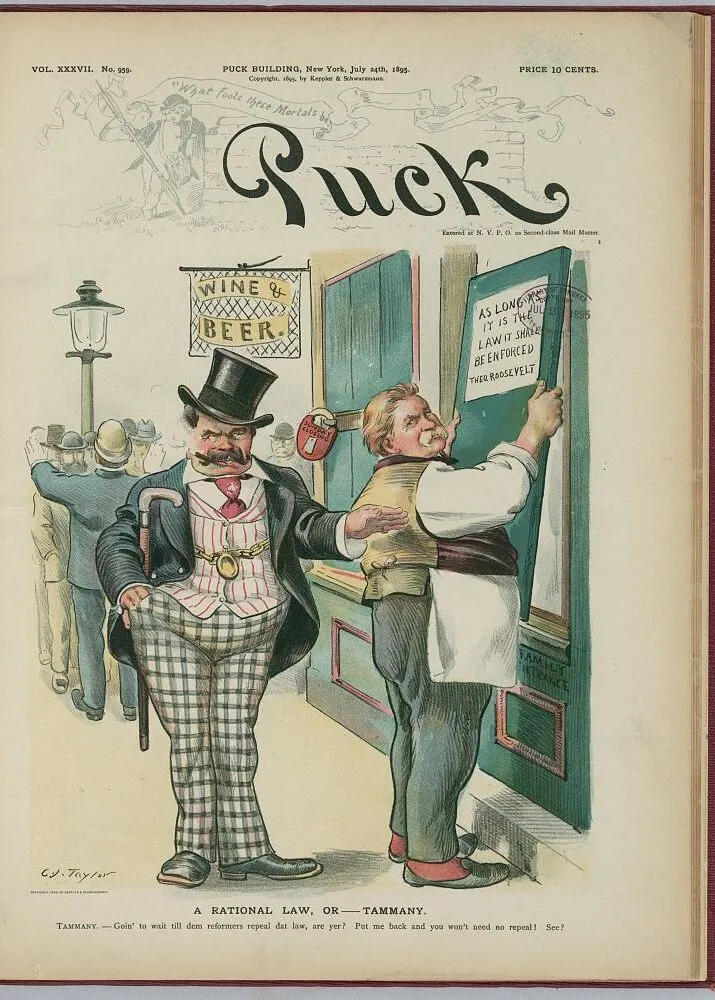
“As long as it is the law it shall be enforced. — Theo. Roosevelt” Roosevelt enforced the widely hated law requiring saloons to close on Sundays. Critics howled and Tammany schemed, but he held that a law on the books must be obeyed. (Library of Congress)

Roosevelt used the board to force out the old guard — including the powerful, and suspiciously wealthy, Superintendent Thomas Byrnes. (Theodore Roosevelt Collection, Harvard College Library)
Removing the Corrupt: Superintendent Thomas Byrnes
The most dramatic moment of Roosevelt's tenure came when he forced the retirement of Superintendent Thomas Byrnes, the legendary de facto chief of the police department. Byrnes had served for decades and had developed the police force as his personal fiefdom, bending it to his will and his interests. He was intimately connected to Tammany Hall, the Democratic machine that controlled New York City politics through networks of patronage and corruption. Byrnes had grown mysteriously wealthy through his decades of service—police captains on modest salaries somehow accumulated fortunes worth hundreds of thousands of dollars, and Byrnes was no exception. He accepted bribes from criminals and from saloon keepers in exchange for looking the other way. He accommodated underworld figures, allowing thieves and gamblers to operate openly in exchange for protection money. Every New Yorker knew it. The newspapers hinted at it. But nobody in the established order had dared to challenge him until Theodore Roosevelt arrived with no respect for the old machines.
Roosevelt publicized Byrnes’s corruption and made clear that the old regime’s days were numbered. The pressure was relentless and devastating. Newspapers printed detailed stories of Byrnes's inexplicable wealth—how a man drawing a police salary had accumulated real estate holdings and securities worth fortunes. Roosevelt's authority and his moral force were ranged on one side of the scale; Byrnes's power and his political connections were on the other. Within weeks of the new board’s arrival, Byrnes applied for retirement — on May 27, 1895 — rather than endure the public humiliation of a forced removal, and the commissioners approved it. Inspector "Clubber" Williams, another corrupt officer who had accumulated suspicious wealth and was widely known to use excessive force against poor people in poor neighborhoods, had retired days earlier, on May 24, under the same pressure. The removal of these corrupt officers sent shockwaves through the department. Officers who had believed themselves secure in their positions, protected by political connections, suddenly realized that the new Police Commissioner was willing to challenge anyone, regardless of rank or connections.
Modernizing the Force: The Bicycle Squad and New Technologies
Not all of Roosevelt's police reforms involved confrontation with corruption. Some involved genuine innovation and modernization. He established the bicycle squad—officers on bicycles who could respond quickly to incidents in crowded urban neighborhoods, covering more ground more efficiently than officers on foot, arriving at scenes of trouble faster than police on their usual beats. It seems like a small thing now in an era of police vehicles and radio communications, but it was forward-thinking then. Roosevelt understood that modern cities required modern police methods adapted to the urban environment. He was intensely interested in adopting new technologies and new techniques if they made the force more effective and more responsive to public safety needs. He installed a telephone system to improve communication within the department—a revolutionary innovation in the 1890s that allowed precinct captains to communicate with the central office and coordinate response to crimes in progress. The bicycle squad represented his fundamental belief that even in reform, you were always looking for ways to improve, to innovate, to do the job better. He believed that public servants had a responsibility to adapt to changing conditions and to use the best tools available.

Roosevelt embraced new technology to modernize the force — including a bicycle squad whose fast, agile officers could run down runaway horses and reckless “scorchers.” (New York Public Library, Picture Collection)

Real power lay with a four-member board that often deadlocked. A hostile colleague could block Roosevelt at every turn — a frustration that pushed him toward Washington. (Theodore Roosevelt Collection, Harvard College Library)
The Frustrations of Limited Authority
For all his energy and determination, Roosevelt eventually grew frustrated with his position. The Police Commission was a four-member board, with two Republicans and two Democrats. Critical decisions required consensus. Democratic commissioner Andrew Parker, loyal to Tammany Hall, could obstruct Roosevelt's initiatives. The structure meant that Roosevelt's authority was limited by the need for board consensus. He wanted a position where he could act decisively, without having to negotiate with political opponents. By 1897, after two years in the post, he was ready to move on. But his two years as Police Commissioner had made him a national figure. He had fought corruption and largely won. He had demonstrated that a single man with integrity and determination could challenge the most entrenched corruption and make a difference.
A Platform for the Next Rise
Theodore Roosevelt left the Police Commission in 1897 with his reputation as a reformer substantially elevated. He had proven himself as an executive administrator capable of managing a large institution. He had earned the respect of reformers and progressives across the country. He had made enemies of politicians and criminals who profited from corruption, but he had made allies of citizens who wanted clean, honest government. He had learned valuable lessons about executive power and the limitations of shared authority. He had demonstrated the power of publicity and moral force in achieving reform. When the next opportunity arose—appointment as Assistant Secretary of the Navy—he was ready to take it. And from there, the path to the presidency would begin to open before him.
Continue Reading
- Jacob Riis — Roosevelt's partner in urban reform and documentation
- Assistant Secretary of the Navy — His next reform platform
- The New York State Assembly — His first reform efforts in politics
Primary Sources at the TR Center
Explore original documents and resources related to this topic in the Theodore Roosevelt Center Digital Library.
- Life of Theodore Roosevelt Timeline — Key dates and events throughout his career
- Politics and Government Encyclopedia — Overview of Roosevelt's governmental roles
- Theodore Roosevelt Biography — Comprehensive biographical overview
From the Archives
Explore original photographs, documents, and illustrations related to this topic in the Theodore Roosevelt Center Digital Library.
Recommended Reading
- The Rise of Theodore Roosevelt by Edmund Morris (1979). ISBN: 978-0-307-77782-9
- Theodore Roosevelt the Citizen by Jacob Riis
- Theodore Roosevelt: A Life by Nathan Miller (1992). ISBN: 978-0-688-04693-2