
Theodore Roosevelt and Jacob Riis: Reformer and Muckraker United
The Other Half Lives: How a Book Changed Roosevelt's Thinking
Jacob Riis's book How the Other Half Lives, published in 1890, had been a revelation to Theodore Roosevelt. The book was a combination of journalism, social analysis, and photography. Riis had photographed the tenements of New York's Lower East Side—the dark, crowded buildings where recent immigrants and poor working families lived in conditions of unimaginable squalor. He had documented children working in sweatshops, families crowded into airless rooms, the diseases and dangers that came from living in such conditions. He had walked through these neighborhoods himself, camera in hand, documenting what he saw. The book was illustrated with photographs—a revolutionary way to tell a story at that time—and the images were powerful and undeniable.
When Roosevelt read How the Other Half Lives, something shifted in his thinking. He had been a reformer in the abstract sense—he had fought for civil service reform and good government. But Riis's book made poverty real. It made clear that the condition of the urban poor was not a matter of individual failure or laziness, but of systematic exploitation and neglect. The tenements themselves—the physical structures—were designed in ways that guaranteed disease, darkness, and despair. To improve the condition of the poor, you had to change the systems that created and perpetuated poverty.
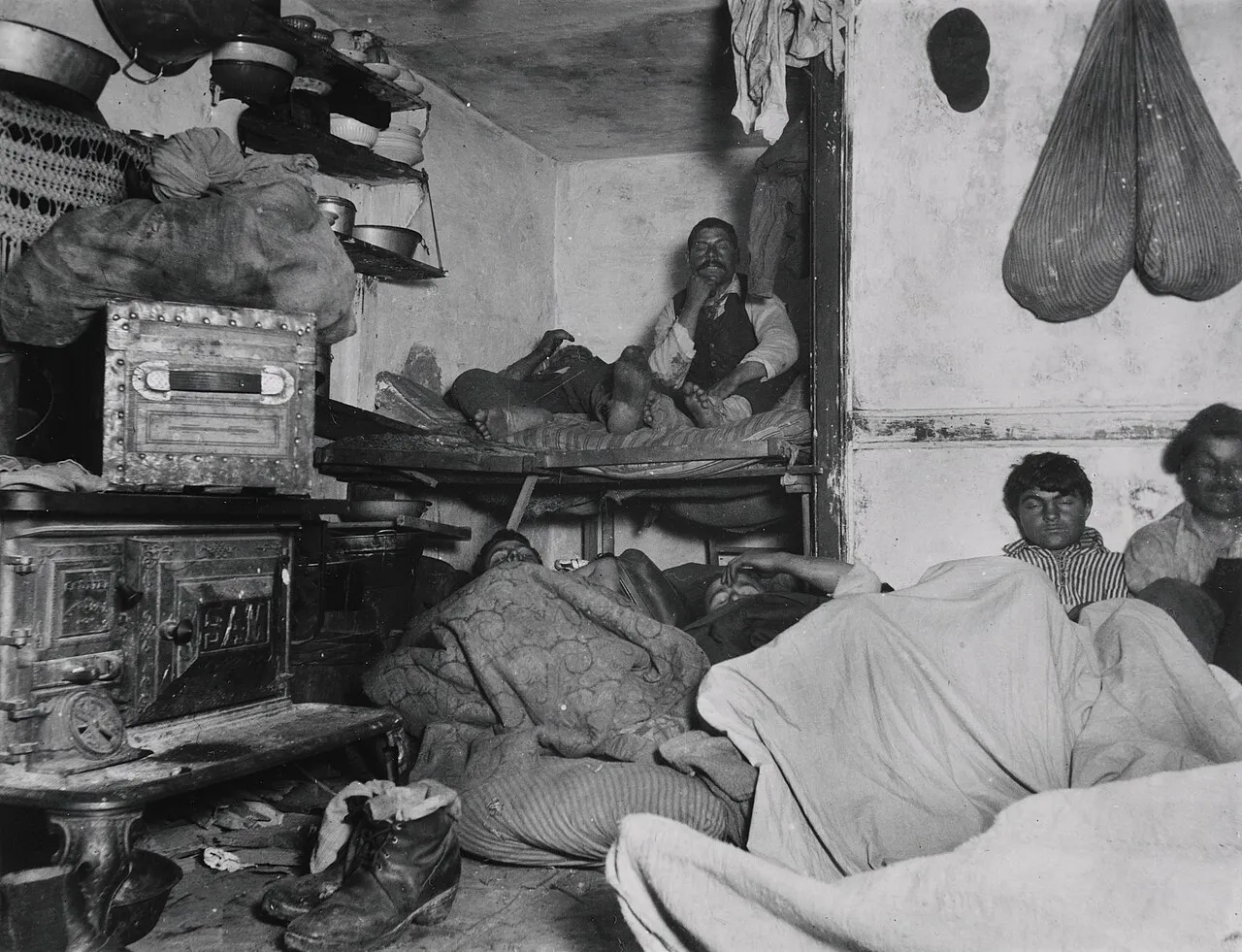
Lodgers packed into a Bayard Street tenement, from Jacob Riis's How the Other Half Lives (1890). (Museum of the City of New York)

Bandit's Roost off Mulberry Bend, one of the most notorious slum alleys Roosevelt toured on his midnight rounds. (Museum of the City of New York)
The Midnight Rambles: Documentation and Publicity
Roosevelt and Riis began their partnership with the famous midnight rambles through the Lower East Side. Roosevelt wanted to see what the nighttime conditions were like in the poorest neighborhoods. What were the streets like after dark? Where were the police? What crimes were happening? What kinds of establishments were operating illegally? Riis accompanied Roosevelt with his camera, documenting what they saw. They would emerge from darkness to confront police officers sleeping on their beats or gathering in saloons. The photographers would capture the scenes. The next day, Riis's newspaper accounts and photographs would appear, telling the story of corruption and neglect.
This was a new kind of journalism. It was not simple accusation or angry rhetoric. It was documentation. It was evidence. A photograph showed readers exactly what conditions were like. A police officer asleep on his beat was not a disputed claim; it was a fact captured on film. The combination of Roosevelt's authority as Police Commissioner and Riis's ability to tell the story and provide visual evidence was powerful. It was impossible to deny or ignore. The public could see what was happening. The newspapers were telling them that corruption was real and systematic.
Understanding Urban Poverty
Roosevelt's exposure to Riis's work and to the conditions of the poor tenements had a lasting impact on his thinking about social problems. He came to understand that individual virtue and hard work, while important, were not sufficient to overcome systematic poverty and exploitation. He came to believe that government had a responsibility to improve the conditions of life for working people. He came to understand that unsafe working conditions, inadequate housing, and child labor were not matters of individual failure but of systemic injustice.
This understanding would shape Roosevelt's progressive politics in the years to come. When he became President, he would advocate for workplace safety laws, for pure food legislation, for child labor restrictions. These policies were not radical—they seem modest by modern standards—but they represented a significant shift in American political thinking. The idea that government should intervene to protect workers and ensure safe conditions was new and controversial. Roosevelt's exposure to Riis's documentation of poverty had convinced him that such intervention was necessary.
"To Mr. Riis was given the great gift of making others see what he saw and feel what he felt."
— Theodore Roosevelt on Jacob Riis, in American Ideals
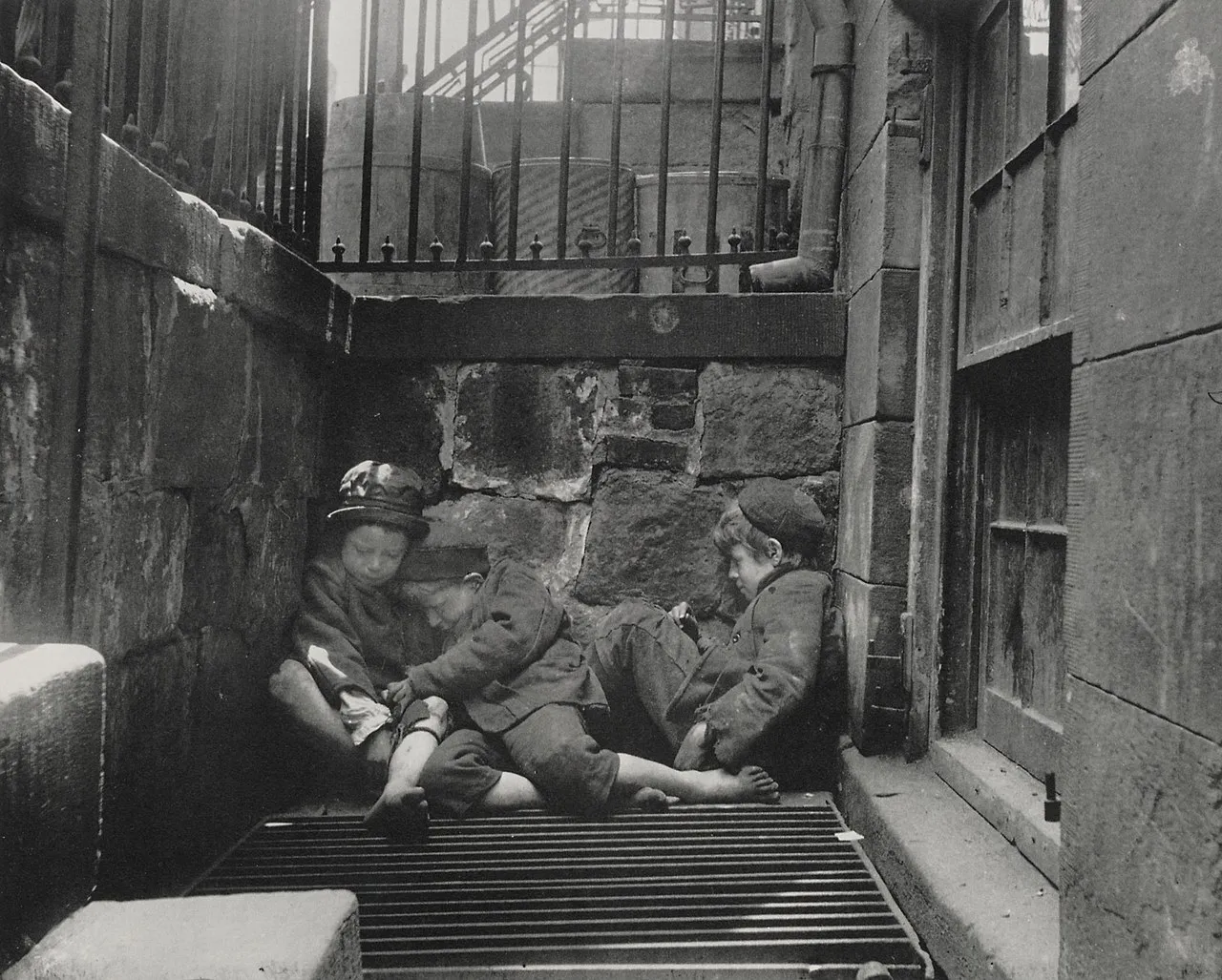
Homeless children Riis photographed in the tenement district, images that awakened comfortable readers to urban poverty. (Museum of the City of New York)

Jacob Riis, the muckraking journalist and photographer whose reform crusade drew Roosevelt into a lasting partnership. (Library of Congress)
A Friendship Built on Shared Purpose
Roosevelt's partnership with Riis was not a tactical alliance or a political calculation. It was a genuine friendship built on shared conviction about the need for reform. Roosevelt stated: "The man who was closest to me throughout my two years in the Police Department was Jacob Riis." They believed in each other's work. Roosevelt believed that Riis's documentation of conditions was truthful and powerful. Riis believed that Roosevelt's willingness to enforce laws and challenge corruption was genuine and necessary.
This partnership between a politician and a journalist, between a man with formal authority and a man with the power of public communication, represented something important: the possibility of change through the combination of political power and public attention. Roosevelt could not have accomplished his reforms without publicity. Riis could not have changed conditions without a reformer willing to act. Together, they were more powerful than either could have been alone.
Beyond the Police Commission: A Lasting Legacy
Even after Roosevelt left his position as Police Commissioner in 1897, his friendship with Riis endured. When Roosevelt became President, Riis would visit the White House. Roosevelt would seek Riis's advice on social questions. The two men shared a conviction that government existed not merely to preserve order but to improve the conditions of life for ordinary people. Roosevelt never stopped crediting Riis with showing him what was actually happening in the tenements — and making him understand why it mattered. The debt went back to the start of their friendship: after reading How the Other Half Lives, Roosevelt had called at Riis's office and, finding him out, left a card saying he had read the book and had "come to help" — a moment Riis recorded proudly in his autobiography, The Making of an American.
Jacob Riis died in 1914. Theodore Roosevelt lived nearly five more years, until January 1919. But the partnership that had begun in 1895 had lasting consequences. It had shaped Roosevelt's understanding of social problems. It had influenced his policies as President. It had demonstrated the power of combining political action with public communication to achieve reform. And it had shown that a reformer and a muckraker, a politician and a journalist, could work together for purposes that transcended partisan politics or personal advancement—the genuine improvement of human conditions and the pursuit of justice.

Roosevelt at his desk in public office; Riis called him the best police commissioner New York ever had. (Library of Congress)
A Model for Change
The relationship between Theodore Roosevelt and Jacob Riis remains a model for how change can happen in America. It shows the power of documentation and truth-telling. It shows the importance of combining moral conviction with political power. It shows what becomes possible when a politician listens to those who have seen the worst of what exists and uses his authority to change it. Their partnership demonstrated that reform requires both the voice that speaks truth and the authority that can act on that truth.
Continue Reading
- Police Commissioner of New York City—Roosevelt's reform work in the NYPD
- Civil Service Commission—Roosevelt's earlier anti-corruption work
- How Theodore Roosevelt Became President—Roosevelt's path to the White House
- The Square Deal—Roosevelt's progressive policies as President
- Rise to Power Overview—Roosevelt's political ascent
- Rise to Power Timeline—Key events in Roosevelt's early career
Primary Sources at the TR Center
The Theodore Roosevelt Center's digital library contains materials related to Roosevelt and Jacob Riis's reform work.
- Family and Friends encyclopedia—Information about Roosevelt's important relationships
- Theodore Roosevelt Life Timeline—Key dates in Roosevelt's career
- Theodore Roosevelt Biography—Comprehensive biographical information
- TR Center Bibliography—References on Roosevelt's reform work and relationships
From the Archives
Explore original photographs, documents, and illustrations related to this topic in the Theodore Roosevelt Center Digital Library.
Recommended Reading
- Rediscovering Jacob Riis: Exposure Journalism and Photography in Turn-of-the-Century New York by Bonnie Yochelson and Daniel Czitrom (2007)
- The Rise of Theodore Roosevelt by Edmund Morris (1979). ISBN: 978-0-307-77782-9
- Theodore Roosevelt the Citizen by Jacob Riis