
U.S. Civil Service Commission: Reforming Federal Government (1889-1895)
The Spoils System and the Problem It Created
For most of American history, federal government jobs had been distributed as political rewards. A politician won an election, and then he handed out government positions to his supporters. These jobs—in post offices, customs houses, federal offices across the country—came with opportunities to collect bribes, to accept kickbacks, to grow wealthy on the public dime. Federal employees were not hired based on their ability to do the job. They were hired because they had supported the right candidate or belonged to the right party. The result was that federal government was staffed with incompetent cronies, corrupt officials, and men who saw government service as a path to personal enrichment.
The Pendleton Civil Service Act of 1883 had begun to change this system. It required that certain government positions be filled through competitive examination, based on merit rather than political connections. But when Roosevelt took office in 1889, the system was still small—only about 27,000 of the 160,000 federal positions were covered by the merit system. The vast majority of federal jobs were still distributed through political patronage. Theodore Roosevelt's job was to expand the merit system and to enforce it against politicians and officials who profited from the old spoils system.
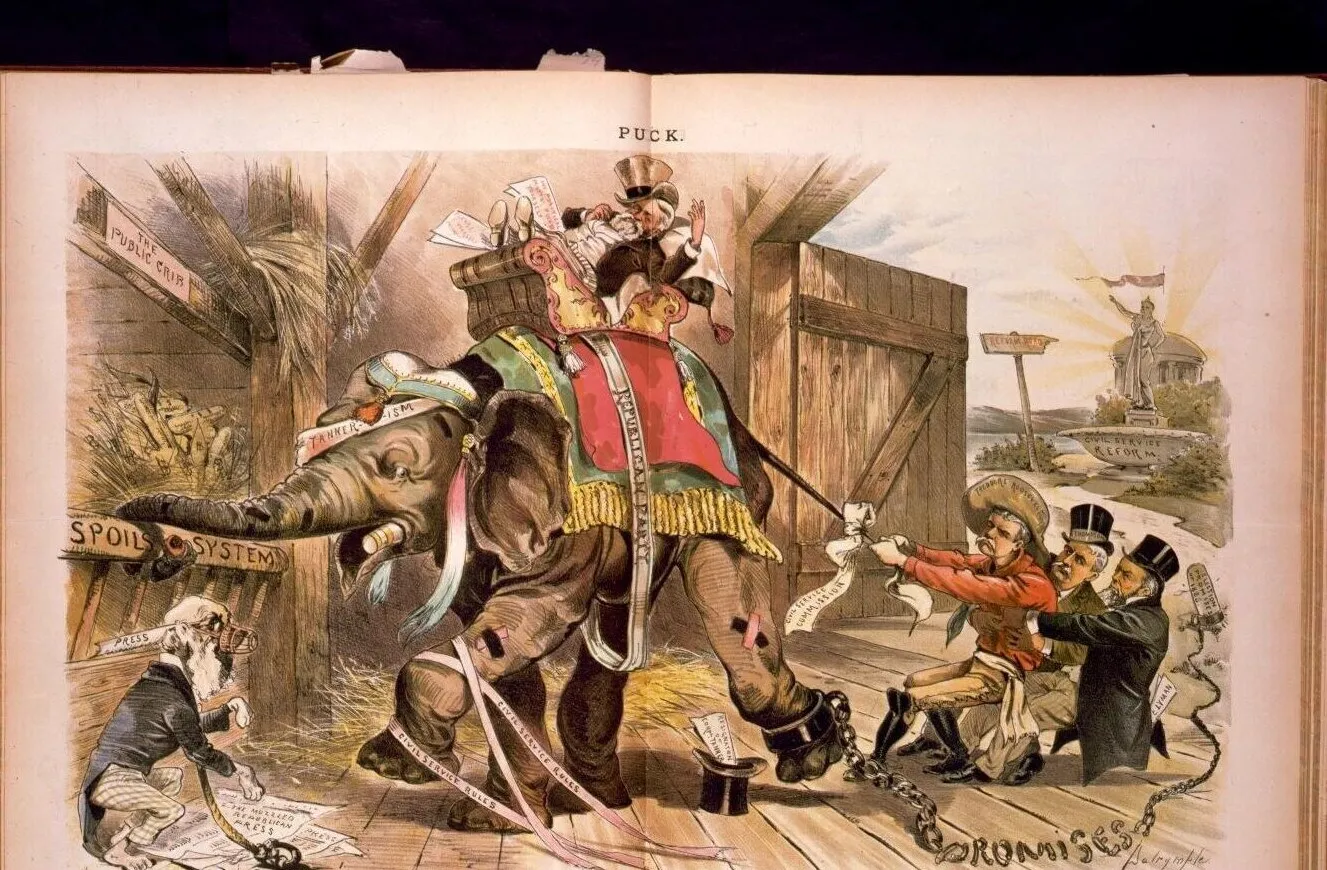
Puck cartoon lampooning the spoils system: "the pull that civil service reform has with this administration." (Library of Congress)

Theodore Roosevelt as United States Civil Service Commissioner, ca. 1889-1895. (Harvard College Library)
A Six-Year Battle Against Corruption
Roosevelt brought to the Civil Service Commission the same intensity and moral conviction that had characterized his Assembly years. He was not content to administer the examination system passively. He wanted to attack the entire corrupt infrastructure of patronage politics. He launched investigations into federal agencies, particularly the New York Custom House—one of the most important federal offices and also one of the most corrupt. Custom House collectors had traditionally used their positions to extract bribes and enrich themselves. Roosevelt attacked this corruption directly, publishing findings that embarrassed the Custom House administration and recommending the dismissal of officers engaged in corrupt practices.
He investigated fraud in federal service across the country. He held public hearings where witnesses testified to corruption they had witnessed. He antagonized politicians in both parties who benefited from the spoils system. He exposed violations and demanded enforcement. He did not simply process paperwork; he made civil service reform a national issue, and he did it with relentless energy.
Expanding the Classified Service
Over his six years on the Commission, Roosevelt helped double the number of federal positions protected by civil service examination. When he started in 1889, approximately 27,000 positions were classified. By 1895, when he left the Commission, more than 54,000 positions were classified. This expansion was not automatic or effortless. It required Roosevelt to work with sympathetic members of Congress, to lobby the President to use his executive authority to reclassify positions, and to fight against cabinet secretaries like Postmaster General John Wanamaker, who saw the expansion of civil service as a threat to their partisan control.
One of Roosevelt's most dramatic battles involved the postmaster of Milwaukee, a man named George Paul who had systematically violated examination requirements by manipulating test scores. Roosevelt and the Commission demanded Paul's removal. Wanamaker tried to protect him. President Harrison declined to remove him, and Paul remained in office until his death in May 1890 — but the Commission’s exposure of his exam-rigging was vindicated, and the fight established that the Commission could enforce the merit system even against resistance from powerful officials.
Inspecting the Indian Service
Patronage ran deep in the Indian Service, where jobs at reservation agencies and schools were often handed out as political rewards. In the summer of 1892, Roosevelt went to see for himself. He toured Indian agencies and schools in South Dakota, Nebraska and Kansas, among them Pine Ridge and Cheyenne River, traveling part of the way with Herbert Welsh of the Indian Rights Association.
His findings were published in 1893 as the Report of Hon. Theodore Roosevelt made to the United States Civil Service Commission upon a visit to certain Indian reservations and Indian schools in South Dakota, Nebraska, and Kansas. He argued that the people running agencies and schools should be chosen for their fitness, not their politics. Like most reformers of his day, he did not question the government’s goal of assimilating Native people; his fight was over who carried that policy out. Read more about Roosevelt and Native Americans.

Roosevelt at his desk in 1895, the year he left the Civil Service Commission after six years of reform work. (Library of Congress)

A portrait of Roosevelt from his years as Civil Service Commissioner, when the reform fight shaped his political character. (Harvard College Library)
The Education of Theodore Roosevelt
The Civil Service Commission years educated Roosevelt in a crucial lesson: formal authority without enforcement power is limited. The Commission could investigate, could gather evidence, could document violations—but it could not force compliance if cabinet secretaries and the President refused to act. This experience shaped Roosevelt's later approach to executive power. When he held positions with actual authority—as Police Commissioner, as Governor, and as President—he would insist on clear hierarchical control and would brook no resistance from subordinates. The frustrations of the Commission years taught him that effective executive action required real power, not just formal authority.
"As far as was humanly possible, the appointments and promotions were made without regard to any question except the fitness of the man and the needs of the service."
— Theodore Roosevelt on his Civil Service Commission years · Theodore Roosevelt Center quote archive
Building a National Reputation
What the Civil Service Commission position lacked in formal power, it made up for in visibility. Newspaper accounts of Roosevelt's investigations made him a recognizable figure across the nation. His testimony before Congressional committees established him as an expert in administrative reform. His public statements about the need to destroy the spoils system made him a hero to Americans who cared about clean, honest government. The position that seemed unglamorous when he took it became a platform from which to reach a national audience.
By 1894, as his six-year tenure on the Commission approached its end, Roosevelt's political stock had risen considerably. He had demonstrated that he could handle a federal position with skill and integrity. He had built a reputation as an incorruptible reformer. He had supporters among reform Republicans and among ordinary citizens who wanted to see government cleaned up. What he needed next was a position with real executive authority—and that position was about to present itself in the form of Police Commissioner of New York City.

Roosevelt during his years as Civil Service Commissioner, holding his son Ted. Photograph by Wilhelm. (Harvard College Library)
Civil Service Reform as a Foundation for Progress
The work that Roosevelt did on the Civil Service Commission was foundational to American democratic reform. The modern civil service—the system where federal employees are hired based on merit, not political connections—is a direct legacy of the work that Roosevelt and others did in the 1890s. Without civil service reform, the federal government could not have functioned effectively. It could not have managed the growing complexity of industrial America. It could not have provided the services that modern government is expected to provide.
For Theodore Roosevelt personally, the Commission years were a crucial apprenticeship. They taught him how government worked at the federal level. They educated him in the limitations of regulatory commissions and the necessity of clear executive authority. They built his reputation as a reformer and established him as a national figure. They were, in many ways, the foundation on which his rise to power was built.
Continue Reading
- Police Commissioner of New York City—Roosevelt's next reform position with executive authority
- New York State Assembly—Roosevelt's early reform work
- Governor of New York—Roosevelt's executive position
- Assistant Secretary of the Navy—Roosevelt's federal executive position
- Rise to Power Overview—Roosevelt's political ascent
- Rise to Power Timeline—Key events in Roosevelt's career
Primary Sources at the TR Center
The Theodore Roosevelt Center's digital library contains materials related to Roosevelt's civil service reform work.
- Politics and Government encyclopedia—Overview of Roosevelt's political work
- Theodore Roosevelt Life Timeline—Key dates in Roosevelt's career
- Theodore Roosevelt Biography—Comprehensive biographical information
- TR Center Bibliography—References on Roosevelt's reform work
From the Archives
Explore original photographs, documents, and illustrations related to this topic in the Theodore Roosevelt Center Digital Library.
Recommended Reading
- The Rise of Theodore Roosevelt by Edmund Morris (1979). ISBN: 978-0-307-77782-9
- Theodore Roosevelt: A Life by Nathan Miller (1992). ISBN: 978-0-688-04693-2
- A Strenuous Life: Theodore Roosevelt and the Rise of the Modern American Presidency by William H. Harbaugh (1961)