
Theodore Roosevelt's Cabinet: Strong Minds and Stronger Authority
John Hay and the State Department Legacy
John Hay, McKinley's Secretary of State, remained in office when Roosevelt took over in 1901. Hay was already sixty-two years old, a man of considerable prestige and diplomatic experience. He had served as Secretary of State since 1898 and had successfully negotiated key foreign policy achievements, including the Open Door policy toward China and the Hay-Pauncefote Treaty that cleared the way for an American-built isthmian canal. Roosevelt respected Hay enormously, calling him one of the finest statesmen he had known.
Hay served as Secretary of State for the first four years of Roosevelt's presidency, though increasingly his health failed him. He died in office in July 1905, leaving Roosevelt to find a successor. The loss was personal as well as professional—Roosevelt had valued not just Hay's diplomatic skill but his counsel on matters great and small.

John Hay served as Secretary of State, guiding Roosevelt’s early diplomacy until his death in 1905. (Harvard College Library, Theodore Roosevelt Collection)

Elihu Root modernized the U.S. Army as Secretary of War, then succeeded John Hay at the State Department. (Harvard College Library, Theodore Roosevelt Collection)
Elihu Root: The Indispensable Administrator
If any cabinet officer approached Roosevelt as an intellectual equal, it was Elihu Root. Root began his tenure as Secretary of War under McKinley in 1899 and continued in that role when Roosevelt became president. Root was a brilliant lawyer, a superb administrator, and a man of towering intellect. He was also, importantly, someone Roosevelt trusted completely. The two men could engage in genuine debate about policy without ego getting in the way. Roosevelt came to regard him as the ablest man in American public life.
Root's tenure as Secretary of War (1901-1904) was transformative. He reorganized the Army along professional lines, established the War College as a training institution for senior officers, reformed officer training and promotion, and brought modern management practices to the War Department. Root believed that the military required professional expertise and scientific management—principles that aligned perfectly with Roosevelt's progressivism. Roosevelt gave Root considerable latitude in military matters, and Root used it wisely. When Hay died in 1905, Roosevelt turned to Root to serve as the new Secretary of State. Root accepted and served in that position from 1905 until January 1909, when he resigned to take a seat in the United States Senate. Robert Bacon served as Roosevelt's third Secretary of State for the final weeks of the term.
Root's transition from War Secretary to Secretary of State was unusual and significant. It demonstrated Roosevelt's confidence in Root's abilities across multiple domains. As Secretary of State, Root proved equally capable, negotiating important agreements and advancing American diplomatic interests. He guided American participation in the Algeciras Conference, handled complex Caribbean policy, and managed American relations with European powers. Few cabinet officers served under Roosevelt longer or with greater influence. Root's subsequent career—including service in the Senate and his prominence in Republican circles—reflected the credibility he had earned as Roosevelt's most trusted administrator.
William Howard Taft: War Secretary and Presidential Hope
When Elihu Root stepped down as Secretary of War in 1904, Roosevelt selected William Howard Taft to replace him. Taft, a former federal judge, was then serving as Governor-General of the Philippines, where he had governed since 1901; he brought significant administrative experience and a cautious, constitutional temperament that contrasted with Roosevelt's dynamism. Yet Taft was loyal and capable, and he handled the War Department competently from 1904 to 1908.
More importantly, Taft was Roosevelt's choice as his successor. As the 1908 election approached and Roosevelt honored his 1904 promise not to seek another term, he began grooming Taft as the Republican nominee. Taft's service as War Secretary gave him visibility and executive experience that helped convince Republican leaders and the public that he was ready for the presidency. Their eventual partnership and later conflict would shape American politics for decades.

William Howard Taft, Roosevelt’s Secretary of War and trusted troubleshooter, whom the president groomed as his presidential successor. (Library of Congress)

Philander C. Knox, Attorney General, led the administration’s landmark antitrust prosecutions, including the Northern Securities case. (Harvard College Library, Theodore Roosevelt Collection)
Philander Knox and the Justice Department
Philander Knox served as Attorney General from 1901 until June 1904, when he resigned to become a United States Senator from Pennsylvania. He was succeeded by William H. Moody (1904-1906) and then Charles J. Bonaparte (1906-1909), who carried the administration's antitrust campaign forward. Knox was a skilled lawyer and a tough enforcer, which suited Roosevelt's aggressive approach to trust-busting and regulatory reform. Roosevelt's administration filed more antitrust suits than any previous administration, and Knox orchestrated many of these cases.
Knox's tenure reflected Roosevelt's belief that the Justice Department should be an active force for reform, not a passive legal service to the executive branch. When Roosevelt wanted to challenge monopolies, Knox was ready to act. The Northern Securities case, the most famous antitrust action of the Roosevelt era, was argued by Knox's office.
The Other Cabinet Voices: Continuity and Change
Beyond the four figures who dominated his cabinet, Roosevelt worked with a range of talented, if sometimes more specialized, administrators. James Wilson served as Secretary of Agriculture throughout Roosevelt's presidency, overseeing the dramatic expansion of forest reserves and helping implement Roosevelt's conservation agenda. Wilson was competent and loyal, though not a major policy innovator. He simply did what the president wanted done.
The Treasury Department under Lyman Gage (1901-1902), Leslie Shaw (1902-1907), and later George B. Cortelyou (1907-1909) handled fiscal policy and financial regulation. Shaw was a capable administrator who worked effectively with Roosevelt on financial policy. The Department of Commerce and Labor, established in 1903 partly at Roosevelt's urging, became a tool for gathering economic information and promoting American business interests abroad. The Navy Department, central to the ambitions of the navalist president, passed through six hands during the Roosevelt years: John D. Long, William H. Moody, Paul Morton, Charles J. Bonaparte, Victor H. Metcalf, and Truman H. Newberry.

James “Tama Jim” Wilson, the long-serving Secretary of Agriculture, embodied the continuity that steadied Roosevelt’s cabinet through change. (Harvard College Library, Theodore Roosevelt Collection)
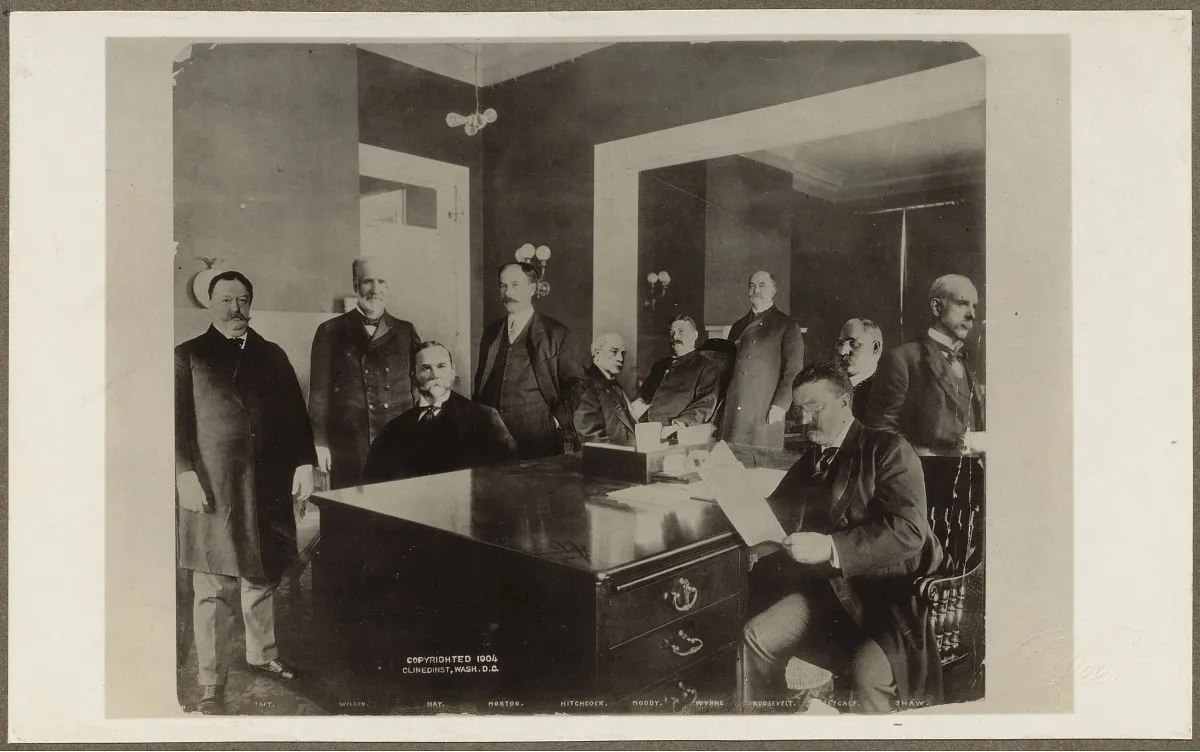
President Roosevelt with his cabinet, the advisers he personally selected and closely managed to carry out his agenda. (Harvard College Library, Theodore Roosevelt Collection)
How Roosevelt Selected and Managed His Cabinet
Roosevelt approached cabinet selection with clear criteria. He wanted people of genuine ability—lawyers, judges, businessmen, military officers who had proven themselves in their fields. He actively sought out strong, independent thinkers who would challenge him in private discussion. But he never confused cabinet discussion with final authority. Roosevelt made the decisions. His cabinet officers implemented them. This reflected his "stewardship theory" of the presidency: the president possessed broad authority to act, and the cabinet existed to serve presidential purposes.
Roosevelt was an engaged cabinet leader who broke with precedent in the extent of his active involvement. He held regular cabinet meetings and actually listened to what his officers said. He read their reports and consulted with them on important questions. He sometimes changed his mind when presented with compelling evidence or arguments. But once a decision was made, he expected complete loyalty. Officers who could not support the president's policies were expected to resign. When Taft later dismissed Gifford Pinchot, Roosevelt took it as a personal betrayal and evidence that Taft had abandoned the progressive agenda.
This combination of openness to debate and absolute final authority made Roosevelt's cabinet a far more professional body than many that preceded it. These were not figureheads or party hacks filling positions as rewards for political service. They were working administrators expected to carry out a presidential agenda actively and professionally. Roosevelt demanded competence and expected results. Cabinet officers who failed to deliver found themselves replaced.
Loyalty mattered enormously to Roosevelt. He was deeply attached to people he trusted and could be quite vindictive toward those he felt had betrayed him. But as long as officers maintained loyalty while the working relationship continued, Roosevelt gave them the space they needed to do their jobs. Elihu Root could disagree with the president in cabinet meetings and still retain Roosevelt's full confidence. That kind of trust was rare in American government, then and now. When Root left office, Roosevelt lost an irreplaceable source of counsel and a steadying presence that would be sorely missed in his subsequent political conflicts.
Policy Coordination and Cabinet Effectiveness
Roosevelt's cabinet worked more effectively as an instrument of presidential policy than any previous cabinet in American history. This reflected both the quality of the officers and Roosevelt's skill in managing them. He ensured that cabinet departments coordinated with each other rather than operating in isolation. He used the cabinet to disseminate his vision across the executive branch. He expected each officer to understand not merely his own department's functions but how those functions served larger presidential purposes.
The cabinet's effectiveness was evident in major policy achievements: the expansion of the Army and the modernization of the military under Root; the aggressive trust-busting under Knox at Justice; the expansion of forest reserves and conservation under Wilson at Agriculture; the coordination of American foreign policy across State, War, and Navy Departments. These achievements required not merely individual competence but effective coordination—something Roosevelt's cabinet leadership ensured.

President Theodore Roosevelt at his White House desk. He directed an assertive foreign policy that lifted the United States into the front rank of world powers. (Library of Congress)
The Cabinet as an Extension of Presidential Will
Roosevelt's cabinet ultimately embodied his theory of the presidency. The cabinet existed to serve the president's vision and agenda. Individual officers might have expertise or specialized knowledge that Roosevelt respected, but ultimate authority rested with the chief executive. Roosevelt used his cabinet to accomplish his goals—trust-busting, conservation, reform, and the projection of American power abroad. When officers fulfilled that role effectively, they enjoyed his favor and protection. When they did not, they departed.
For more information about Roosevelt's approach to the presidency and his leadership style, visit the Theodore Roosevelt Center at Dickinson State University.
The cabinet Roosevelt assembled was not especially ideologically homogeneous. These were pragmatists united by loyalty to the president and commitment to efficient, active government. It was a cabinet that reflected Roosevelt's conviction that the executive branch should be a force for progress in American society.
Continue Reading
- Executive Power: The Stewardship Theory — How Roosevelt revolutionized the scope of presidential authority
- Trust-Busting and Regulatory Reform — How the cabinet coordinated antitrust actions
- William Howard Taft — Roosevelt's chosen successor
Primary Sources at the TR Center
Explore original documents and resources related to this topic in the Theodore Roosevelt Center Digital Library.
- Roosevelt's Administration and Cabinet — Encyclopedia entries on cabinet officers and government structure
From the Archives
Explore original photographs, documents, and illustrations related to this topic in the Theodore Roosevelt Center Digital Library.
Recommended Reading
- Theodore Roosevelt: A Life, Nathan Miller, 2011, ISBN 978-0062078543
- The Rise of Theodore Roosevelt, Edmund Morris, 1979, ISBN 978-0812976205
- Elihu Root and the Conservative Tradition, Richard W. Leopold, 1954