
The Coal Strike of 1902: The President Who Sided with the Miners
Winter Without Heat: An American Crisis
In May 1902, 150,000 anthracite coal miners in Pennsylvania walked off their jobs. The strike was over wages—the miners earned a pittance, sometimes barely enough to survive—and over the mine owners' absolute refusal to recognize their union or negotiate with union representatives. This might have seemed a routine labor dispute, easily ignored by a president focused on foreign policy and tariff legislation. But it was not routine. Anthracite coal was the lifeblood of the American industrial economy. It heated the homes of millions of Americans from New England to the Midwest. It powered the factories that manufactured goods. It drove the locomotives that pulled freight and passengers across the continent.
By September 1902, with winter approaching, the crisis had become catastrophic. Schools across the North were forced to close for lack of fuel. Hospitals were running critically short of coal, unable to heat operating rooms, unable to maintain warm rooms for patients. Families throughout the industrial Northeast were preparing for a winter without adequate heat—in temperatures that would fall far below freezing, in homes where children and elderly relatives would huddle together for warmth. City officials warned of a humanitarian disaster if the strike continued past November.
The mine owners, meanwhile, refused to budge. They owned the coal. They owned the mines. They owned the land. The workers, they insisted, were fortunate to have jobs at all. The owners would not recognize the union. They would not negotiate with what they termed "union radicals." If workers wanted employment, workers would accept whatever wages and conditions the owners dictated. This was capitalism: workers had no leverage; they had only the choice to accept starvation wages or starve. The owners fully expected the federal government to side with capital against labor, as the federal government had consistently done throughout American history.
Theodore Roosevelt surprised everyone, including the mine owners and his own advisors. He did not side with capital. Instead, he positioned himself as an honest referee, determined to ensure that neither side—neither greedy capitalists nor potentially radical labor unions—trampled the public interest. It was a revolutionary moment in American history, one that would define Roosevelt's presidency and reshape the relationship between government and labor.

Miners with their mules at an anthracite coal mine; the 1902 strike shut down mines like this and threatened the nation's winter fuel. (Harvard College Library, Theodore Roosevelt Collection)

Anthracite coal miners at the end of a shift — the men whose long strike for better pay and shorter hours brought the country to a crisis. (Harvard College Library, Theodore Roosevelt Collection)
The Human Cost: Families in the Cold
To understand Roosevelt's intervention, one must understand what the strike meant for ordinary Americans. The miners themselves lived in poverty. The Pennsylvania coal fields were controlled by a handful of industrial titans—the Reading Railroad, the Erie Railroad, and the Delaware, Lackawanna & Western Railroad, which operated the mines as extensions of their rail empires. Miners worked underground in dangerous conditions for twelve hours or more per day. They were paid per ton of coal extracted, meaning that their wages depended on market prices over which they had no control. In years of low coal prices, miners earned barely enough to eat.
But the strike's impact radiated far beyond the mines. Coal shortage meant schools closing—children sent home without education because buildings could not be heated. It meant hospitals struggling to maintain sterile operating rooms, to keep patients warm enough to survive. It meant families in cold climates burning wood, burning anything they could find, as temperatures plummeted. It meant elderly people and infants dying of cold-related illnesses. It meant industrial factories closing because they lacked fuel to operate. It meant jobs disappearing throughout the industrial Northeast as factories shut down.
The humanitarian dimensions were unmistakable. Mayors of major cities wrote to President Roosevelt begging for intervention. The Mayor of New York warned that a winter without adequate coal would result in deaths among the poor and elderly on a massive scale. The suffering was not theoretical—it was immediate and growing with each passing week.
Summoning the Adversaries
In October 1902, with winter approaching, Roosevelt took a step no American president had ever taken. He invited both the mine owners and union leaders to the White House. Not to lobby them separately. Not to pressure one side. But to sit down together, in the president's presence, and negotiate a settlement that would serve the public interest.
The symbolism alone was astonishing. By summoning the mine owners to the White House as supplicants before the president, Roosevelt implicitly rejected the premise that they were sovereign actors answerable only to market forces and property rights. They were American citizens subject to the authority of the federal government and to public opinion. If their refusal to negotiate condemned millions of Americans to a freezing winter, they bore moral responsibility for that catastrophe.
The mine owners arrived expecting to negotiate with Roosevelt much as they had negotiated with previous presidents—as equals, with government acting as a neutral facilitator. They were wrong. Roosevelt made clear he represented the American people, not some neutral position above the fray. The public needed coal; the miners needed fair wages. Both needs were legitimate. The owners needed to accept that reality.

Roosevelt on tour amid the coal crisis. In October 1902 he took the extraordinary step of summoning the mine operators and miners' leader John Mitchell to the White House. (Harvard College Library, Theodore Roosevelt Collection)

“Next! A president who ‘does’ things” — a cartoon on Roosevelt's willingness to act on the coal strike where others would not. (Library of Congress)
The Owner's Arrogance and Roosevelt's Defiance
The mine owners proved arrogant beyond what Roosevelt had anticipated. They refused to recognize the miners' union as legitimate. They refused to sit at a table with union leaders as equals. They refused to accept the principle that workers had any voice in determining their own wages or conditions of labor. Instead, they proposed that Roosevelt appoint an arbitration commission—but only if that commission's members were selected exclusively by the owners themselves. This was not negotiation. It was an insult disguised as cooperation: a demand that the president rubber-stamp whatever the owners decreed.
The owners' position was articulated most memorably by George F. Baer, one of the principal mine operators and official spokesman for the owners' coalition. When William F. Clark, a Wilkes-Barre photographer, wrote to Baer appealing to him as a Christian to end the strike, Baer responded in a private letter—soon leaked to the press— with words that encapsulated the arrogance and moral blindness of the industrial age. He wrote: “The rights and interests of the laboring man will be protected and cared for—not by the labor agitators, but by the Christian men to whom God in His infinite wisdom has given the control of the property interests of the country, and upon the successful management of which so much depends.” This was the owners' entire philosophy in one stunning statement: workers had rights only insofar as the Christian capitalists who owned the mines chose to grant them. God himself, according to this view, had appointed the owners to rule labor and had granted them this responsibility. The owners were not servants of the miners but their masters, and they owed them nothing except what divine wisdom suggested they should provide.
Roosevelt found Baer's invocation of divine appointment to control labor to be not merely wrong but blasphemous. Roosevelt was himself a man of deep religious conviction, but his Christianity emphasized obligation to the poor and the vulnerable, not the prerogatives of wealth and property. He believed that Christians had responsibilities to ensure justice and dignity for all people, especially those without power. He was not prepared to accept that workers' lives could be sacrificed to the owners' arrogance and refusal to negotiate like human beings with other human beings.
Roosevelt's patience had distinct limits. According to contemporary accounts of the October White House meeting, he informed the owners that if they did not accept negotiation immediately—genuine negotiation with union leaders present, as equals—he would order federal troops to seize the coal mines and operate them directly for public benefit. This was an extraordinarily bold statement: the president of the United States was threatening to nationalize an entire industry because its owners would not negotiate in good faith. This would have been, in essence, a form of socialism imposed by a Republican president acting to protect the public welfare. The constitutionality of such action was uncertain and remains debated by scholars today. But Roosevelt made the threat credible through the absolute seriousness of his manner and his demonstrated willingness to use executive power expansively when he believed the public interest demanded it.
Whether Roosevelt would actually have possessed constitutional authority to seize the mines was legally uncertain—and remains debated by constitutional scholars to this day. The Constitution's takings clause, interpreted by courts, generally protects property from seizure without compensation. But Roosevelt made the threat credible through his demeanor, his absolute seriousness, and his demonstrated willingness to expand executive power when he believed the public interest demanded it. The owners, recognizing that Roosevelt meant precisely what he said and that military seizure would be catastrophic for their commercial interests and personal fortunes, capitulated. The final terms were brokered by Secretary of War Elihu Root and J.P. Morgan aboard Morgan's yacht Corsair: the operators agreed to accept arbitration by a commission appointed by the president. The miners, led with notable discipline by UMW president John Mitchell, returned to work on October 23, 1902, pending the commission's decision.
The Arbitration Settlement
The Anthracite Coal Strike Commission, carefully composed by Roosevelt to include both management-friendly and labor-friendly voices, spent months hearing evidence and arguments. The commission ordered a settlement in March 1903 that represented a genuine but limited victory for the miners. The miners won a 10 percent wage increase—modest but meaningful. They won a reduction in working hours. Most importantly, they won recognition that their grievances would be heard through union representatives in workplace disputes. Management did not formally recognize the union, and wages were not transformed, but the principle that workers would have a voice in working conditions was established. Workers were no longer simply subject to the unilateral will of mine owners. They had a mechanism to be heard.
The significance lay not in the specific settlement but in the revolutionary principle it established: the federal government would henceforth position itself as an active arbiter between labor and capital, ensuring that neither side trampled public interest. This was unprecedented. In all prior American history, government had sided with capital against labor. Police and state militia had broken strikes with violence. Federal judges had issued injunctions against strikers. Presidents had typically supported business interests. Roosevelt was saying that those days were ending, that a new era was beginning in which government would stand between labor and capital, protecting the interests of ordinary citizens.
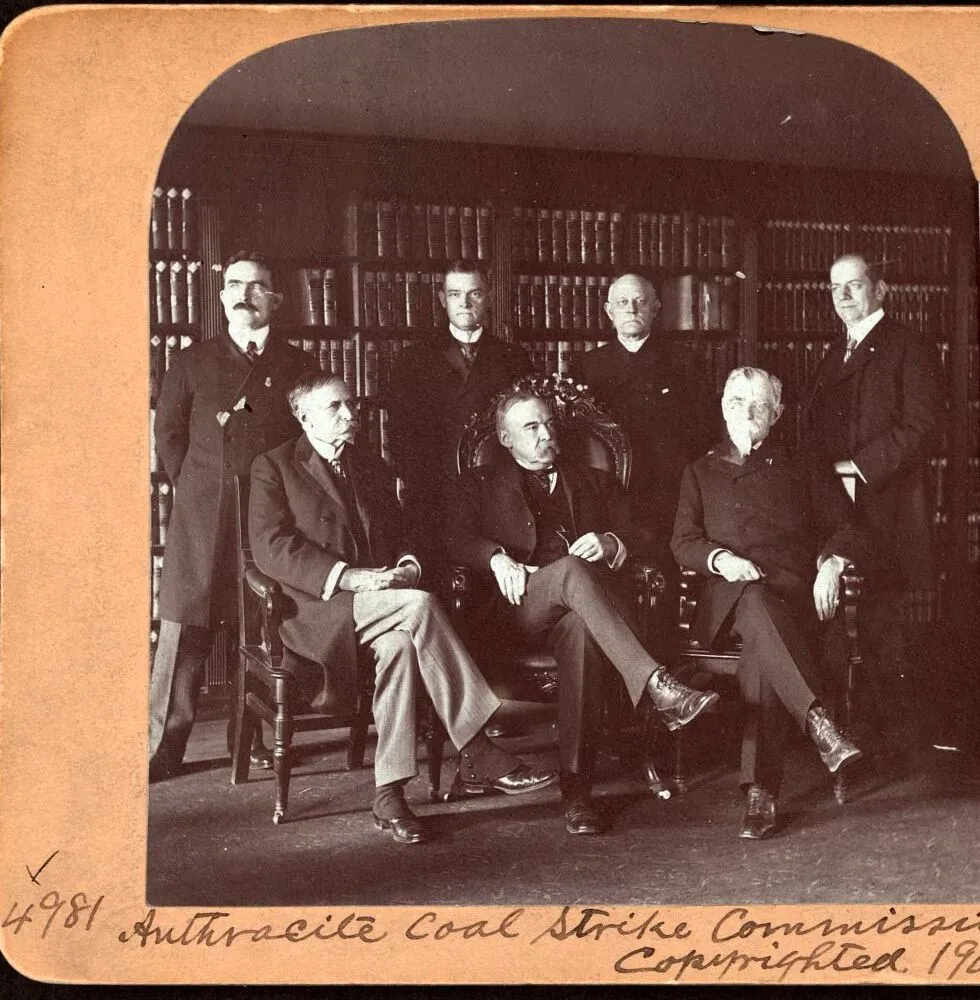
The Anthracite Coal Strike Commission, appointed by Roosevelt in 1902, whose arbitration ended the strike and set the terms of settlement. (Library of Congress)
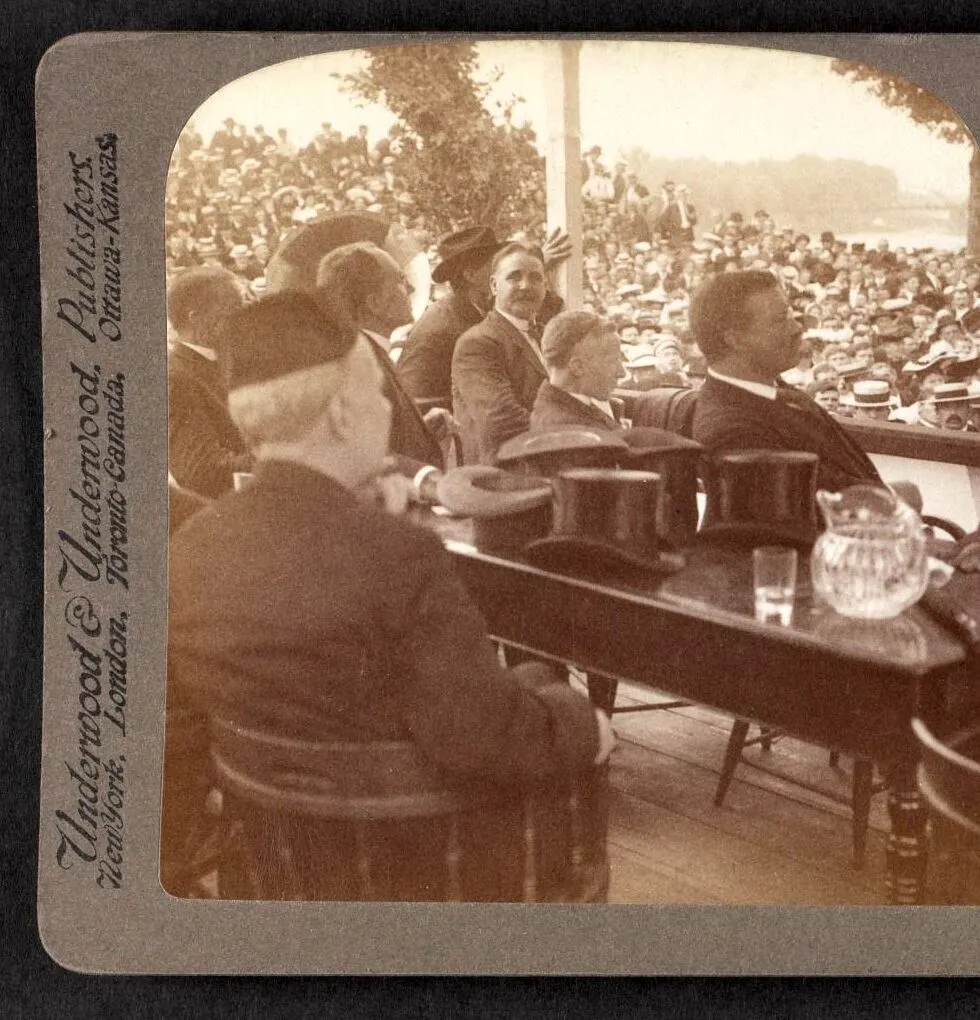
Roosevelt addresses a vast crowd of miners; his intervention in a private labor dispute set a precedent for federal power that reshaped the presidency. (Library of Congress)
The Precedent and Its Constitutional Implications
The coal strike of 1902 became the defining moment of Roosevelt's labor policy and established a constitutional precedent that would resonate throughout the twentieth century. It established that the federal government possessed broad authority to intervene in labor disputes when public interest was demonstrably threatened. It signaled that Roosevelt did not accept the capitalist orthodoxy that workers' only recourse was to starve or accept owners' terms. It announced, on a national stage, that the twentieth century would see fundamentally different labor relations than the nineteenth century had seen.
This was constitutionally unprecedented. Previous presidents had used federal troops to break strikes—to protect strike-breakers and to suppress strikers. But no previous president had positioned himself as an active arbiter between labor and capital, threatening to nationalize industry if owners refused to negotiate. Roosevelt was expanding executive power in ways that challenged fundamental assumptions about property rights and government's role in the economy.
The settlement itself was modest by some standards. The miners received a 10 percent wage increase—significant but not transformative. They received a reduction in hours worked. Most importantly, they received recognition that their grievances would be heard through union representatives, without requiring formal union recognition. The basic capitalist structure—private ownership of the mines—remained intact.
But the precedent was revolutionary: henceforth, the federal government would position itself as an active participant in major labor disputes, willing to intervene when public interest was threatened, unwilling to permit either capital or labor to impose suffering on the American people.
Public Support and Political Consequences
Critics from the business community denounced Roosevelt as a dangerous radical who was undermining property rights and encouraging labor radicalism. They feared that his threat of federal seizure set a precedent that would embolden future demands for government intervention in business. Critics from the labor movement complained that Roosevelt had not gone far enough—that he had imposed a settlement rather than permitting the miners to struggle for complete victory. They wanted unions to be able to demand whatever they wished without presidential constraint.
But the American public embraced Roosevelt's intervention enthusiastically. Public opinion was overwhelmingly supportive of his role in resolving the coal strike. Ordinary people—the families that would have frozen without coal, the children in schools without heat, the hospital patients in dark wards—understood that Roosevelt had protected them against a catastrophe that neither unconstrained business nor unconstrained labor would have prevented.
This public support was crucial to Roosevelt's political position. It told him that ordinary Americans wanted government to protect them against both greedy capitalists who refused to share profits with workers and radical labor movements that threatened to shut down entire industries for sectarian purposes. This conviction—that the federal government should serve as fair arbiter between competing interests, protecting the public interest above all—became a central pillar of his Square Deal philosophy.
Roosevelt was not proclaiming socialism. He was not demanding that the government seize the mines permanently or take control of industry. He was proclaiming that in modern industrial America, government neutrality was impossible and undesirable. The only honest course was for government to actively protect the public interest—a principle central to his Square Deal philosophy—even if that required threatening to seize private property.
The 1902 coal strike also revealed Roosevelt's political acumen at its highest level. By credibly threatening federal seizure, he forced the owners to negotiate—something they had refused to do. By brokering a settlement that gave the miners real gains while preserving the basic capitalist structure, he avoided both the charge that he favored radical seizure of property and the charge that he was merely a tool of business interests. He occupied the middle ground, claiming to represent the American people as a whole rather than any faction.
Continue Reading
- The Square Deal — Roosevelt's philosophy of fairness between capital and labor
- Trust-Busting — Challenging monopolies and corporate excess
- Executive Power — Roosevelt's stewardship theory and presidential authority
- The Bully Pulpit — Using presidential communication to shape public opinion
- The Election of 1904 — Roosevelt's mandate to continue his reform agenda
Primary Sources at the TR Center
Explore documents and correspondence related to the coal strike in the Theodore Roosevelt Center Digital Library.
- John Mitchell Encyclopedia Entry — Union leader during the 1902 coal strike
- Politics and Government Encyclopedia — Essays on Roosevelt's labor policy and arbitration approach
- Roosevelt Biography — Comprehensive information on his presidency and reform initiatives
- Roosevelt's Writings — Speeches and articles about his labor policy
From the Archives
Explore original photographs, documents, and illustrations related to this topic in the Theodore Roosevelt Center Digital Library.
Recommended Reading
- “The Anthracite Strike of 1902: A Record of Confusion” by Robert H. Wiebe, Mississippi Valley Historical Review (1961)
- Theodore Roosevelt and Labor in New York State, 1898–1900 by G. Wallace Chessman (1957)
- Labor in America: A History by Foster Rhea Dulles and Melvyn Dubofsky (1984). ISBN: 978-0882750827
- Theodore Roosevelt: A Life by Nathan Miller (2011). ISBN: 978-0061340382