
The Buffalo Soldiers at San Juan Hill: Unsung Heroes of American Victory
Who Were the Buffalo Soldiers?
The 9th and 10th Cavalry regiments were regiments of Black enlisted men commanded, in 1898, almost entirely by white officers — the Army then permitted almost no Black commissioned officers, a fact that is itself part of the story. The regiments were originally created after the Civil War, composed of Black soldiers who had fought in that war or who had joined the Army afterward. The Black regulars who fought in Cuba also included two infantry regiments, the 24th and 25th; the 24th Infantry took part in the assault on the San Juan blockhouse itself. By 1898, the Buffalo Soldiers were highly professional military units. Many of them had spent decades in service, much of it fighting in the Indian Wars on the frontier. They had extensive combat experience. They understood cavalry tactics. They were expert marksmen. They were tough, disciplined soldiers who had proven themselves through years of military service.
The nickname "Buffalo Soldiers" came from Native Americans, who had given the name to Black cavalry units fighting in the Indian Wars. The exact origin of the name is debated, but it became the accepted designation for the Black cavalry regiments. By the Spanish-American War, the Buffalo Soldiers had established a reputation for military effectiveness and personal bravery. They were respected by the men who served with them and by military commanders who had worked with them in previous campaigns.

Troopers of the 10th Cavalry, one of the Army's four Black regular regiments known as Buffalo Soldiers, on drill in 1898 before deploying to Cuba. (Theodore Roosevelt Collection, Harvard College Library)

Black infantrymen of the 24th or 25th Infantry advance through the brush in Cuba in 1898, during the campaign that carried the San Juan heights. (Theodore Roosevelt Collection, Harvard College Library)
At the Battle: Courage Under Fire
When the fighting erupted at San Juan Hill on July 1, 1898, the Buffalo Soldiers demonstrated the same courage and discipline that had characterized their service throughout their military careers. The 9th and 10th Cavalry regiments were involved in the assault on Kettle Hill. They fought under Spanish artillery and rifle fire. They advanced against fortified positions. They suffered casualties, just as the Rough Riders did. But they maintained discipline and continued the advance.
The fighting was intense and chaotic. Officers were killed or wounded. Enlisted men fell to Spanish fire. But the Buffalo Soldiers, like the Rough Riders and other American units present, pressed forward. Their discipline and training enabled them to continue operating effectively even under heavy fire. Their marksmanship was excellent—Spanish forces knew they were facing experienced soldiers. The Buffalo Soldiers' role was crucial to the American success at Kettle Hill and San Juan Hill. Without them, the American forces might not have prevailed against Spanish resistance.
"Our men behaved very well indeed — white regulars, colored regulars, and Rough Riders alike."
— Theodore Roosevelt, The Rough Riders (1899). In the same book he recorded that on the right of Kettle Hill, Captains Taylor and McBlain "and their men of the Ninth were first up."
Theodore Roosevelt's Initial Acknowledgment
In the immediate aftermath of the battle, Theodore Roosevelt acknowledged the role of the Buffalo Soldiers. He had fought alongside them. He knew that their courage had been essential to the American victory. In his initial reports and in communications with his superiors, Roosevelt praised the Black cavalry units. He noted their discipline, their effectiveness in combat, and their personal bravery. For a brief moment in history, the contribution of the Buffalo Soldiers was recognized and honored by one of the most prominent American officers present at the battle.

A mounted cavalry troop, from either the 9th or 10th Cavalry, formed up in 1898. These Buffalo Soldier regiments fought beside the Rough Riders in Cuba. (Theodore Roosevelt Collection, Harvard College Library)

A soldier of the 25th Infantry, Company A, in a studio portrait. The four Black regular regiments served with distinction even as they faced unequal recognition. (Library of Congress, Prints and Photographs Division)
The Contradiction: Roosevelt's Later Disparagement
But something changed as Roosevelt reflected on his combat experience. In his book The Rough Riders, published in 1899, Roosevelt included disparaging remarks about the performance of Black soldiers in combat. He suggested that Black troops were less reliable than white troops, that they panicked more easily under fire, that their combat effectiveness was limited by their race. These comments contradicted what he had witnessed and what he had reported immediately after the battle. The contradiction is difficult to explain. Some historians suggest that Roosevelt's views on race evolved in a negative direction in the years after the war. Others note that political and social pressures may have influenced Roosevelt to align his public statements with the racial attitudes that were dominant in America at the time.
This contradiction—initial praise followed by later disparagement—became one of the most troubling aspects of Roosevelt's legacy. He had witnessed the Buffalo Soldiers' courage. He had fought beside them. Yet his later accounts undermined their accomplishments. The effect was to minimize the role of Black soldiers in American victory and to suggest that American success was primarily the result of white soldiers' efforts. This was historically inaccurate. The Buffalo Soldiers had played an essential role in the American victory at San Juan Hill. Their courage and professional competence were beyond question.
The Brownsville Incident and Its Aftermath
Years later, in 1906, when Roosevelt was President, his relationship with the Buffalo Soldiers took a dramatic and tragic turn. In Brownsville, Texas, there was an incident involving African American soldiers of the 25th Infantry Regiment (another Black unit) and the white civilian population of the town. There was a disturbance, gunfire was fired, and a white civilian was killed. Roosevelt, responding to pressure from Southern political figures, ordered the discharge "without honor" of three companies of the 25th Infantry—167 soldiers—without individual courts-martial or specific evidence of their guilt. It was a mass punishment of innocent men based on their race.
The Brownsville incident became notorious. Civil rights activists and supporters of the African American community protested the discharges. The incident poisoned Roosevelt's relationship with Black Americans. It suggested that Roosevelt's acknowledgment of the Buffalo Soldiers' courage at San Juan Hill, while genuine, had not translated into a genuine commitment to racial justice. When forced to choose between supporting African American soldiers and appeasing Southern white politicians, Roosevelt had chosen politics over principle. The discharges were not reversed during Roosevelt’s lifetime or immediately after his presidency. Not until 1972 did the Army finally reverse the Brownsville discharges and change the men’s records to honorable — vindication that came too late for all but the last surviving soldiers.
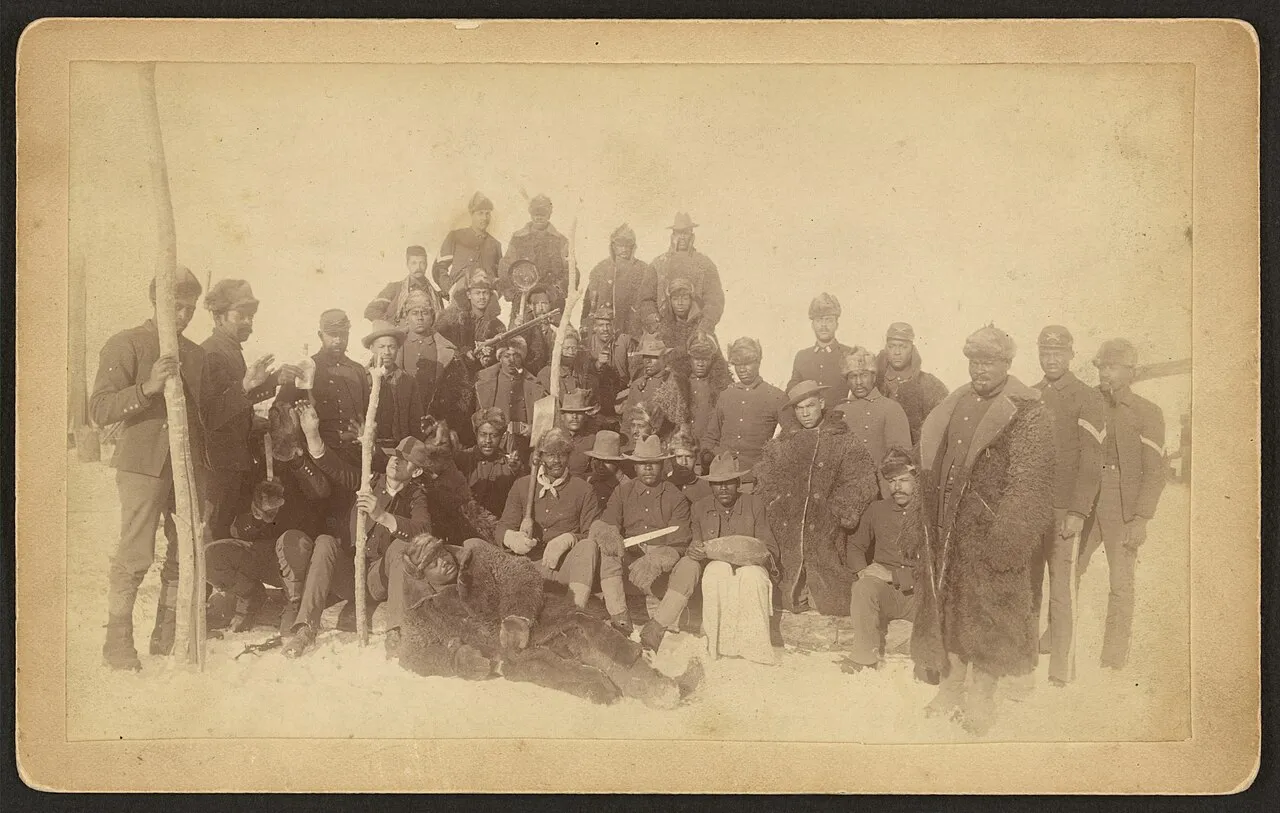
Buffalo Soldiers of the 25th Infantry at Fort Keogh, Montana, some in buffalo robes. Three companies of the 25th were unjustly discharged after the 1906 Brownsville affair. (Library of Congress, Prints and Photographs Division)

Sergeant Major Edward L. Baker Jr. of the 10th Cavalry received the Medal of Honor for valor at Santiago de Cuba on July 1, 1898. (U.S. Army, public domain)
Historical Recognition and Delayed Justice
In recent years, historians have worked to restore the Buffalo Soldiers to their proper place in the history of the Spanish-American War. Monuments have been erected. Books have been published. The 9th and 10th Cavalry regiments are now recognized as essential to American victory at San Juan Hill. The contributions of individual Buffalo Soldiers are being documented and preserved. It is now understood that the popular narrative of "Theodore Roosevelt's victory at San Juan Hill"—a narrative that credits Roosevelt and the Rough Riders almost exclusively—is incomplete. A full accounting of the battle must include the role of the Buffalo Soldiers.
The story of the Buffalo Soldiers at San Juan Hill is a story with multiple layers. It is a story of professional soldiers demonstrating courage under fire. It is a story of racial discrimination and the complicated relationship between military service and racial justice in America. It is a story of how historical narratives can be shaped to minimize the contributions of some groups and magnify the contributions of others. It is a story that reminds us that the American past is more complex than the simple narratives often taught to schoolchildren. The Buffalo Soldiers were there. They fought with courage. They died and were wounded. They helped win the battle. And for many years, they were forgotten or minimized in the popular memory. Reclaiming their story is an act of historical justice.
The Debt We Owe
Theodore Roosevelt's famous "crowded hour" at San Juan Hill was made possible partly by the discipline and courage of the Buffalo Soldiers who fought beside him. American victory on those hills was not the sole achievement of Roosevelt and the Rough Riders, but the combined achievement of multiple military units, including the Black cavalry regiments. To tell the story of San Juan Hill without acknowledging the role of the Buffalo Soldiers is to tell an incomplete story. To honor Roosevelt's courage while ignoring the Buffalo Soldiers' courage is to commit an injustice. The American military tradition includes the valor of the Buffalo Soldiers, and that tradition demands that we remember their contributions and honor their service.
Continue Reading
- The Battle of San Juan Hill—The pivotal battle where Buffalo Soldiers served with distinction
- The Rough Riders—Roosevelt's volunteer cavalry unit at San Juan Hill
- The Spanish-American War—The conflict where the Buffalo Soldiers served
- Race Relations During the Presidency—Roosevelt's complicated legacy on racial issues
- Rise to Power Overview—Roosevelt's path to the presidency
- Rise to Power Timeline—Key events in Roosevelt's military career
Primary Sources at the TR Center
The Theodore Roosevelt Center's digital library contains primary sources related to the Buffalo Soldiers and the Spanish-American War.
- Spanish-American War timeline—A detailed chronology of the war and battles
- Rough Riders at San Juan Hill photo—Historic image from the battle
- The Rough Riders book—Roosevelt's memoir of the campaign
- Racism subject page—Overview of Roosevelt's racial attitudes
From the Archives
Explore original photographs, documents, and illustrations related to this topic in the Theodore Roosevelt Center Digital Library.
Recommended Reading
- The Buffalo Soldiers by William H. Leckie (1967)
- The Crowded Hour: Theodore Roosevelt, the Rough Riders, and Lessons of Leadership by Clay Risen (2019). ISBN: 978-0-385-54582-3
- The Rise of Theodore Roosevelt by Edmund Morris (1979). ISBN: 978-0-307-77782-9