
How Theodore and Franklin Roosevelt Were Related
The Roosevelt Family Branches
The Roosevelt family had split into two main branches centuries earlier. The two lines descended from the sons of Nicholas Roosevelt, who died in 1742: the Oyster Bay branch, descended from Johannes Roosevelt, produced Theodore Roosevelt, while the Hyde Park branch, descended from Jacobus ("James") Roosevelt, produced Franklin Delano Roosevelt.
Theodore Roosevelt (1858–1919) grew up on the East Side of Manhattan and was descended directly from Theodore Roosevelt Sr., the philanthropist and "Muscular Christian" who so profoundly shaped young Theodore's character.
Franklin Delano Roosevelt (1882–1945) grew up in Hyde Park, a village in the Hudson Valley, in a more remote, old-money way. FDR's family had been wealthy longer than Theodore's, but with a different temperament—quieter, more inclined toward privacy and tradition than toward the vigorous public engagement that characterized Theodore's branch.

Theodore Roosevelt with his wife Edith and their children at Oyster Bay, the heart of the family’s senior branch, around 1907 (Pach Brothers, Library of Congress).

Theodore Roosevelt, the elder of the two Roosevelt presidents and Franklin’s fifth cousin, in an official portrait, 1904 (Pach Brothers, Library of Congress).
The Fifth Cousin Connection
The genealogical relationship between Theodore and FDR was distant: they were fifth cousins, sharing a common ancestor, Nicholas Roosevelt, six generations back. This made them relations, certainly, but not of the immediate family—not siblings, not parents and children, not even first cousins.
Yet in the context of turn-of-the-century American society, especially among the Eastern Establishment, this was a meaningful connection. It meant shared background, shared social circles, shared understanding of what aristocracy and privilege entailed.
Eleanor Roosevelt: The Bridge Between the Branches
What made Theodore and Franklin genuinely family was the marriage of Franklin Delano Roosevelt to Eleanor Roosevelt, Theodore's niece.
Eleanor Roosevelt was born in 1884, the daughter of Elliott Roosevelt, Theodore's younger brother. Elliott had been brilliant, athletic, and promising in youth—but he had descended into alcoholism and personal tragedy. Eleanor's mother, Anna, had died in 1892, and Elliott had died in 1894 when Eleanor was just nine years old, leaving her largely orphaned and living with relatives.
Theodore took a protective interest in Eleanor. She was his niece, but she was also a girl who had lost her father to the same weaknesses that had threatened Theodore's brother. Theodore wanted to see her secure, happy, and married well.

Eleanor Roosevelt, Theodore’s niece and Franklin’s wife, was the family link between the Oyster Bay and Hyde Park branches (Underwood & Underwood, Library of Congress).

Eleanor Roosevelt in her wedding gown, 1905; President Theodore Roosevelt gave the bride away at her March 17, 1905 marriage to Franklin (Pach Brothers, U.S. National Archives).
The Wedding: March 17, 1905
When Eleanor Roosevelt engaged herself to marry her fifth cousin Franklin Delano Roosevelt, Theodore Roosevelt was delighted. Here was Eleanor, marrying a man of good family and good prospects, a man who was connected to the Oyster Bay branch through her own family history. The marriage would link the two Roosevelt branches, weaving them together through the marriage bond.
On March 17, 1905, Eleanor and Franklin were married at 6 East 76th Street in New York. And who gave the bride away? Theodore Roosevelt himself, the President of the United States, used his position as the closest male relative of standing to walk Eleanor down the aisle and give her to her husband.
It was a symbolic act of tremendous importance. The President of the United States, presiding over the union of the Hyde Park and Oyster Bay branches, represented the unity and continuity of the Roosevelt name and the Roosevelt dynasty.
The Oyster Bay vs. Hyde Park Divide
But even as Theodore blessed the marriage, there were tensions between the two branches. The Oyster Bay Roosevelts were Republican, progressive in the Theodore Roosevelt sense, engaged in public life, and vigorous in their approach to politics and society. The Hyde Park Roosevelts were more traditionally conservative in some ways, more inclined toward privacy, though they too had a sense of public duty.
Franklin, marrying Eleanor, was joining himself to the Oyster Bay branch through his wife while remaining rooted in the Hyde Park tradition. The marriage would prove consequential—Franklin would become President twenty-eight years later, in 1933, and would lead the nation through the Great Depression and World War II.

Franklin Roosevelt sailing at Campobello, the summer retreat of the family’s Hyde Park branch, around 1900 (FDR Presidential Library, U.S. National Archives).
The Broader Family Dynamics
The relationship between Theodore and Franklin was cordial but not close. Theodore was 24 years older than Franklin and represented a different generation and a different political philosophy. When Franklin entered politics as a Democrat in 1910, Theodore—then a Republican and former president—viewed the younger man with some skepticism.
But the family tie remained. Eleanor was Theodore's niece. Franklin had married into the Oyster Bay branch. The Roosevelts, scattered across New York State and Manhattan, remained a connected family network, bound by name, by property, by shared history, and by the understanding that they had responsibilities to the nation.
Two Presidents, One Dynasty
It remains remarkable that the United States had two presidents from such a closely connected family within 35 years: Theodore Roosevelt serving as President from 1901–1909, and his fifth cousin Franklin Delano Roosevelt serving from 1933–1945. Both men were shaped by their family background, by New York values, by a sense of noblesse oblige, and by a conviction that government should be an instrument of popular will and social reform.
Yet they came to political power through different means and with different philosophies. Theodore was a Republican, a Progressive, a reformer of business and a champion of conservation. Franklin was a Democrat who led the nation through economic and military crisis. Theodore rose to prominence through rapid advancement in New York politics and his military service; Franklin rose more slowly, through patronage connections and the support of established Democratic leaders. Theodore's presidency emphasized presidential power and reform from above; Franklin's presidency responded to the Great Depression and World War II with experimentation and crisis management.
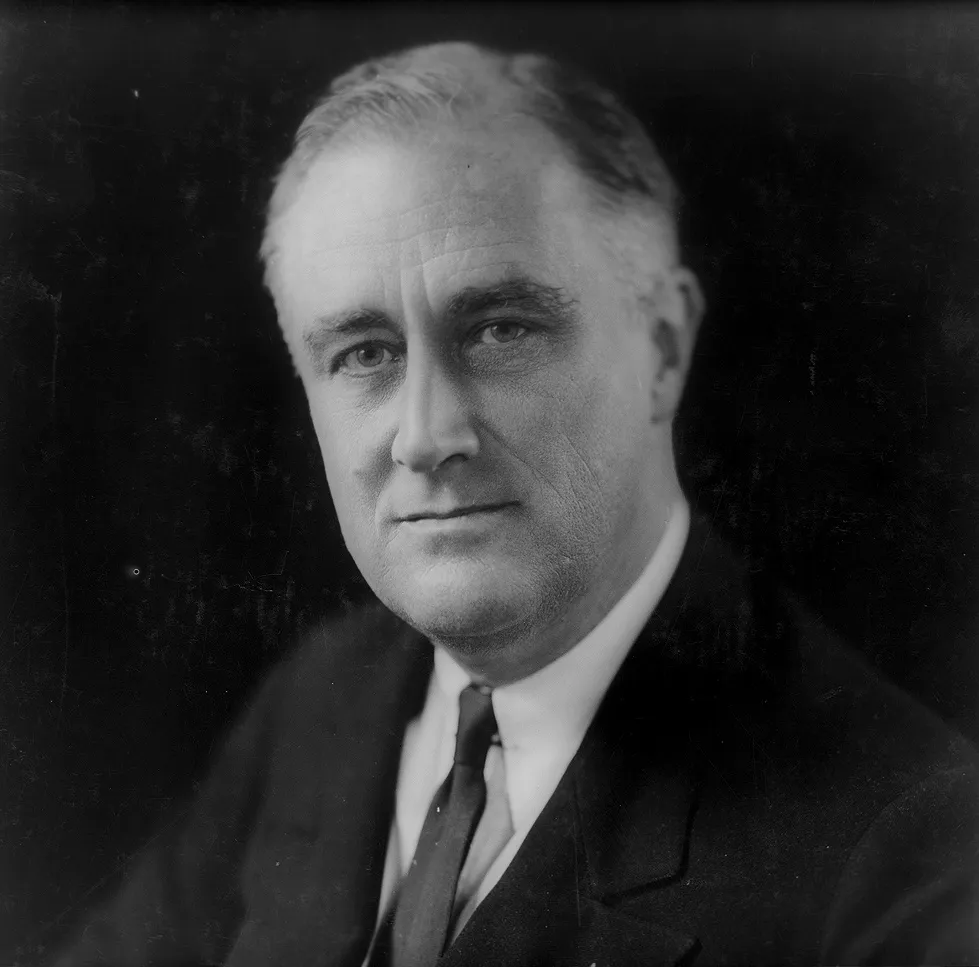
Franklin D. Roosevelt, the second Roosevelt to reach the White House, in a 1933 presidential portrait (Elias Goldensky, Library of Congress).
TR and FDR: The Wedding and a Generational Transfer
That March day in 1905 when Theodore gave Eleanor away was a symbolic moment of family continuity and generational succession. Theodore Roosevelt, at the height of his presidential power, was presiding over the marriage that would unite the two major Roosevelt branches. Franklin, marrying into this connection and gaining Eleanor as his link to the Oyster Bay branch, was beginning his own ascent to power. Twenty-eight years later, Franklin would be President—having learned the lessons of politics, having cultivated the connections, having built the networks that would allow him to rise to the nation's highest office. Some historians suggest that Theodore saw in Franklin a younger version of himself—a man of vigor and ambition, though with different political convictions. Others suggest there was tension between the two—that the old president distrusted the younger man's Democratic leanings and his less aggressive approach to national policy.
Policy Parallels and Differences
Despite their different political parties and approaches, Theodore and Franklin shared surprising common ground in their actual governing philosophies. Both believed in the necessity of strong executive power to address national problems. Both believed in conservation and environmental protection. Both were willing to expand federal authority to address economic inequality and protect vulnerable populations. Franklin's New Deal drew inspiration from some of Theodore's Progressive policies, though Franklin adapted them to the different conditions of the Great Depression. Both men viewed government not as a force to be minimized but as a tool for national improvement. Both believed that private interests must be constrained when they conflicted with the common good. These philosophical similarities, despite the men's different parties and temperaments, suggest that the Roosevelt family had produced a coherent approach to governance—one that valued reform, executive power, and public service.

Franklin Roosevelt as Assistant Secretary of the Navy in 1913, holding the same post Theodore had occupied sixteen years earlier (Library of Congress).
How FDR Consciously Modeled His Presidency on TR's
Franklin Delano Roosevelt openly admired his distant cousin's presidency and consciously adopted some of TR's approaches and policies. Like Theodore, Franklin expanded the powers of the presidency to meet national crises. Like Theodore, Franklin pursued conservation policies and believed in the federal government's responsibility to protect natural resources for future generations. Like Theodore, Franklin viewed the wealthy and powerful as needing to be constrained through vigorous exercise of executive authority. Franklin's campaign against big business paralleled Theodore's trust-busting. Franklin's social security programs echoed Theodore's earlier calls for greater protection of working people. When Franklin faced the crisis of the Great Depression, he looked back to Theodore's response to industrial monopolies and corruption as a model for how a president could use federal power to address urgent national problems. Eleanor, his wife and Theodore's niece, served as a living connection between the two presidencies and could provide insight into her uncle's thinking and approach to governance.
The Political Rivalry and Family Divisions
Despite the family connections, there were real political divisions between the Oyster Bay and Hyde Park Roosevelts. When Franklin entered politics as a Democrat in 1910, Theodore—then an ex-president but still a powerful voice in Republican politics—was skeptical and disapproving. Theodore ran against the Republican incumbent, William Howard Taft, and the Democratic nominee, Woodrow Wilson, in 1912, and Franklin was aligned with Wilson, who won and whose administration he joined. The two men were on opposite sides of major political contests. Theodore's progressivism was channeled through the Republican Party (and the Progressive Party in 1912); Franklin's progressivism was expressed through the Democratic Party. Some of the family maintained that Theodore's vigorous leadership had been superior to Franklin's more cautious, experimental approach. Others argued that Franklin's pragmatism and flexibility were better suited to the conditions he faced. These family debates were not merely personal; they reflected genuine differences about how government should work and what approaches to reform were most effective.

Eleanor Roosevelt in 1933; her alliance with Franklin’s Hyde Park branch deepened tensions with her Oyster Bay relatives (Library of Congress).
The Roosevelt Legacy Continues
The Roosevelt name endured through both presidencies, and the family tree that linked them—through Eleanor's marriage to Franklin, through their shared ancestry, through the complicated bonds of kinship—represented something essential about the American establishment: it was not a rigid oligarchy, but a network of influential families bound together by marriage, shared values, and a sense of public service. The two Roosevelt presidencies, separated by twenty-four years but connected through family, represented a remarkable concentration of power and influence within a single extended family. Yet the family remained diverse in its politics, its temperament, and its approaches to governance. In this, the Roosevelts exemplified the American aristocratic ideal at its best: families of privilege using their position to shape the nation toward their vision of the good society, yet respecting the democratic process enough to contest with each other through electoral politics rather than through family machinations or oligarchic control.
Continue Reading
- The Roosevelt Family — The family dynamics and heritage that shaped both cousins
- Roosevelt's Six Children — Eleanor's cousins and their contributions to American life
- Homes and Historic Places — The estates and residences that sustained both presidencies
Primary Sources at the TR Center
Explore Roosevelt and FDR family letters and documents in the Theodore Roosevelt Center Digital Library.
- Roosevelt Family Genealogy and Correspondence — Letters between Theodore and Franklin, and between Theodore and Eleanor
- Two Presidents, One Dynasty — Scholarly essays comparing the presidencies of Theodore and Franklin Roosevelt
From the Archives
Explore original photographs, documents, and illustrations related to this topic in the Theodore Roosevelt Center Digital Library.
Recommended Reading
- The Roosevelts by Geoffrey C. Ward (2014). ISBN: 978-0-307-70023-0
- The Roosevelt Cousins by Linda Donn (2001). ISBN: 0-679-44637-0