
Did Roosevelt Like Being Called "Teddy"? What the Evidence Shows
The Common Assumption
Most people assume that Theodore Roosevelt enjoyed being called "Teddy." The association with the teddy bear—a beloved childhood toy that bears his nickname—suggests affection. The nickname appears friendly and approachable. It seems natural that a vigorous, energetic man would embrace a friendly, informal nickname. Yet the historical evidence suggests a different story. Roosevelt actually disliked being called "Teddy," though he could not prevent the public and press from using the nickname.
This misconception reveals something important about how we create narratives around historical figures. We make assumptions based on what seems natural or fitting, without checking original sources. In this case, the assumption is wrong.

Theodore Roosevelt addresses an immense crowd at the Alamo in San Antonio. The public embraced 'Teddy' as an affectionate nickname—an assumption of fondness the man himself did not share. (Library of Congress)

A formal portrait of Theodore Roosevelt. His family and closest friends called him 'Theodore' or 'T.R.'—never 'Teddy.' (Pach Brothers, Library of Congress)
What Roosevelt Preferred
Roosevelt's family and close friends called him by various names, but "Teddy" was not among them. His family used "Theodore"—"Thee" had been his father's nickname, while the boy Roosevelt was "Teedie." His close friends often called him "TR." The man himself was quite formal about his name, at least early in his life. As president, he was "President Roosevelt" or "Mr. President." In less formal contexts, he was "Theodore" or "TR."
Roosevelt was born "Theodore," and throughout his life, his full name was the one he preferred. The nickname "Teddy" came from the public, from the press, and eventually from popular culture. It was imposed upon him, not chosen by him.
The Origin of the "Teddy" Nickname
The nickname "Teddy" emerged gradually in public usage, particularly after the Mississippi bear incident of 1902. The cartoonist Clifford Berryman drew the incident with a small, appealing bear cub; the cartoon itself did not label the bear, but the public quickly attached Roosevelt's nickname to it, and the connection between Roosevelt and the bear was made. Eventually, the stuffed toy bear that Morris Michtom created was called "Teddy's Bear," shortened to "teddy bear." The public embraced the nickname.
By the time Roosevelt left the presidency, "Teddy" was widely used by newspapers, magazines, and ordinary people. It had become the colloquial, public name for the president. Yet the evidence suggests that Roosevelt himself was not pleased about it.

Clifford Berryman's 1902 cartoon 'Drawing the Line in Mississippi' linked Roosevelt to a bear cub after a Mississippi hunt and gave rise to the 'teddy bear.' (Clifford K. Berryman, Library of Congress)

President and Mrs. Roosevelt with their family in 1903. Those closest to him—including his wife Edith—called him 'Theodore,' not 'Teddy.' (Library of Congress)
Evidence of His Dislike
The primary evidence of Roosevelt's dislike for "Teddy" comes from his family and close associates. Those closest to him rarely used the nickname. His wife Edith called him "Theodore." His children called him "Father." His sister Bamie called him "Theodore." In private correspondence and family documents, he is consistently "Theodore," not "Teddy."
Additionally, Roosevelt occasionally expressed his distaste for the nickname in private. While he could not control public usage, he made clear in his circle that he preferred "Theodore." The nickname was something the public called him—and something he tolerated but did not choose.
The Teddy Bear Permission: Reluctant Acceptance
According to Michtom family tradition, Morris Michtom wrote to ask permission to call his toy bear "Teddy's Bear," and Roosevelt granted it with some amusement or resignation. No such letter has ever been found, so the story cannot be documented. He understood that he could not control the public's use of his name. The nickname was already widespread. Refusing to allow the toy to be called "Teddy's Bear" would not have stopped people from calling it that informally anyway. Roosevelt accepted the reality that the public had given him a nickname he did not choose.
This was not enthusiastic endorsement. It was pragmatic acceptance of what he could not prevent. Roosevelt's personality was such that he could laugh at things he did not like—this may have been the case with "Teddy." He understood the humor of a tough, vigorous hunter's name being attached to a soft, cuddly stuffed animal. But amusement at something is not the same as liking it.
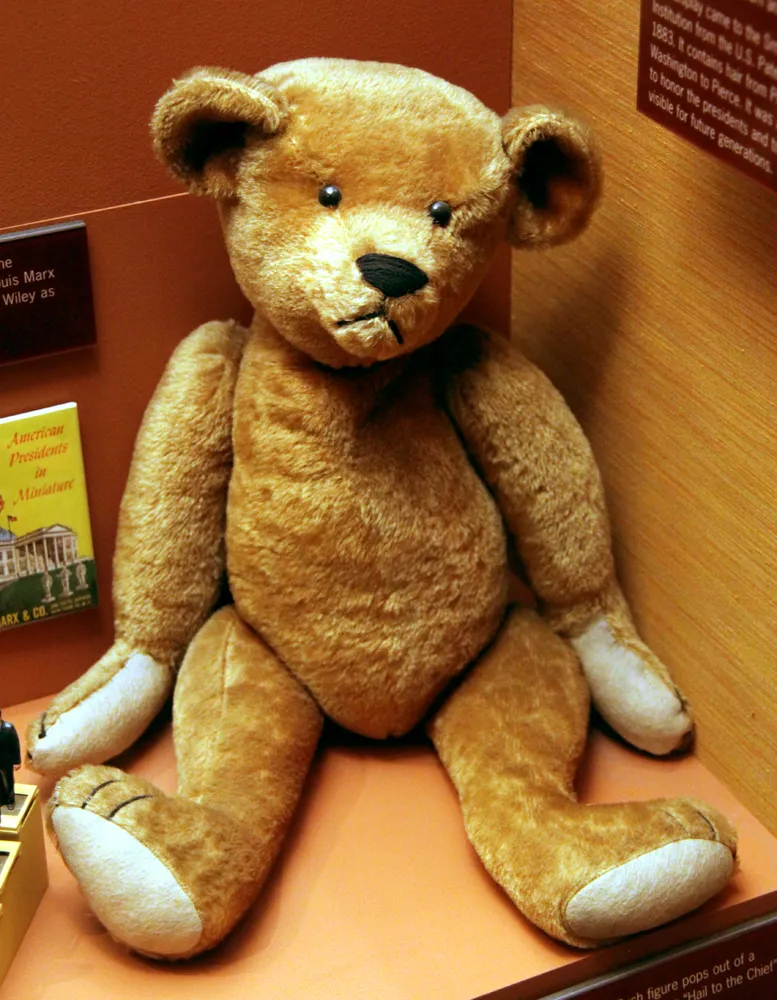
An original 1903 'Teddy Bear' at the Smithsonian. Roosevelt reluctantly allowed his name on the stuffed toy that would make the nickname permanent. (Smithsonian, via Wikimedia Commons, CC BY-SA 2.0)
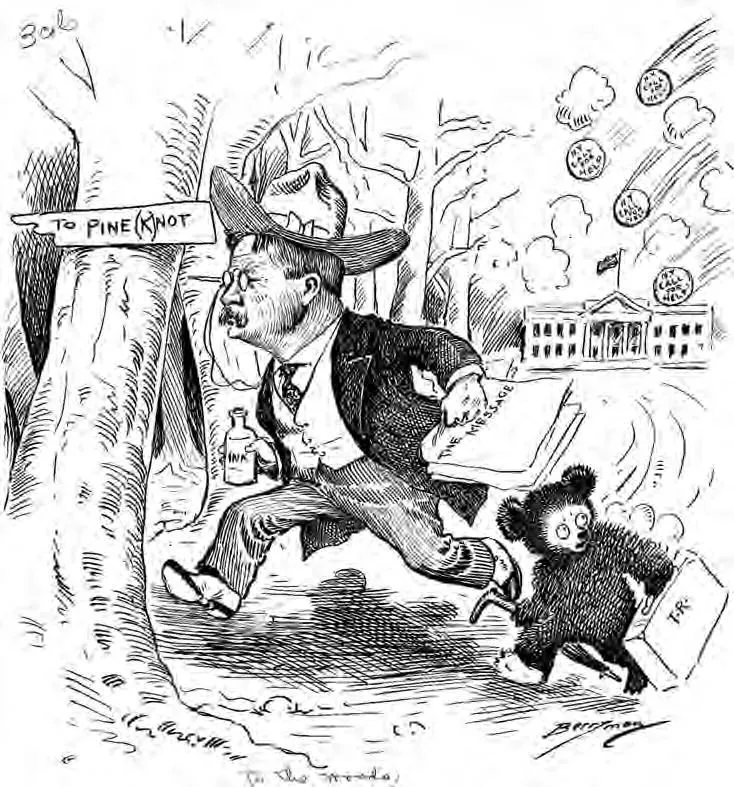
Berryman kept drawing his little 'Teddy Bear' character alongside Roosevelt for years, as in 'To the Woods!'—cementing the nickname in the public imagination. (Clifford K. Berryman, Library of Congress)
The Nickname's Persistence
Once "Teddy" entered popular usage, it could not be removed. Roosevelt himself, despite his preferences, could not undo what the public had created. After his death, "Teddy" became even more associated with him, partly through the teddy bear's continued popularity. Today, many people know him as "Teddy Roosevelt," despite the fact that he himself preferred "Theodore Roosevelt."
This illustrates an important point about fame and public image. A public figure does not entirely control his or her public image. The public creates its own narrative, its own language, and its own associations. Roosevelt was stuck with "Teddy" because that is what the public called him. He could only control his own usage within his family and close circle.
What This Reveals About Roosevelt
Roosevelt's dislike of "Teddy" reveals something about his personality. He was quite formal and proper in certain respects, despite his reputation for vigor and informality. He valued correct usage and proper address. He was not the completely casual, entirely informal figure that popular culture has made him. He had standards and preferences, and he maintained those standards within his circle while accepting the reality of public usage he could not control.
The "Teddy" misconception also reveals how we construct narratives about historical figures. We make assumptions, we rely on popular associations (teddy bear = Teddy = a friendly nickname), and we don't check original sources. The real Roosevelt—who disliked the nickname—is lost in favor of a simpler, more intuitive assumption. This is one example of how myths develop and persist even in the face of evidence to the contrary.

Theodore Roosevelt in a reflective 1902 portrait. The gap between the private man and his public image is a reminder to check original sources. (Library of Congress)
The Lesson: Check Your Sources
The next time you encounter a claim about a historical figure, consider checking the source. Did Roosevelt actually say that famous quote? Do we have original documentation? Was the incident as commonly described? Did the person actually believe what we assume they believed? Checking sources reveals the real history, which is often more interesting and complex than the myths.
For more about Roosevelt's life and beliefs, explore the Theodore Roosevelt Center's research collection.
Continue Reading
- Fun Facts — More on TR
- Myths & Legends — More on TR
Primary Sources at the TR Center
Explore original documents and resources related to this topic in the Theodore Roosevelt Center Digital Library.
- TR Center Digital Library — Primary source collection
From the Archives
Explore original photographs, documents, and illustrations related to this topic in the Theodore Roosevelt Center Digital Library.
- Centennial of the Teddy Bear — Article about Roosevelt and the teddy bear origin
- Parade of the teddy bears sheet music — Sheet music celebrating the teddy bear
Recommended Reading
- Theodore Roosevelt: A Strenuous Life by Kathleen Dalton (2007). ISBN: 978-0-307-42968-1
- Theodore Rex by Edmund Morris (2001). ISBN: 978-0-307-77781-2