
The 1884 Republican National Convention: When Ideals Meet Politics
Chicago, June 1884: A Young Delegate's Moral Stand
In June 1884, the Republican Party held its national convention in Chicago to nominate a presidential candidate. Theodore Roosevelt, at twenty-five years old, attended as a delegate representing New York, bringing with him the moral intensity and reformist zeal that had characterized his Assembly years. The question before the convention was straightforward but fraught with conflict: would the party nominate James G. Blaine of Maine, the front-runner, or would it select George F. Edmunds of Vermont, the reformer's choice? The stakes seemed high to the young idealists who had come to Chicago believing they might influence the party's direction toward reform and away from the corruption that had plagued Republican politics for nearly a quarter-century.
Blaine's record was tainted, at least in the eyes of reform-minded Republicans. For fifteen years he had been unable satisfactorily to explain certain improprieties during his time as Speaker of the House—a favorable ruling in behalf of a railroad whose bonds he had subsequently purchased. Rumors of deeper corruption, accusations of financial impropriety in Congress, suggestions of shadowy dealings with railroads—all of this haunted Blaine's candidacy. The reformers, who had fought to establish civil service reform and to end the patronage system that had enriched party machines for decades, saw in Blaine's nomination a betrayal of everything they stood for. They wanted Edmunds, a Vermont Senator who was honest, industrious, unambitious, and, most importantly, whose record was clean and whose commitment to reform was beyond question.
Roosevelt positioned himself firmly with the reformers at the convention. He was known as one of the rising stars of the New York reform movement. His Assembly record was impressive. His moral convictions seemed unshakeable. Many expected that when push came to shove, Roosevelt would bolt the party rather than support Blaine, joining the "Mugwumps"—reform Republicans who would ultimately support the Democratic candidate, Grover Cleveland, rather than endorse what they saw as Republican corruption. Few observers believed the young aristocrat from New York would compromise on principle when principle seemed so clearly at stake.

Theodore Roosevelt in 1884, the year the 25-year-old assemblyman served as a reform delegate to the Republican National Convention in Chicago. (Library of Congress)

Crowds turn out for arriving Republican delegates during the 1884 campaign, when the fight over the party’s nomination gripped national politics. (Wikimedia Commons)
Roosevelt's Historic Nomination Speech
The defining moment of the convention for Roosevelt came when the delegates gathered to elect a temporary chairman. The Republican National Committee had designated Powell Clayton, a flagrant Blaine supporter, to control the convention's proceedings. The reformers understood at once what this meant: without neutral guidance from the chair, Blaine's handlers would manipulate the convention machinery to secure his nomination. Working through the night, Roosevelt and his ally Henry Cabot Lodge built opposition among both their independent delegates and sympathetic Arthur supporters to defeat Clayton. In a moment of high drama, as the convention filled for its opening session on Tuesday morning, June 3 and the band played "My Country 'Tis of Thee," Lodge stood and in his grating voice announced: "I move you, Mr. Chairman, to substitute the name of the Hon. John R. Lynch, of Mississippi."
Then Roosevelt rose to speak—his first and only oratory of the entire convention. In a speech marked by obvious effort, his body visibly shaking with emotion, the twenty-five-year-old delegate rose to nominate John R. Lynch, an honorable African American Congressman from Mississippi, for the position. It was an extraordinary political statement at a time when such gestures were genuinely daring: here was a young white aristocrat from New York publicly nominating a black man for convention leadership, asserting through his actions that the Republican Party was the party of racial inclusion and reform. The speech, interrupted six times by applause, was praised as "neat and effective" and "blunt and manly."
The significance of Roosevelt's action extended beyond the moment. Lynch was elected by 424 votes to Clayton's 384—a narrow but dramatic victory. Roosevelt's nomination revealed his complex relationship with racial issues. He was, by the standards of his era, genuinely concerned with the rights and dignity of African Americans, viewing them as fellow citizens deserving of equal political participation and leadership. At the same time, his support for Lynch's nomination was also a strategic political move—a way of positioning himself as a reformer willing to challenge conventional racial attitudes and assert the reformers' commitment to the principles that had made the Republican Party the party of emancipation and equality.
The convention ultimately nominated James G. Blaine for the presidency on Friday, June 6, despite the reformers' exhausting efforts. For three days, Roosevelt had fought frantically from delegation to delegation, refusing to surrender hope even when Blaine's support became overwhelming. At one point, in desperation, he jumped into his chair and yelled for a roll call until his face turned red, shouting so forcefully that the entire hall reverberated with whistles and catcalls. When a New Jersey delegate told him to sit down and stop his noise, Roosevelt's temper cracked, and — as convention lore had it — he snapped back an unprintable retort. But the fourth ballot sealed Blaine's nomination. Roosevelt faced the moment of decision that would confront many reform Republicans: would he preserve the integrity of principle by bolting the party, or would he maintain party loyalty and attempt to influence the party from within?
The Candidates and the Ideological Battle
The real question at Chicago was between two Republican visions and two Americas. On one side was James G. Blaine of Maine, the front-runner and master politician, whose supporters filled Exposition Hall with adoration. Blaine had an inexplicable hold upon both party and public. The mere sight of his boozy, silver-bearded features in a train window was enough to make women weep with adoration and men vow they would never vote for any other Republican. His supporters arrived from the West and Pennsylvania full of whiskey and love for the "Plumed Knight," bearing bags of "boodle" to purchase uncommitted delegates. On the other side stood George F. Edmunds of Vermont, representing the reform wing of the party. Edmunds was honest, industrious, unambitious, and dull, but for these very reasons he appealed to Independent Republicans—the young, idealistic reformers who rejected both the Stalwart machine men and the Half-Breed corruptionists.
Vastly outnumbering both groups at the convention were the "Old Guard"—veteran party members who had voted for Lincoln and Grant, men who had prospered mightily under the spoils system for nearly a quarter-century of Republican power. They held the party so holy that some of them cast their delegate badges in gold. They looked askance at the Edmunds men, who not only refused to be bought but sanctimoniously shut up shop on Sunday morning, as if their morality required rest from politics. Independents were promptly accused of having more ice than blood in their blue Northeastern veins, and it became standard procedure for members of the Old Guard to turn up their coat collars and shiver ostentatiously whenever somebody like Henry Cabot Lodge walked by.
Edmunds' record was spotless; his commitment to reform was beyond question. He represented everything that idealistic reform Republicans believed the party should stand for. Blaine, by contrast, had been at the center of numerous financial controversies. The Mulligan Letters had revealed his involvement in dubious railroad dealings. His conduct as Secretary of State had been questioned. His personal financial ethics were under a cloud of suspicion that never fully lifted. Roosevelt and Lodge described him privately as "decidedly mottled"—an elegant formulation that captured both the criticism of his ethical record and the acknowledgment that he was not entirely corrupt. But to reformers, any moral compromise at all was too much. The choice between them was not merely a choice between two candidates; it was a choice about the party's soul and its commitment to the reform principles that had attracted young men like Roosevelt in the first place.

James G. Blaine of Maine, the powerful party favorite whose nomination Roosevelt and the reformers fought to block at the 1884 convention. (Library of Congress)

John R. Lynch of Mississippi, the formerly enslaved congressman whom Roosevelt helped elect temporary convention chairman in a reform victory. (Wikimedia Commons)
The Backroom Dealing and Party Politics
Behind the public debates about Blaine and Edmunds, there was a complex world of backroom dealing and political negotiation. Party bosses had largely committed themselves to Blaine before the convention began. The reform faction was mobilizing, hoping to create a coalition behind Edmunds that could stop Blaine on early ballots. Roosevelt was in the middle of these negotiations, representing New York reform Republicans and trying to influence the outcome. The question was not whether there would be negotiations and deals—that was inevitable in convention politics—but whether reforms principles would prevail in those negotiations. As Roosevelt circulated through the convention, he encountered senior party figures who were making it clear that party loyalty would be remembered and rewarded in future contests. Those who supported Blaine would advance within the party hierarchy; those who bolted would find themselves marginalized.

Senator George F. Edmunds of Vermont, the reform candidate Roosevelt and the anti-Blaine delegates championed at the 1884 convention. (Library of Congress)
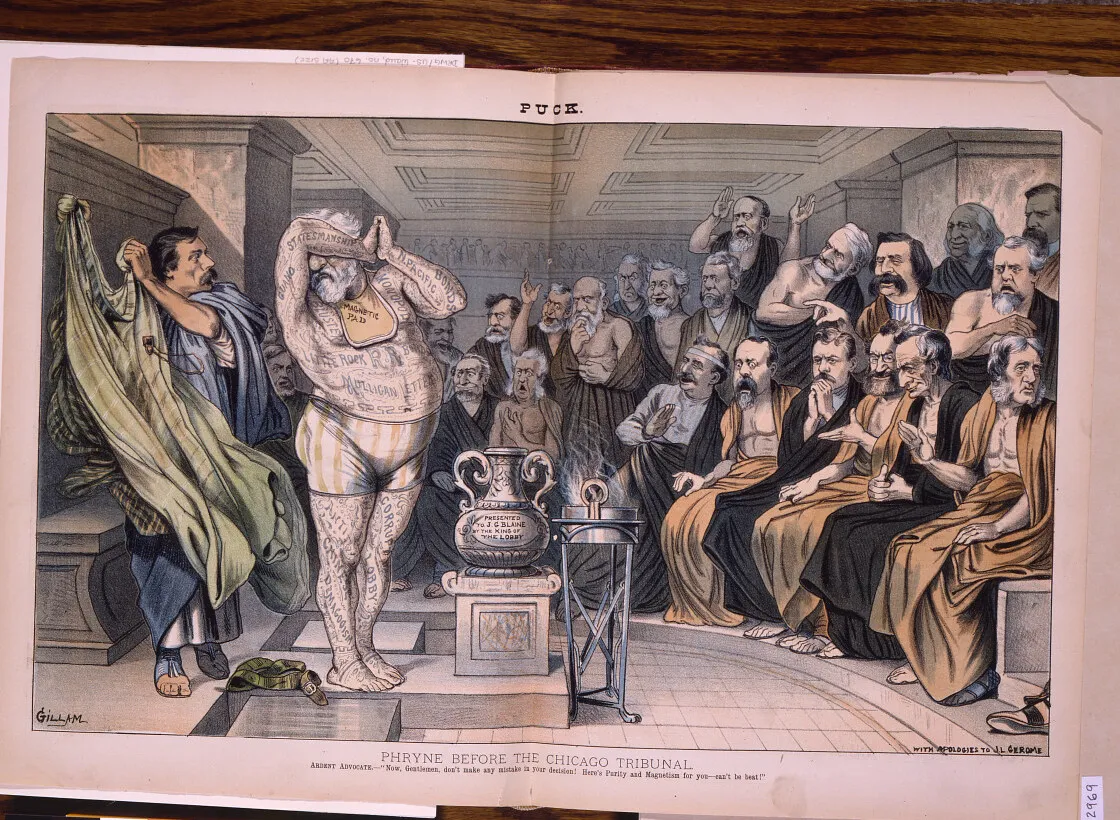
An 1884 Puck cartoon lampoons Blaine as a tattooed figure exposed before the party, capturing the era’s reform-versus-machine struggle. (Library of Congress)
The Pragmatic Choice: Party Loyalty Over Principle
Roosevelt faced a terrible dilemma. He remained in Chicago after Blaine's nomination, exhausted and wrought up, unable to sleep at midnight on the night of Blaine's triumph. In a moment of raw emotion, he told an Evening Post editor that rather than vote for Blaine, he would give "hearty support" to any decent Democrat. The remark revealed a man at the end of his tether, politically and physically, confronted with a choice that seemed to offer no acceptable option. If he bolted the party, he would join the "Mugwumps"—reform Republicans who would ultimately support Cleveland—but he would also marginalize himself within the Republican Party he hoped to shape. If he stayed with the party, he would be compromising his moral convictions on an issue he believed fundamental to the party's soul.
But Roosevelt chose party loyalty. At St. Paul, as he traveled west to Dakota, a reporter from the Pioneer Press confronted him with a single fateful word: "bolt." Some sixth sense warned Roosevelt that "bolt" was the most fatal word in American politics. "I shall bolt the Convention by no means," he replied carefully. "I have no personal objections to Blaine." Roosevelt understood, at twenty-five, something that many idealistic young reformers never quite grasp: that political effectiveness sometimes requires pragmatic compromise. This understanding came in part from his father, whose reputation as a moral man had not prevented him from pragmatic engagement with the political system. It came also from his years in the Assembly, where he had learned that the art of politics was negotiating among imperfect alternatives.
This decision was not made lightly. Roosevelt genuinely believed in reform. He genuinely opposed corruption. He genuinely believed that the Republican Party should nominate candidates whose records were clean. But he also understood that a young politician from New York who bolted his party over a single nomination would find himself isolated and ineffective. The Mugwumps who supported Cleveland would preserve their political integrity but would marginalize themselves within the Republican Party. Roosevelt wanted to remain within the party structure, to accumulate power, to eventually shape the party in the direction he wanted it to go. To do that, he needed the friendship and support of party leaders who controlled the mechanisms of advancement.
The calculation was pragmatic: by supporting Blaine, despite reservations, Roosevelt demonstrated party reliability—a credential that would be valuable in subsequent negotiations with party leadership. If he was to advance to positions of real power within the Republican Party, he needed to show that he could be trusted, that he understood party discipline, that he would not bolt over every disagreement. His strategic vision was long-term: lose this particular battle over the nominee, but position himself to win larger battles over the direction of the party in future years. Yet this choice cost him greatly. His decision to support Blaine enraged the reform press and his former allies. Old friends and intellectual leaders of Massachusetts society, men whose names he had grown up with—Adams, Quincy, Lowell, Saltonstall, Everett, and Eliot—turned away from him. Lodge confessed that supporting Blaine was "the bitterest thing I ever had to do in my life," and reform newspapers thunder that "no ranch or other hiding place in the world" could shelter a so-called Independent who voted for the likes of James G. Blaine.
Blaine's Defeat and the Mugwump Revolt
The election itself vindicated neither Blaine nor Cleveland in straightforward fashion. Blaine lost to Cleveland, though the margin was surprisingly close. The Mugwumps' decision to support Cleveland had proven consequential; without Mugwump defection, Blaine might have won. Roosevelt's pragmatic choice to support Blaine had not secured victory for the party, but it had established his credentials as a loyal party member. Some Mugwumps had scorned him for this compromise—they saw him as a young man who had sacrificed principle for political advancement. But Roosevelt had calculated correctly: his party loyalty, even when the party lost, would be remembered and would serve him well in subsequent contests for party leadership positions.
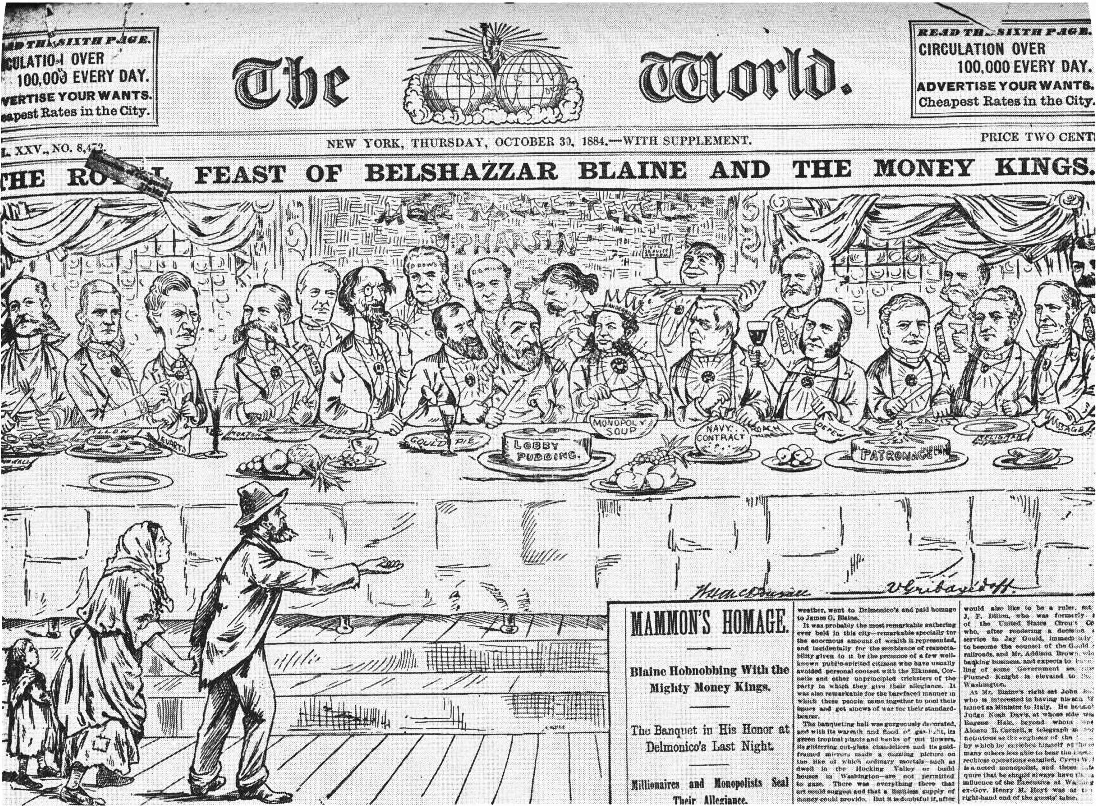
The famous “Royal Feast of Belshazzar Blaine and the Money Kings” cartoon, which helped fuel the Mugwump revolt against Blaine in 1884. (Wikimedia Commons)

A young Theodore Roosevelt in his college years; the 1884 convention marked his turn from pure idealism toward political pragmatism. (Library of Congress)
How the Convention Made Roosevelt a Pragmatist
The 1884 convention represented a turning point in Roosevelt's political development. He had entered it as an idealistic reformer willing to take principled stands, convinced that political virtue was compatible with political success. He emerged as a pragmatist who understood that in a democratic system, you needed power to accomplish reform. Reform from the margins was ineffective; reform from within institutions required compromise and the slow accumulation of allies. This was not a moral failing—it was political maturity.
In later years, Roosevelt's support of the "Plumed Knight" proved to be something of an embarrassment, even to himself. Nobody has ever satisfactorily reconciled his passionate antagonism to Blaine in May and June with his equally passionate partisanship in October and November. Yet in bowing to the will of the party, Roosevelt was acting as a complete political professional, thinking strategically about his long-term power rather than his immediate moral satisfaction. He genuinely believed, as he would write after the election, that "we have fought a good winning fight when our friends the Independents were backing us; and we have both of us, when circumstances turned them against us, fought the losing fight grimly out to the end." What mattered was not victory in a single convention fight, but the accumulation of power and influence over years and decades.
Roosevelt would later advocate powerfully for reform throughout his career, championing civil service, conservation, labor rights, and antitrust enforcement. But he would do so from positions of real power: as Governor of New York, as Vice President, as President. The convention had taught him that idealism without power was mere sentiment, while pragmatism grounded in principle could actually change institutions and policies over time. A great political truth, recognized by the best political theorists, is that you cannot reform a party from the outside; you must work within it, build coalitions, accumulate influence, and then push for change from positions of strength. This was the lesson of 1884.
Continue Reading
- The New York State Assembly (1882–1884) — Roosevelt's formative legislative experience that shaped his political philosophy.
- Alice Hathaway Lee Roosevelt — The personal tragedy that occurred during the year of the convention.
- The Double Tragedy: February 14, 1884 — The devastating loss that followed this political convention.
- Police Commissioner of New York — His next step in public service after the Assembly.
- Timeline: New York Politics Period — Detailed chronology of these turbulent years.
From the Archives
Explore original photographs, documents, and illustrations related to this topic in the Theodore Roosevelt Center Digital Library.
Recommended Reading
- The Rise of Theodore Roosevelt, Edmund Morris, 1979, ISBN 978-0812976205
- The Republic for Which It Stands: The United States During Reconstruction and the Gilded Age, 1865–1896, Richard White, 2017, ISBN 978-0190464869