
The New Nationalism (1910)
A Progressive Manifesto at Osawatomie
On August 31, 1910, former President Theodore Roosevelt traveled to Osawatomie, Kansas, to speak at a dedication ceremony for a memorial to John Brown, the abolitionist martyr of Bleeding Kansas. Roosevelt had left the presidency less than two years earlier, in March 1909. He had spent the intervening time traveling to Africa for a safari and hunting expedition, then touring Europe where he had been received by kings, emperors, and the intellectual elite of the continent. He had returned to America in June 1910, and almost immediately found himself drawn back into political controversy.
He was restless, intellectually alive, and increasingly critical of his successor William Howard Taft's conservative leadership. Taft had disappointed progressives by taking a more cautious approach to conservation, by being insufficiently aggressive in antitrust enforcement, and by failing to embrace the progressive vision that Roosevelt believed was essential to American democracy. The more Roosevelt saw of Taft's presidency, the more convinced he became that the man who had been his chosen successor had betrayed the progressive cause.
The Osawatomie speech was ostensibly about John Brown and the fight against slavery. But Roosevelt seized the occasion to deliver something larger: a comprehensive statement of progressive political philosophy. The speech was not intended as a full political program—yet it became one, revealing the intellectual foundations of Roosevelt's return to politics and his 1912 campaign as a Progressive. The crowd of approximately 30,000 people who gathered to hear Roosevelt speak seemed to understand that something significant was occurring. The former president was marking his return to the political arena and was articulating a vision that would shape American politics for decades to come.

Kansas Governor Walter Stubbs (center) leads the reception welcoming Theodore Roosevelt to Osawatomie, where TR delivered his New Nationalism address on August 31, 1910 (Theodore Roosevelt Collection, Harvard College Library).

Roosevelt in full oratorical stride on his 1910 tour; at Osawatomie he invoked the memory of abolitionist John Brown to argue that human welfare must stand above property rights (Theodore Roosevelt Collection, Harvard College Library).
John Brown and the Moral Imperatives of Reform
The choice of Osawatomie was symbolically charged with meaning. John Brown had fought in Kansas in the 1850s to prevent the spread of slavery into new territories. He had killed pro-slavery settlers. He had been tried for treason and executed. Yet many progressives and reformers saw Brown not as a terrorist but as a martyr—a man who had understood that some moral causes transcended ordinary law, that the fight against injustice sometimes required sacrifice and even violence.
Roosevelt was drawing a parallel between Brown's fight against slavery and the progressive fight against monopoly, inequality, and corruption. If Brown's cause was righteous—and Roosevelt believed it was—then surely the cause of progressive reform was equally righteous. The language was subtle but unmistakable: the fight for social justice was a moral imperative as fundamental as the fight against slavery.
The Intellectual Framework: Herbert Croly and Progressive Thought
Roosevelt had been deeply influenced by Herbert Croly's book "The Promise of American Life," published in 1909. Croly was a political theorist and editor of The Architectural Record who had become increasingly concerned with the direction of American democracy. He argued that American democracy had become dominated by special interests and corrupt political machines, that the promise of America—the belief that the nation offered opportunity and justice to ordinary citizens—had been betrayed by wealthy elites and corporate monopolies. The nation needed federal power—stronger federal power—to protect ordinary citizens from exploitation by big business and to restore the promise of America.
Croly's vision was not socialist in the European sense. He was not calling for the abolition of private property or capitalism. Rather, he was arguing for a more active federal government that would regulate and control capital in the interests of the public good. Roosevelt absorbed these ideas enthusiastically and recognized in them a philosophical justification for the expansion of executive and federal power that he believed necessary.
The Osawatomie speech outlined a vision of government activism that went far beyond the Square Deal he had promoted as president. During his presidency, Roosevelt had emphasized fairness and justice in the relationships between capital and labor, between government and business. Now, in 1910, he was calling for something more ambitious: progressive taxation (including an income tax), workers' compensation laws, strong protection of labor rights, aggressive regulation of big business, conservation of natural resources under federal control, and a more democratic political system. These were radical ideas for 1910—and they were explicitly labeled as "New Nationalism" to distinguish them from the old laissez-faire conservatism that had dominated Republican thinking for decades.

As a writer and editor at The Outlook after leaving the White House, Roosevelt absorbed the progressive ideas of thinkers like Herbert Croly that gave the New Nationalism its intellectual framework (Library of Congress).
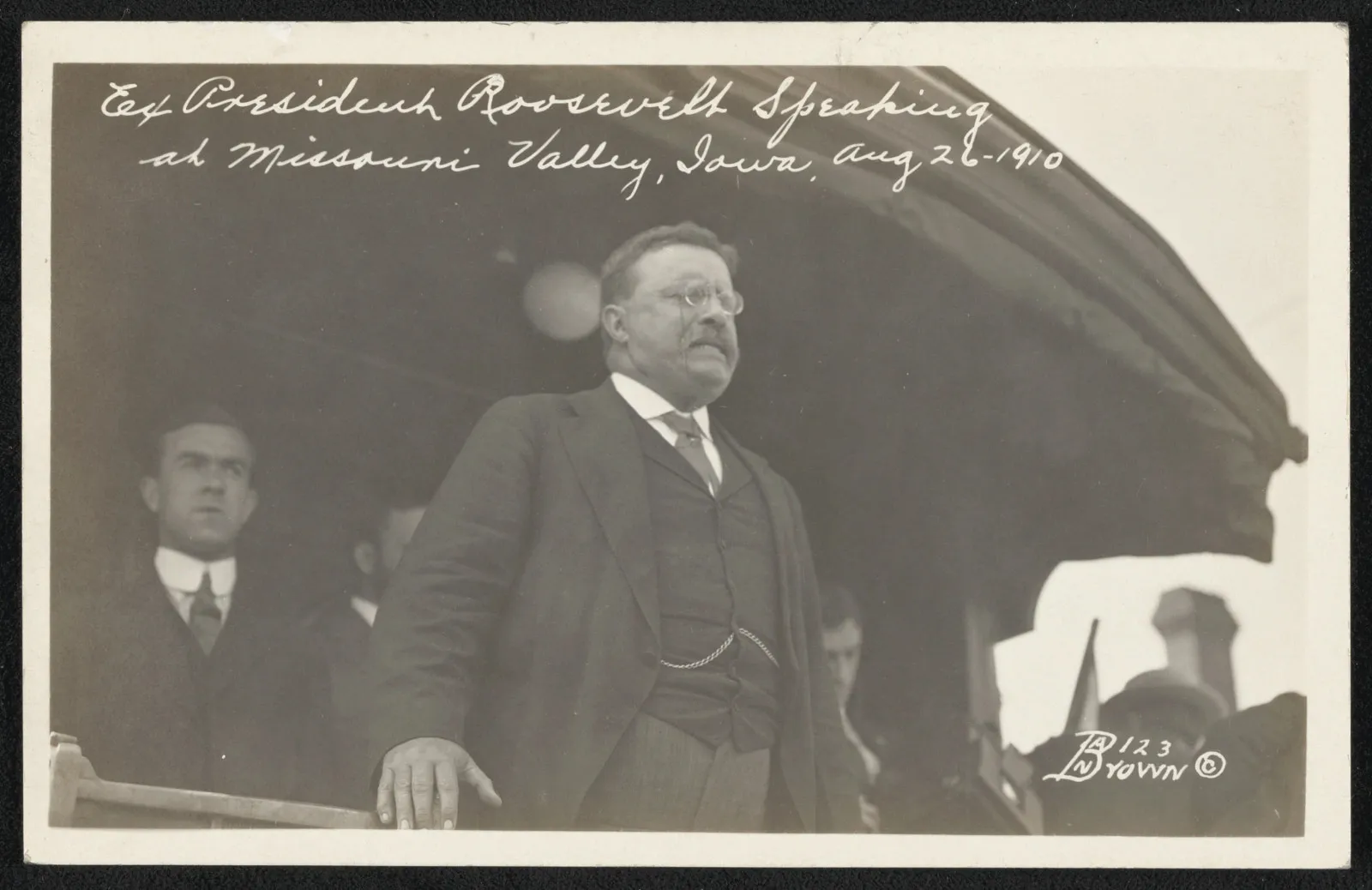
Roosevelt addresses a crowd at Missouri Valley, Iowa, in August 1910, carrying his central message that the national interest must come before private privilege (Library of Congress).
The Core Vision: The National Interest Over Private Privilege
Roosevelt's central argument was direct: the interests of the nation as a whole must supersede the private interests of wealthy individuals and corporations. He believed in property rights—but property rights existed within a framework of national welfare. Factories, mines, railroads, and financial institutions were too important to be left entirely to private owners. The federal government had both the right and the duty to regulate them in the public interest.
"The New Nationalism puts the national need before sectional or personal advantage. It is impatient of the utter confusion that results from local legislatures attempting to treat national issues as local issues."
— "The New Nationalism," Osawatomie, Kansas, August 31, 1910
This was heresy to conservatives and to proponents of states' rights. But Roosevelt was convinced that the modern industrial state required national solutions. Piecemeal regulation by individual states was insufficient and ineffective. Only federal power—wielded by an executive willing to challenge special interests—could protect workers, preserve natural resources, and ensure fair competition.
Labor, Wages, and Social Reform
Roosevelt spoke forcefully about the condition of American workers. He advocated for a minimum wage, reasonable working hours, safe conditions, and the right of workers to organize. He called for workmen's compensation—the idea that if a man was injured while working for a corporation, that corporation had a responsibility to compensate him. These ideas were considered dangerously radical by business interests. Yet Roosevelt presented them as practical necessities. Modern capitalism, he argued, had created dependencies that required new protections.
He was not anti-business. He wanted business to flourish. But he believed that business could not be allowed to exploit workers, degrade the environment, or corrupt the political system. Regulation was not punishment but a precondition for healthy capitalism.
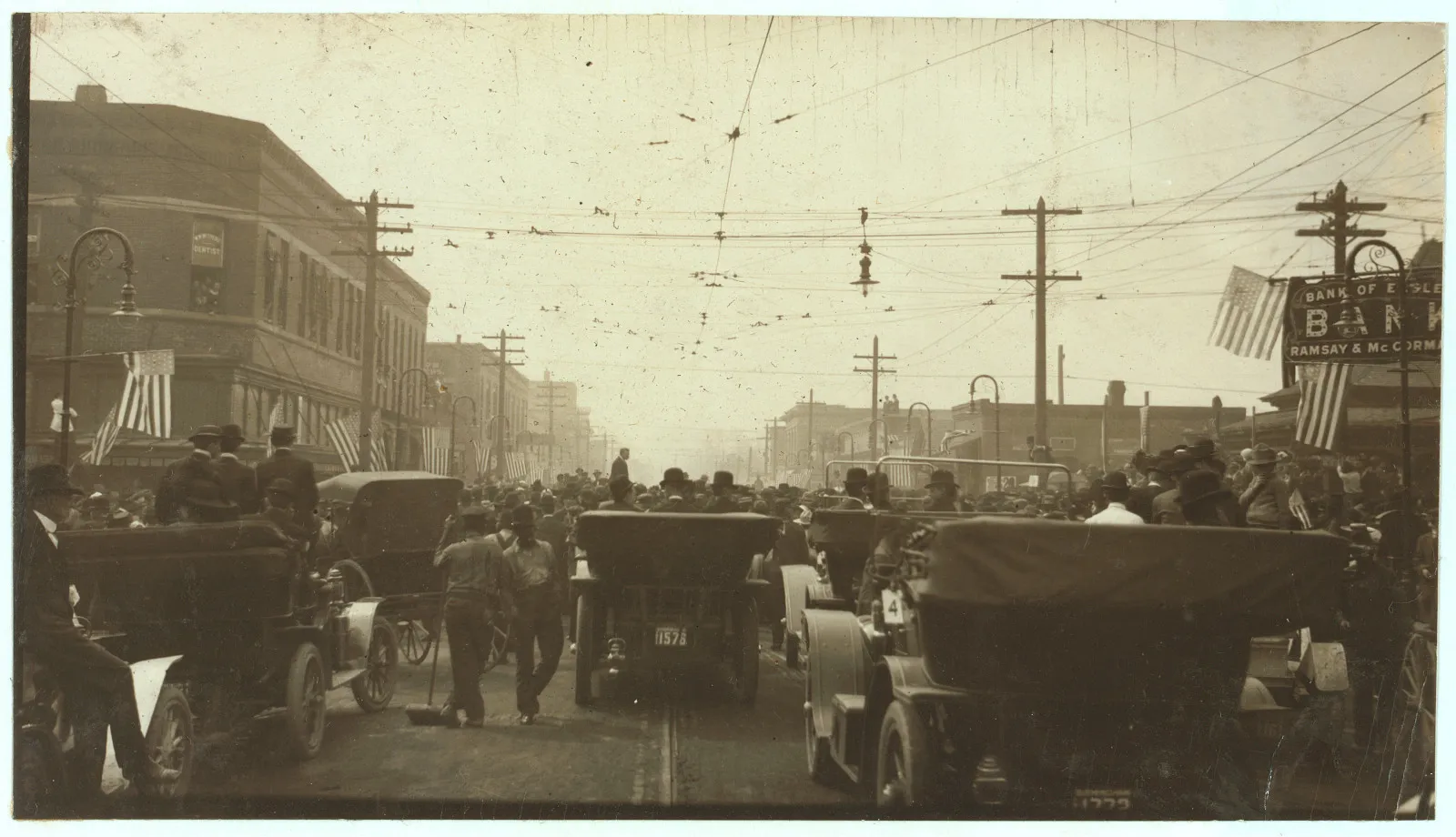
Roosevelt’s motorcade passes through the steel town of Ensley, Alabama; his New Nationalism called for minimum wages, workplace safety, and social insurance for industrial workers (Library of Congress).

Delegates to a conference on the conservation of natural resources; Roosevelt made stewardship of forests, waters, and minerals for future generations a central plank of the New Nationalism (Theodore Roosevelt Collection, Harvard College Library).
Conservation and Natural Resources
Roosevelt emphasized that natural resources belonged to the nation, not to individuals or corporations. Forests, waterways, minerals, and public lands should be held in trust for future generations and managed for the national good. This was not sentimentalism but sound economic policy. Unregulated exploitation led to depletion and waste. Rational conservation—federal management—protected long-term prosperity.
This vision of conservation would influence environmental thought for decades. Roosevelt understood that private interests would often destroy natural resources in pursuit of short-term profit. Only a strong federal government, acting in the public interest, could prevent catastrophic environmental degradation.
The Political System and Democracy
Roosevelt also addressed the political system itself. He called for direct democracy measures—the initiative, referendum, and recall—to empower ordinary citizens against corrupt machines and special interests. He advocated for women's suffrage (a radical position in 1910). He believed in strong executive power, but power checked by democratic accountability. The presidency, in his vision, should be the people's instrument, not the tool of wealthy special interests.

Roosevelt speaks to a packed crowd at Hornell, New York, in 1910; the New Nationalism demanded a more direct and responsive democracy through primaries and popular checks on entrenched power (Theodore Roosevelt Collection, Harvard College Library).

Roosevelt makes his case amid a dense crowd at Hot Springs, Arkansas; his New Nationalism proposed graduated taxes, labor laws, and corporate regulation decades ahead of their time (Theodore Roosevelt Collection, Harvard College Library).
The Specific Reforms: Policy Proposals Decades Ahead of Their Time
The New Nationalism speech called for specific reforms that would not be enacted for years or decades—some not until after Roosevelt's death. A graduated income tax (not enacted until the 16th Amendment was ratified in 1913). An inheritance tax to prevent the emergence of a hereditary aristocracy of wealth (not enacted until 1916). Workers' compensation laws to protect workers injured on the job (various states began enacting these after 1910; the first federal workers' compensation law was enacted in 1916). Prohibition of child labor (Congress passed the Keating-Owen Act in 1916, but the Supreme Court struck it down in 1918; durable federal prohibition came only with the Fair Labor Standards Act of 1938). Direct election of senators (the 17th Amendment was ratified in 1913). Women's suffrage (the 19th Amendment was not ratified until 1920).
Roosevelt also called for the regulation of labor hours, for a minimum wage (a radical proposal at the time), and for social insurance—essentially a forerunner of Social Security, which would not be enacted until 1935 under Franklin Roosevelt. At a time when most American political figures were opposing these reforms as dangerous socialism, Theodore Roosevelt was calling them essential to democratic survival and economic justice. It was a remarkable political stance for a man of wealth and privilege from an aristocratic family to advocate so vigorously for the protection of workers and the redistribution of wealth through progressive taxation.
The Path to the Presidency
The Osawatomie speech made clear that Roosevelt would not simply retire to private life. It signaled his growing dissatisfaction with Taft and outlined a political program that would become the platform of the Progressive Party. Over the next two years, Roosevelt became increasingly convinced that Taft was abandoning progressivism and that he himself needed to return to the presidency to rescue the movement.
When conservative Republicans rejected his return in 1912 and renominated Taft, Roosevelt ran as a Progressive, effectively splitting the Republican vote and handing the election to Democrat Woodrow Wilson. The Osawatomie speech had been the opening salvo of the campaign that would result in Roosevelt's third-party run and his defeat in 1912. Yet the New Nationalism had lasting impact. Many of Roosevelt's ideas—progressive taxation, labor protections, conservation, stronger federal regulation of business—became law under Wilson and under later presidents, both Democratic and Republican. In this sense, Roosevelt's defeat in 1912 was paradoxically a victory for his progressive agenda.

Roosevelt with Rough Rider veterans during the 1912 Bull Moose campaign; the New Nationalism became the platform of his Progressive Party run for the presidency (Theodore Roosevelt Collection, Harvard College Library).
Legacy of the New Nationalism
Roosevelt's Osawatomie speech represents a pivotal moment in American progressive thought. It married conservative concerns about property and order with radical demands for social justice and federal power. It was not socialism—Roosevelt was explicitly opposed to socialism—but it was a fierce challenge to laissez-faire capitalism. Historians have debated whether the New Nationalism was coherent or contradictory. Was Roosevelt trying to save capitalism or transform it? Most likely, he believed the two goals were inseparable. Capitalism had to be reformed—regulated, made more just, more responsive to workers—or it would destroy itself through exploitation and corruption.
For more on Roosevelt's political thought and his progressive vision, explore the Theodore Roosevelt Center's resources on the Progressive Era.
Continue Reading
- All Major Speeches — More on TR
- Quotes on Leadership — More on TR
Primary Sources at the TR Center
Explore original documents and resources related to this topic in the Theodore Roosevelt Center Digital Library.
- TR Center Digital Library — Primary source collection
From the Archives
Explore original photographs, documents, and illustrations related to this topic in the Theodore Roosevelt Center Digital Library.
Recommended Reading
- Colonel Roosevelt by Edmund Morris (2010). ISBN: 978-0-679-60415-0
- The Bully Pulpit by Doris Kearns Goodwin (2013). ISBN: 978-1-4165-4786-0
- Theodore Roosevelt, the Progressive Party, and the Transformation of American Democracy by Sidney M. Milkis (2009). ISBN: 978-0-7006-1667-1