
Ten Facts About Theodore Roosevelt in the Dakota Badlands
1. Returned to Dakota as a Grief-Stricken Twenty-Five-Year-Old
Fleeing to the Frontier
On February 14, 1884, in a single day of almost diabolical cruelty, Theodore Roosevelt lost both his wife Alice and his mother. Alice died of Bright's disease, a kidney ailment, just two days after giving birth to their daughter. On the same day, roughly eleven hours before Alice's death, his mother Martha died of typhoid fever. Theodore's diary entry for that date is among the most poignant documents in American history. He drew a thick black X across the page and wrote simply: "The light has gone out of my life." Two days later he filled two more pages with a brief account of their life together; after that, the diary stayed blank for almost four months. The grief seemed complete, immobilizing. By September 1883, before the double tragedy, Theodore had already made a hunting trip to the Dakota Territory, investing in ranching operations and falling in love with the frontier landscape. After February 1884, the Badlands became not merely an adventure but a refuge, a place where he could flee the suffocating sympathy of New York society and work through his grief through relentless physical action. He was a young man, just twenty-five years old, whose carefully constructed life had collapsed in a single day. The Badlands offered what grief counselors would later call "active recovery": he could work eighteen-hour days, riding across harsh terrain, managing cattle, sleeping under stars. The motion and the effort seemed to alleviate the weight of despair.

Roosevelt and members of the Smithsonian-Roosevelt African Expedition with a bull elephant taken at Meru, 1909-1910. The expedition sent more than 11,000 natural-history specimens to the Smithsonian. (Library of Congress)

A round-up on one of Roosevelt's Dakota cattle ranches. He poured roughly $82,500 (about $2.5 million today) into his Badlands cattle operations (Harvard College Library, Theodore Roosevelt Collection).
2. Invested $82,500 (Roughly $2.5 Million Today) in Cattle Operations
A Substantial Wager on the Frontier
Theodore's commitment to ranching was not a casual hobby but a serious financial investment. When he arrived in the Badlands in 1883, he invested approximately $14,000 in the Maltese Cross Ranch, roughly a tenth of the inheritance his father had left him—a sum representing substantial wealth in the 1880s. After Alice's death, when he decided to make a more permanent commitment to Dakota, he expanded his operations dramatically. By some estimates, his total investment in cattle and ranching operations reached approximately $82,500—a fortune at the time, equivalent to roughly $2.5 million in modern currency. This was not a wealthy man playing at being a cowboy; this was a serious financial commitment that represented a significant portion of his available capital. He held approximately 3,000 head of cattle bearing the Roosevelt brand at the height of his operations. He invested in the Elkhorn Ranch, a remote operation along the Little Missouri River that he built from logs. He became involved in the Little Missouri Stockmen's Association, an organization designed to manage grazing lands and prevent rustling. For a moment in the 1880s, Theodore Roosevelt was not merely a visitor to the frontier; he was a substantial cattleman with significant financial interests in the Dakota Territory.
3. Local Cowboys Called Him the "Four-Eyed Dude"
Earning Respect Through Capability
When Theodore Roosevelt first arrived in Little Missouri, wearing his tailored clothes and speaking with his Ivy League accent, the local ranchers and cowboys were skeptical. This young man in his spectacles—"four-eyed" as frontier roughnecks would say—seemed unlikely to survive a season in the Badlands, let alone become a successful cattleman. The nickname was not entirely unkind; frontier people had a rough sense of humor, and they were skeptical of any outsider, particularly one from the elite East. But Theodore was undeterred by mockery or doubt. He was searching for something that New York could not provide: validation that came not from family connections or inherited wealth but from demonstrated capability and courage. He learned to break horses, to ride all day across the badlands in all weather, to manage cattle, to survive on the frontier. Gradually, almost imperceptibly, the skepticism gave way to respect. The young man with the spectacles and the Ivy League accent proved that he could work as hard as any man, that he could ride as well, shoot as straight, and endure as much. By the time he left the Badlands, he was no longer "the four-eyed dude"; he was Roosevelt, a man who had proved himself capable on the frontier and earned the respect of the men he worked with. This transformation—from outsider and object of mockery to respected member of the community—was precisely what he needed. It proved to him that his identity was not dependent on family or inherited status but on his own demonstrated capability and character.

Roosevelt on the round-up in 1885. Local cowhands first dismissed the bespectacled Easterner as a "four-eyed dude" before he won their respect (Harvard College Library, Theodore Roosevelt Collection).

Roosevelt guarding the boat thieves he chased down the ice-choked Little Missouri River in the spring of 1886 (Harvard College Library, Theodore Roosevelt Collection).
4. Chased Boat Thieves Down the Little Missouri River and Read Tolstoy by Campfire
Frontier Justice and Intellectual Life
In the spring of 1886, when rustlers stole a boat belonging to Theodore's ranch, he did not accept the loss passively. As a deputy sheriff for the region, he set out with his ranch hands Bill Sewall and Wilmot Dow and pursued the thieves down the icy Little Missouri River for several days, eventually capturing three men—Finnegan and two accomplices. While Sewall and Dow continued downriver with the boats, Theodore personally guarded the prisoners on an overland trek of roughly 45 miles to the town of Dickinson, trudging behind the hired wagon that carried them. The incident reveals his character perfectly: he was willing to take on the inconvenience and danger of pursuing justice not out of personal financial loss but out of principle. Law and order had to be maintained. But the more remarkable detail reveals something equally important about Theodore's nature: while pursuing the boat thieves down the frozen river, he read Tolstoy. The man pursuing criminals across the frontier was simultaneously immersed in the complex moral and philosophical arguments of a Russian novelist. Theodore Roosevelt could not be reduced to a single dimension. He was not merely a man of action; he was a man of thought and action simultaneously. Even in the depths of the frontier, in the midst of pursuing justice against rustlers, he remained intellectually engaged, grappling with the great questions of literature and philosophy. This ability to hold multiple identities simultaneously—frontiersman and intellectual, rancher and writer, man of action and man of thought—was central to who he was.
5. Lost Roughly 60 Percent of His Herd in the Winter of 1886-87
Nature's Indifference
The winter of 1886-87 was one of the most severe on record in the Northern Plains. Temperatures dropped to forty degrees below zero. Snowfall buried ranches so deeply that cattle standing in pastures could not reach grass. Thousands of cattle starved to death. Ranchers who had seemed wealthy and secure were bankrupted overnight. Theodore's ranching operation was devastated. He lost roughly 60 percent of his cattle. Of the approximately $82,500 he had invested in his ranching operations, historians estimate his net losses at roughly $25,000. The financial loss was painful, but the psychological impact was more significant. The Badlands had seemed to promise a life of independence and self-sufficiency; instead, they had demonstrated the brutal limits of individual will against natural forces beyond human control. A man could be strong, courageous, and determined, and still be crushed by circumstances entirely beyond his power to influence. Snow fell. Temperatures dropped. Cattle died. No amount of willpower or determination could change these facts. The experience taught Theodore something crucial about the limits of individual effort, the reality of luck and chance, the need for practical, hardheaded assessment of reality rather than romantic idealization.

A Roosevelt ranch on the snow-buried Dakota plains. The brutal winter of 1886-87 destroyed roughly 60 percent of his cattle herd (Harvard College Library, Theodore Roosevelt Collection).

The contents page of Hunting Trips of a Ranchman (1885), the first of three books Roosevelt wrote during his Dakota years, opening with "Ranching in the Bad Lands" (Biodiversity Heritage Library via Wikimedia Commons).
6. Wrote Three Books During His Dakota Years
The Intellectual Frontiersman
Even while engaged in the demanding physical labor of ranching, Theodore remained intellectually active and productive. He wrote extensively, both journal entries and articles for publication. He completed "Hunting Trips of a Ranchman" (1885), drawing on his hunting experiences in the Badlands and nearby mountains, and wrote much of his biography of Senator Thomas Hart Benton (1887) during these years. His Dakota experiences later supplied the material for "Ranch Life and the Hunting-Trail" (1888), which combined his personal experiences with observations about frontier life and cattle management. These works established Theodore as a serious nature writer and keen observer of the American frontier. The intellectual engagement during the Badlands years reveals something important about Roosevelt's character: he was not attempting to escape his identity as an intellectual and writer; he was attempting to integrate that identity with a more physically engaged life. He wanted to be both a man of thought and a man of action. The Badlands years represented an experiment in that integration—a test of whether an intellectual could become a capable rancher and frontiersman, whether a man raised in wealth and privilege could become a competent worker.
7. The Elkhorn Ranch Became Known as "The Cradle of Conservation"
A Foundation for Future Activism
The Elkhorn Ranch, built by Theodore on a remote stretch of the Little Missouri River, was constructed entirely from logs cut from cottonwood trees along the riverbank. It was a modest operation by comparison to established ranches, but it was Theodore's creation, built through his own labor and vision. The ranch consisted of a main cabin, bunkhouse, and outbuildings, positioned on the banks of the Little Missouri with a view of the badlands landscape that Theodore found almost reverential in beauty. During his time at the Elkhorn Ranch, Theodore spent countless hours observing the landscape, the wildlife, the ecological relationships that constituted the frontier ecosystem. He developed a deep attachment to the land itself and to the animals that inhabited it. Years later, after he left Dakota and eventually became president, Theodore would remember the Elkhorn Ranch and the Badlands as places that had shaped his conservation philosophy. When he later protected 230 million acres as president—more land than any leader before or since—he was enacting the lessons he had learned in Dakota. The Badlands had taught him that wild landscapes and wild animals were not infinite resources to be exploited without limit; they were fragile, vulnerable to destruction, worth preserving. The Elkhorn Ranch became historically significant not because of what happened there at the time, but because it was the place where the future conservationist had fallen in love with wild America.
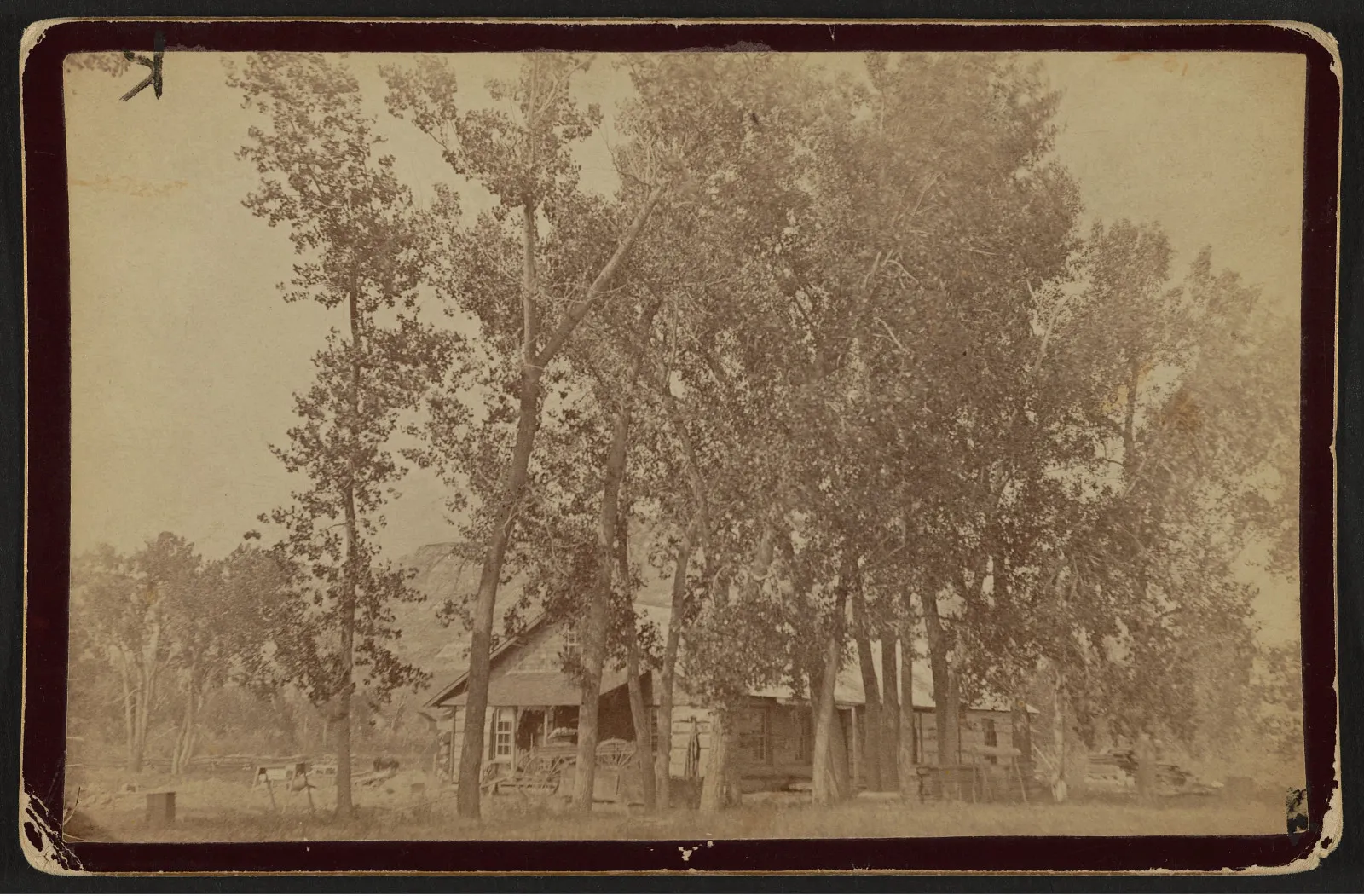
Roosevelt's Elkhorn Ranch, tucked among the cottonwoods on the Little Missouri. The remote site is remembered as a "cradle of conservation" (Harvard College Library, Theodore Roosevelt Collection).

The Marquis de Mores, the flamboyant French nobleman who founded Medora and became Roosevelt's colorful Badlands neighbor (Wikimedia Commons, public domain).
8. The Marquis de Mores Was His Colorful French Neighbor
Aristocrats on the Frontier
One of the most remarkable figures in the Badlands during Roosevelt's time was the Marquis de Mores, a French aristocrat of ancient lineage who arrived in Dakota Territory in 1883 with ambitious entrepreneurial dreams. The Marquis—his full name was Antoine-Amédée-Marie-Vincent-Amat Manca de Vallombrosa—was a cavalry officer, educated at St. Cyr military academy and the Saumur cavalry school. He had married Medora von Hoffman, daughter of a wealthy New York banker, and with access to substantial capital, he came to Dakota to establish a refrigerated beef operation that would revolutionize the cattle trade. The Marquis founded the town of Medora, named for his wife, complete with an ambitious abattoir and dreams of shipping dressed beef directly to eastern markets via the Northern Pacific Railroad. Here were two young men, both descended from aristocratic traditions, both educated and ambitious, both trying to remake themselves on the frontier. Theodore was not the only Eastern intellectual trying to make a place for himself in the Badlands. The Marquis de Mores embodied a different aristocratic tradition—French rather than American, more flamboyant and theatrical in his ambitions. Their relationship was cordial but not intimate; they were competitors in the Badlands economy and represented different visions of what the frontier should become. The Marquis's enterprise eventually failed, but his presence in Dakota revealed that the frontier was attracting ambitious men from across the Atlantic, all seeking to test themselves and their ideas in the raw landscape of the American West.
9. Punched a Drunk Gunslinger in a Hotel Bar
Frontier Justice and Personal Honor
On at least one occasion during his Badlands years, Theodore resorted to physical violence to defend his honor and enforce his will. In a hotel bar in Dakota Territory, a drunk man began insulting Roosevelt, apparently emboldened by alcohol to test the young man from the East. Without hesitation, Theodore responded with his fists. The physical altercation was brief; Theodore's boxing training from his Harvard years gave him an advantage, and the drunk quickly found himself decisively defeated. The incident reveals Roosevelt's character in miniature: he would not tolerate disrespect, and he was willing to resort to physical force to enforce his sense of personal dignity and honor. This was not random violence; it was a response to a deliberate provocation. On the frontier, reputation mattered. A man who accepted insults and disrespect would be marked as weak, as someone who could be bullied or manipulated. Theodore understood this frontier code of honor intuitively. He had remade his body from a sickly, asthmatic boy into someone physically capable. He had learned to ride, shoot, and work alongside hard men. He was not going to allow himself to be diminished by a drunk in a bar. The incident passed without legal consequences—in the Badlands, justice was often a local matter, and the consensus was that the drunk deserved what he got.
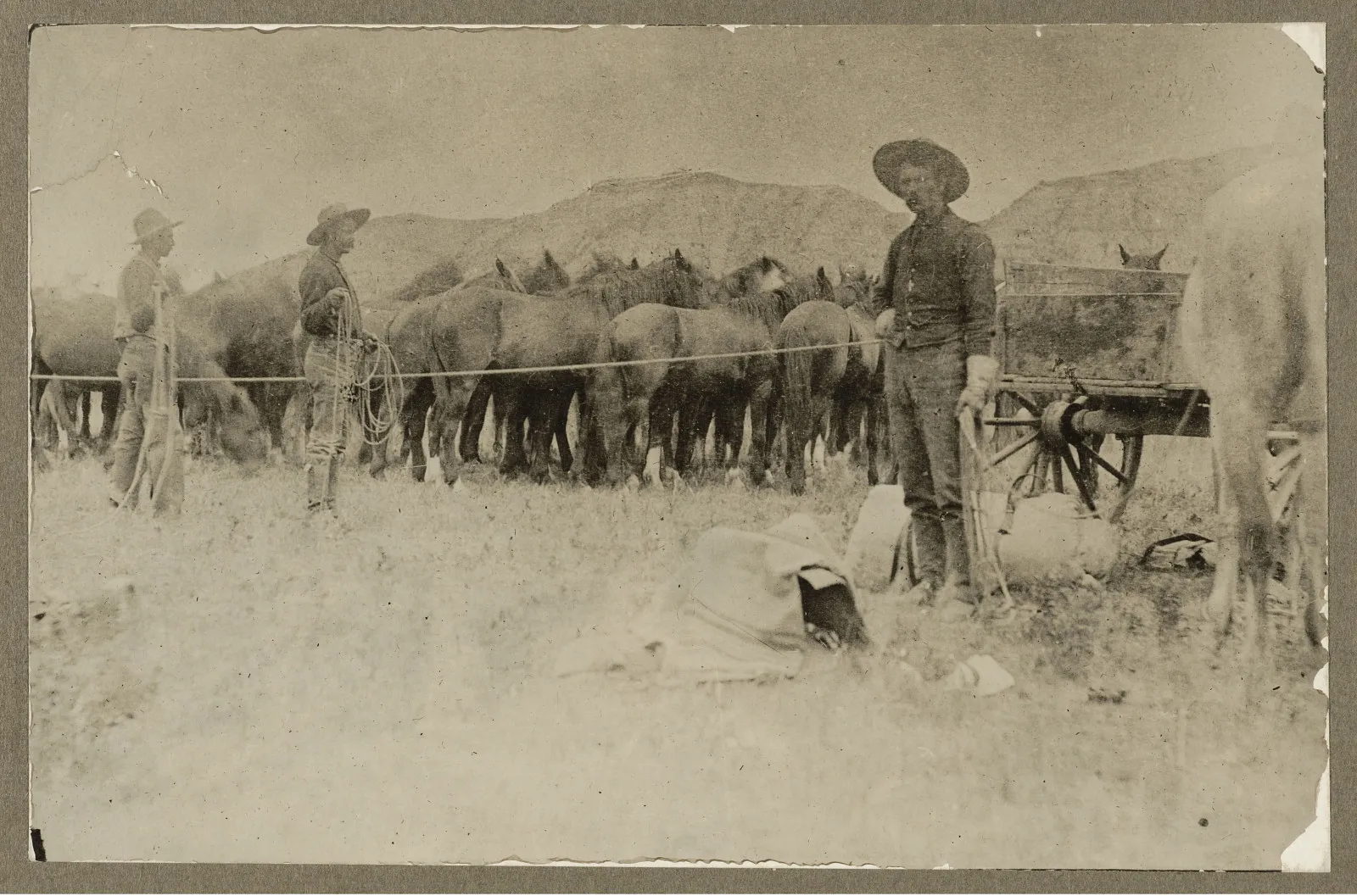
Sylvane Ferris and fellow Dakota cowpunchers. Amid such rough frontier company, Roosevelt famously flattened a drunken, gun-toting bully in a hotel barroom (Harvard College Library, Theodore Roosevelt Collection).
10. "I Would Not Have Been President Had It Not Been for My Experience in North Dakota"
The Crucible That Forged a President
Years later, after leaving the Badlands and eventually ascending to the presidency, Theodore Roosevelt reflected on the significance of his Dakota years. As he put it in 1918: "I have always said I would not have been President had it not been for my experience in North Dakota." This was not mere sentiment or nostalgia. Roosevelt recognized that the Badlands had fundamentally transformed him in ways that were essential to his later leadership. He had arrived in Dakota a grief-stricken, broken young man. He had left a man who had tested himself against the frontier and found himself equal to the test. He had learned that he could survive hardship, that he could endure cold and pain and loss, that he could work alongside rough men and earn their respect through demonstrated capability. He had learned the limits of individual will, the reality of chance and circumstance, the importance of practical assessment over romantic idealization. Most importantly, he had learned that a man could remake himself through conscious effort—not just physically (which he had already done against asthma), but morally and psychologically. The asthmatic boy of Manhattan, the grief-stricken young widower, the inexperienced Eastern dude—all of these had been tested and transformed by the Dakota frontier. When Theodore Roosevelt eventually became president, he brought with him the lessons learned in the Badlands: the conviction that a man should test himself, that physical vigor and moral courage were inseparable, that leadership meant accepting responsibility and pursuing justice. The Badlands were the crucible in which the future leader was forged.

Theodore Roosevelt as the Dakota rancher and hunter he became. He later said he would not have been President without his North Dakota experiences (Harvard College Library, Theodore Roosevelt Collection).
Continue Reading
- The First Trip West—Roosevelt's initial arrival and the beginning of his transformation
- Frontier Life in the Badlands—The daily reality of ranching and earning respect
- The Badlands Landscape—Understanding the country that shaped Roosevelt's thinking
- The Devastating Winter of 1886–87—The catastrophe that ended the ranching era
From the Archives
Explore original photographs, documents, and illustrations related to this topic in the Theodore Roosevelt Center Digital Library.
Recommended Reading
- Theodore Roosevelt in the Dakota Badlands: An Historical Guide by Clay Jenkinson (2006). ISBN: 0-9786267-0-2
- Roosevelt in the Bad Lands by Hermann Hagedorn (1921)
- The Rise of Theodore Roosevelt by Edmund Morris (1979). ISBN: 978-0-307-77782-9