
51 Federal Bird Reserves: Roosevelt's Ornithological Vision
The Ornithological Inspiration
Roosevelt's love of birds began in childhood. As a boy in New York City, he had created a private natural history museum in his bedroom, complete with bird specimens and observations. He sketched birds, collected them, studied their behavior and habits. The ornithological journals of Harvard professors and European naturalists occupied space on his reading shelves alongside history and philosophy. When Roosevelt spoke of birds, it was not as a casual observer but as someone who understood avian biology, behavior, and taxonomy.
This childhood passion never left him. Even as president of the United States, managing trust-busting cases, Panama Canal construction, and international diplomacy, Roosevelt found time to observe birds. He kept binoculars at hand. He noted species in his personal journal. He corresponded with other ornithologists about sightings and identifications.
But Roosevelt understood that his personal pleasure in birds was disappearing rapidly. Waterfowl populations were being decimated by commercial hunting and market gunning—professional hunters killing ducks, geese, and shorebirds by the thousands for city restaurant markets. Egrets were being hunted to near extinction for their plumes, which adorned women's hats. Herons, terns, and auks were slaughtered for feathers and plumage. Shorebird populations on coastal flats were being shot without limit. The commercial destruction was systematic and largely legal.

The snowy egret's breeding plumes made it a target: hunters slaughtered whole colonies to feather women's hats. The outcry from ornithologists and Audubon societies helped move Roosevelt to act. (Andy Morffew / Wikimedia Commons)

On March 14, 1903, Roosevelt declared Florida's Pelican Island the first federal bird reservation — the birthplace of the national wildlife refuge system. (George Gentry / U.S. Fish & Wildlife Service)
Pelican Island: The First Federal Bird Reservation
Roosevelt's conservation of birds began with a single decision. On March 14, 1903, he visited the office of Secretary of the Interior Ethan Allen Hitchcock and asked whether there was any law preventing him from declaring a small island off the Florida coast a federal bird reservation. Pelican Island, in Indian River Lagoon near Sebastian, Florida, had become a haven for waterbirds seeking shelter and breeding grounds. But the island and its birds remained unprotected from hunters and egg collectors.
Told that no law actually prohibited such an action, Roosevelt immediately replied: "Very well, then I so declare it."
By simple executive order of March 14, 1903, Roosevelt established Pelican Island as the first federal bird reservation. The order removed the island from the public domain and dedicated it solely to bird protection. No hunting was permitted. No collecting was allowed. The birds had sanctuary.
Pelican Island proved to be a pilot project. If the government could protect this one small island for birds, why not others? Coastal swamps that served as waterfowl breeding grounds. Marshes that provided crucial food and shelter during migration. Rocky islands where seabirds nested safely from terrestrial predators. Roosevelt began systematically identifying important bird habitats and protecting them through executive authority.
Expanding the Bird Sanctuary Movement
Pelican Island became the first of 51 federal bird reservations that Roosevelt would establish. The reserves protected crucial habitats across the nation: Stump Lake in North Dakota provided breeding grounds for prairie waterfowl. Merritt Island in Florida protected nesting seabirds. Three Arch Rocks off the Oregon coast provided breeding habitat for murres and puffins. The reserves encompassed wetlands, marshes, coastal islands, and inland lakes—every ecosystem that provided critical habitat for America's diminishing bird populations.
The reserves were small by forest preserve standards—often just a few hundred or thousand acres. But they were precisely positioned to protect the most vulnerable species and habitats. A single coastal island could shelter thousands of breeding seabirds. A prairie wetland could support hundreds of thousands of migrating ducks. Roosevelt understood the landscape ecology of bird conservation decades before that concept became standard in wildlife management.
Roosevelt worked closely with the Audubon Society and other ornithological organizations. These groups provided information about important bird habitats and supported executive protection. The partnership between Roosevelt and early conservation organizations demonstrated how a president could work with citizen groups to accomplish conservation goals.
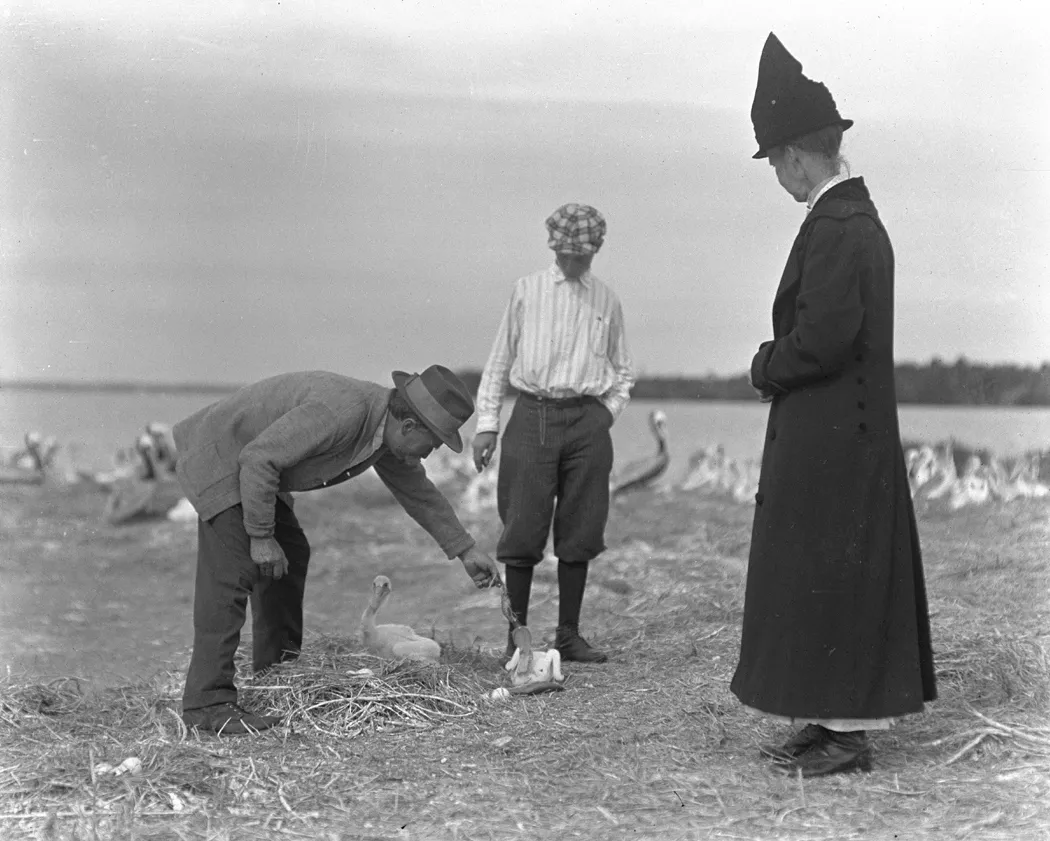
German-born boatbuilder Paul Kroegel became the first federal wildlife warden, guarding Pelican Island for a dollar a month. His post became the model as Roosevelt created reserve after reserve. (U.S. Fish & Wildlife Service)

Ornithologist Frank M. Chapman of the American Museum of Natural History — founder of the Christmas Bird Count — supplied the science and advocacy that guided Roosevelt's reserves. (The World's Work)
The Science of Bird Protection
Roosevelt's bird reserves reflected cutting-edge ornithological knowledge. Professional ornithologists advised him on which sites merited protection and why. Understanding bird migration patterns was crucial—many American species wintered in the Caribbean or Central America, migrated through the interior in spring and fall, and bred in the northern states or Canada. Protecting breeding grounds was useless unless the species could safely migrate and find winter habitat. Roosevelt's reserves were distributed geographically to protect birds throughout their annual cycles.
The reserves also reflected emerging understanding of ecosystem protection. Protecting birds meant protecting the vegetation, insects, and fish they depended upon. The reserves preserved not just isolated species but entire habitats—swamps, marshes, coastal areas, and grasslands where birds could feed, breed, and shelter.
From Bird Reserves to Wildlife Refuges
Roosevelt's 51 bird reservations became the foundation for what is now the National Wildlife Refuge System. The system, which still exists and has expanded to include hundreds of refuges across the nation, traces its origin directly to Pelican Island in 1903. Every refuge administrator, every wildlife manager, every ornithologist working in the refuge system operates within a structure that Roosevelt created.
The birds Roosevelt saved through these reserves tell a conservation story of extraordinary success. Bald eagles, hunted nearly to extinction, have recovered to robust populations. Whooping cranes, reduced to fewer than 20 individuals, have been brought back from the brink through protection and careful management. Waterfowl populations, depleted by commercial hunting, have been sustained through refuge protection and hunting regulation. Species that seemed doomed to extinction in 1900 today exist in healthy populations—a direct result of Roosevelt's decision to protect bird habitat.

Roosevelt's 51 bird reservations grew into today's National Wildlife Refuge System — more than 560 refuges protecting birds like the brown pelican, once nearly lost. (Andy Morffew / Wikimedia Commons)
The Lasting Impact of a Childhood Passion
Roosevelt's bird reserve creation demonstrates how personal passion can translate into consequential policy. A boy who loved birds grew into a man with presidential power. He used that power not for political advantage or economic gain but to protect something he loved—the birds and the habitats they depended upon.
Individually modest—most were small islands, wetlands, and stretches of coast—the 51 bird reserves seeded a refuge system that today protects millions of acres across the nation. The reserves prevented the extinction of countless species. They established the principle that federal government had responsibility for protecting wildlife habitat and ensuring that future generations could experience the diversity of American birdlife.
When Roosevelt spoke about conservation, he often returned to birds. They seemed to crystallize his conservation philosophy perfectly. Birds were not resources to be exploited but living beings worthy of protection in their own right. Their habitats needed preservation. Their populations needed protection from hunting. Future Americans deserved the same opportunity to see eagles, herons, and shorebirds that he had enjoyed.
The National Wildlife Refuge System, which grew from Roosevelt's bird reserves, today encompasses more than 95 million land acres across more than 560 refuges nationwide. Hundreds of millions of birds depend on these refuges annually. Every hunter, every birder, every naturalist who visits a refuge experiences directly the legacy of Theodore Roosevelt's childhood passion for birds.
Birds should be saved because of utilitarian reasons; and, moreover, they should be saved because of reasons unconnected with any return in dollars and cents.
— Theodore Roosevelt, A Book-Lover's Holidays in the Open, 1916
Continue Reading
- National Parks Established Under TR — Five new parks created or expanded during his presidency.
- Gifford Pinchot and Scientific Forestry — Roosevelt's partnership with the nation's leading forester.
- John Muir and the Wilderness Campaign — The naturalist whose writings influenced Roosevelt's conservation vision.
- Roosevelt as a Young Naturalist — How his childhood passion shaped his later presidency.
- Pets at the White House — Roosevelt's diverse menagerie and love of animals.
- Conservation by the Numbers — The full scope of TR's environmental achievements in statistics.
Primary Sources at the TR Center
Explore the TR Center’s Digital Library for documents and resources on Roosevelt’s bird conservation and the National Wildlife Refuge System.
- National Wildlife Refuge System — Information on Roosevelt’s bird reserves and their modern legacy.
- Pets and Wildlife Subject Page — Roosevelt’s passion for animals and nature throughout his life.
- Conservation Encyclopedia — In-depth articles on Roosevelt’s conservation initiatives.
- Roosevelt’s Conservation Record — A comprehensive overview of his environmental accomplishments.
From the Archives
Explore original photographs, documents, and research materials related to Roosevelt's bird reserves in the Theodore Roosevelt Center Digital Library.
Recommended Reading
- Teddy Roosevelt: The Wilderness Warrior by Douglas Brinkley (2009). ISBN: 978-0060565312
- Audubon and His World: A Reasonable Zoology by Alice Ford (1956)
- The Birds of America by John James Audubon (1827)