
Ten Facts About Theodore Roosevelt's Presidency
1. Youngest President in History at Age Forty-Two
A New Model of Presidential Leadership
When Theodore Roosevelt assumed the presidency on September 14, 1901, following McKinley's assassination, he was 42 years and 322 days old—the youngest person ever to assume the office. (John F. Kennedy, elected at 43, remains the youngest ever elected.) Previous presidents had been older men, often selected for their maturity, their experience, and their presumed caution. Roosevelt arrived at the presidency with a fundamentally different understanding of what the office should be. He believed the president should be an active leader, not a ceremonial figurehead. He believed the executive had power beyond what previous presidents had exercised, power to challenge trusts, to protect wild lands, to assert American interests internationally. This youthfulness was not merely chronological; it reflected a different philosophy of leadership. Roosevelt brought to the presidency the energy and the moral seriousness that had characterized his life on the frontier. He believed in direct action, in confronting problems head-on rather than managing them diplomatically from a distance. He believed that a president should use the power of his office to accomplish what he believed to be right, even if it meant challenging established interests or violating what previous presidents had seen as the limits of executive authority. His youth seemed to alarm the older guard of Republican leadership, but it energized the American public, which saw in him a leader of exceptional vigor and capability.

At forty-two, Roosevelt became the youngest person ever to hold the presidency, taking office after William McKinley's assassination in 1901. (Library of Congress)

Roosevelt protected some 230 million acres of public land; here he stands with naturalist John Muir at Glacier Point in Yosemite, 1903. (Library of Congress)
2. Protected 230 Million Acres of Public Land
The Conservationist President
Theodore Roosevelt's most lasting and perhaps most important legacy was his work in conservation. During his presidency, he protected approximately 230 million acres of public land—more land than any president before or since. This figure includes 51 federal bird sanctuaries, 4 national game preserves, 5 national parks, 18 national monuments, and 150 national forests. Roosevelt did not see this as charity or weakness; he saw it as the essential work of a president who understood that America's natural heritage was being destroyed and that the federal government had a responsibility to preserve it for future generations. He used executive authority to create national monuments without waiting for Congressional approval. He championed the conservation movement and brought figures like Gifford Pinchot, the chief of the Forest Service, into positions of significant influence. Roosevelt understood that America had been a land of apparent infinite resources, and that this assumption was fundamentally wrong. The buffalo had nearly been hunted to extinction. The forests of the Northwest were being cleared at an unsustainable rate. The wildlife that had once covered the continent was disappearing. As a young man in the Dakota Badlands, Roosevelt had learned to love wild nature and to recognize its fragility. As president, he had the power to protect it, and he used that power relentlessly. His conservation legacy shaped American environmental policy for generations to come.
3. First President to Win the Nobel Peace Prize
Peacemaker on the World Stage
Despite his reputation as a warlike, aggressive leader, Theodore Roosevelt won the Nobel Peace Prize in 1906 for his role in negotiating the end of the Russo-Japanese War. Russia and Japan had been at war since 1904, and neither side saw a path to an honorable peace through negotiation. Roosevelt offered his services as an intermediary, and through patient diplomacy, he helped bring the two nations to the negotiating table. The peace treaty, negotiated in Portsmouth, New Hampshire, was signed on September 5, 1905. For this achievement, Roosevelt was awarded the Nobel Peace Prize in 1906, becoming the first American president to win the award. The prize seemed to contradict Roosevelt's reputation as a warrior and an advocate for the strenuous life. But Roosevelt understood that peace achieved through understanding and negotiation was superior to peace achieved through the exhaustion of both sides' resources in endless war. He had not opposed the war; but he had recognized that continuing it indefinitely served neither combatant's interests and destabilized the international order. His willingness to intervene diplomatically, to offer his prestige and his nation's weight as a neutral power, demonstrated a subtlety to his foreign policy that was sometimes obscured by his more bellicose rhetoric.

Roosevelt won the 1906 Nobel Peace Prize for mediating an end to the Russo-Japanese War, the first American and first sitting president so honored. (Theodore Roosevelt Collection, Harvard College Library)
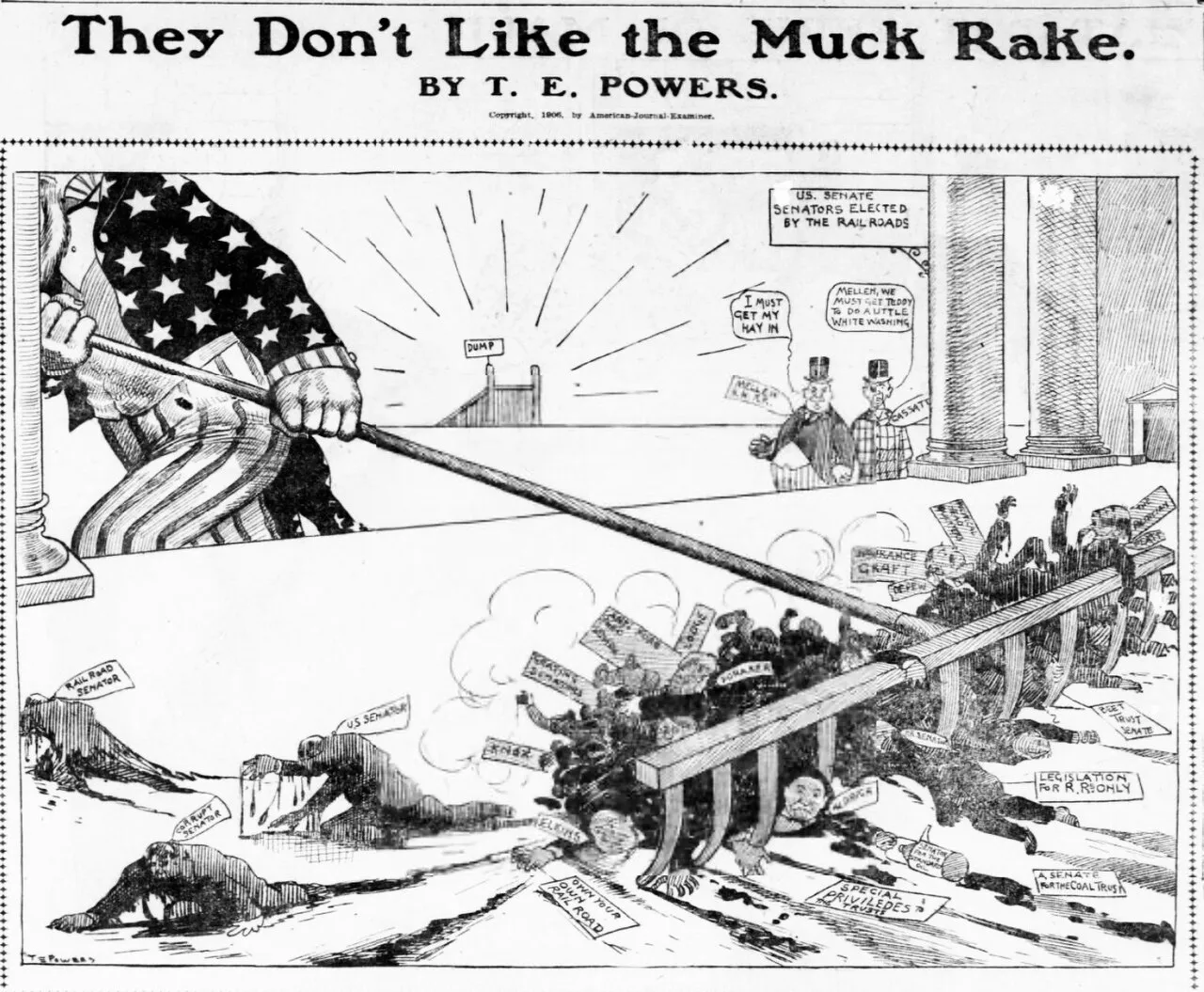
Roosevelt popularized ‘muckraker’ in a 1906 speech; this T. E. Powers cartoon plays on the term he made famous. (Salt Lake City Herald, 1906, Wikimedia Commons)
4. Coined the Term "Muckraker" for Reform Journalists
The Press and Progressive Reform
During Roosevelt's presidency, a new genre of American journalism emerged: investigative reporting focused on exposing corruption, exploitation, and wrongdoing in American business and politics. Figures like Ida Tarbell investigated the Standard Oil trust; Upton Sinclair exposed conditions in the meat-packing industry; Lincoln Steffens examined municipal corruption. These journalists became known as "muckrakers" because they seemed to spend all their time raking through the muck of American life in search of scandal and wrongdoing. Roosevelt himself coined the term, drawing from Bunyan's "Pilgrim's Progress," where a character with a muckrake could see only the filth on the ground and never looked up to heaven. Roosevelt had a complicated relationship with the muckrakers. On one hand, he appreciated their exposure of genuine wrongdoing and their role in supporting progressive reform. On the other hand, he believed some of them went too far, exaggerating problems and pursuing sensationalism over truth. Despite his reservations, Roosevelt's presidency created a political climate in which investigative journalism could flourish. His own willingness to challenge powerful interests, to pursue trust-busting, to advocate for regulation of business—all this gave moral authority to the muckrakers' work. The investigative journalism of the progressive era helped shape American public opinion and supported Roosevelt's reform agenda.
5. Went Blind in One Eye from Boxing
The Cost of the Strenuous Life
Theodore Roosevelt was an enthusiastic boxer throughout his life. He had learned boxing at Harvard and had continued to box even as president, believing that the sport was essential training for the strenuous life he advocated. During a boxing bout in the White House (yes, he boxed in the White House), an opponent struck him in the face with sufficient force to damage his left eye. The injury was serious and permanent: the vision in that eye was essentially lost. Most men of Roosevelt's status would have ceased boxing immediately after such a severe injury. Roosevelt continued, though with somewhat greater caution. The injury to his eye was a visible reminder of the dangers inherent in the physical tests to which he subjected himself. It also revealed something about Roosevelt's character: his willingness to accept personal cost for his principles. He had advocated that American men should test themselves physically, should pursue the strenuous life, should be willing to accept the risks that came with challenging physical activity. He had proven, through his own experiences, that he was willing to accept those risks himself. The blind eye was a price of his philosophy, and he seemed to view it as a reasonable cost for the strength and capability he had gained through boxing and physical training.

Roosevelt lost much of the sight in his left eye after a White House boxing match; he had sparred since his student days at Harvard’s Hemenway Gymnasium, shown here. (Theodore Roosevelt Collection, Harvard College Library)

The Roosevelt children turned the White House into a menagerie; the pony Algonquin, ridden here by Quentin, was famously taken up the mansion’s elevator to cheer a sick Archie. (Theodore Roosevelt Collection, Harvard College Library)
6. His Children Turned the White House Into a Circus: Pony in the Elevator
Family Life in the Executive Mansion
Theodore Roosevelt's children—six from his marriages to Alice and Edith—were as energetic and unconventional as their father. The White House, traditionally a formal and dignified residence, became under Roosevelt's administration a place of considerable chaos. His children roller-skated in the hallways, built elaborate forts, kept an assortment of exotic animals including a pony named Algonquin that was occasionally brought into the house itself. On at least one occasion, the pony was placed in an elevator and taken to the upper floors of the White House—a scenario that would have been unimaginable under previous administrations. Roosevelt and his wife Edith seemed to encourage this chaos rather than resist it. They believed that children needed space to play, to explore, to test themselves. The White House was their home, not a museum, and it should reflect the life of a family with young children. Journalists found this informality shocking. The dignity and formality that had traditionally characterized the president's household seemed to be under siege. But the American public found it charming. Here was a president whose house was filled with the noise and chaos of happy children, who seemed to enjoy his family rather than treating them as an inconvenience to be managed. It was a new model of presidential family life, one that Roosevelt's successors would generally follow.
7. First President to Ride in a Car, Fly in a Plane, and Go Down in a Submarine
Embracing Modern Technology
Theodore Roosevelt was fascinated by modern technology and eager to experience it firsthand. He was the first president to ride publicly in an automobile—a remarkable act given that automobiles were still rare and unreliable machines in the early 1900s. He became the first of the presidents to fly in an airplane—though not until October 11, 1910, nineteen months after leaving office, when he went up with aviator Arch Hoxsey at St. Louis. He was the first president to go down in a submarine, diving aboard USS Plunger in Long Island Sound in August 1905. Each of these experiences revealed Roosevelt's characteristic eagerness to test new things, to understand how they worked, to experience firsthand what was becoming possible through modern technology. These were not mere publicity stunts (though they were certainly that too); they revealed Roosevelt's genuine belief that a modern leader should understand and embrace the technologies that were transforming civilization. He did not retreat into nostalgia for the frontier or resist the modernization of American life. Rather, he engaged with it enthusiastically, riding in cars, flying in planes, examining submarines. This willingness to embrace new technology while maintaining the values of the frontier—physical courage, direct action, respect for nature—was central to Roosevelt's political philosophy.

A president of firsts, Roosevelt was the first to ride publicly in an automobile, later becoming the first to fly in an airplane and to descend in a submarine. (Library of Congress)

Clifford Berryman’s 1902 cartoon of Roosevelt sparing a bear cub on a Mississippi hunt inspired a toymaker’s ‘Teddy’s bear.’ (Clifford K. Berryman, 1902, Library of Congress)
8. The "Teddy Bear" Was Named After Him
A Moment of Mercy
One of the most enduring symbols associated with Theodore Roosevelt emerged from a hunting trip in November 1902. Roosevelt was on a bear hunt in Mississippi when his guides, unable to find bears, captured a young black bear and presented it to him for the "honor" of killing it. The bear, exhausted and terrified, was tied to a tree—a helpless target. Roosevelt refused to shoot it. He considered such killing unsporting, a violation of the ethics of fair chase that he had long advocated. A newspaper cartoonist named Clifford Berryman drew a cartoon depicting Roosevelt declining to shoot the bear, and the image captured the public imagination. A toy maker named Morris Michtom saw the cartoon and created a soft toy bear, which he named "Teddy's Bear" as a tribute to the president. The toy became extraordinarily popular, and it has remained a staple of American childhood ever since. The "teddy bear" is one of the most widely recognized symbols of Roosevelt's presidency, yet it emerged from a moment of mercy rather than conquest. It revealed a side of Roosevelt that his more aggressive rhetoric sometimes obscured: his respect for animals, his belief that hunting should be conducted according to ethical standards, his recognition that power could sometimes be exercised through restraint rather than domination.
9. Built the Panama Canal
Engineering, Imperialism, and Progress
Theodore Roosevelt's most controversial major accomplishment as president was his role in acquiring the Panama Canal Zone and overseeing the construction of the Panama Canal. The canal represented one of the greatest engineering achievements of the era—a waterway that would connect the Atlantic and Pacific oceans, transforming global maritime commerce. Roosevelt supported the idea of an American-controlled canal as essential to American military and economic power. When negotiations with Colombia over canal rights stalled, Roosevelt supported Panamanian separatists in their rebellion against Colombian rule. The separatists succeeded in establishing an independent Panama, and the new nation granted the United States the right to build the canal. The project was enormous: it required the excavation of millions of tons of earth, the construction of locks and dams, the management of disease in the tropical environment. Under Roosevelt's direction, the project moved forward with determination. The canal was not completed until 1914, after Roosevelt had left office, but his administration's work was essential to its eventual success. The canal project was hailed as a triumph of American engineering and determination. It was also deeply controversial, involving Roosevelt's support for the overthrow of Colombian sovereignty and his casual acceptance of American imperial expansion in Central America. Historians have debated whether the canal was worth the moral compromises it required, but there is no question that it represented Roosevelt's determination to shape world events according to his vision of American interests.

Roosevelt drove creation of the Panama Canal; his 1906 visit to the works, seen here at a Culebra Cut steam shovel, was the first foreign trip by a sitting president. (Theodore Roosevelt Collection, Harvard College Library)
10. The "Midnight Forests": Racing to Protect 16 Million Acres Before Congress Could Stop Him
Executive Power and Conservation
One of Roosevelt's most audacious uses of executive power came in early March 1907, when he rushed to establish additional forest reserves before signing legislation that would limit his authority to do so. Congress had attached a rider to the must-sign agricultural appropriations bill stripping the President of the power to proclaim new forest reserves in six Western states. In what became known as the “midnight forests” episode, Roosevelt signed proclamations creating or enlarging forest reserves covering approximately 16 million acres—and only then signed the bill curtailing his own authority. This burst of conservation action was a direct response to Congressional opposition. Republican congressmen, particularly those representing Western states, were growing increasingly angry at Roosevelt's conservation policies, which they saw as locking up valuable public land and preventing economic development. Their rider curtailed the president's authority to create new forest reserves without Congressional approval. Roosevelt, recognizing that the window was closing, moved with characteristic urgency to protect as much land as possible while he still had the authority to do so. It was audacious, even reckless, yet it reflected Roosevelt's conviction that some things were too important to compromise, and that sometimes a leader had to use the full extent of his authority to accomplish what was right. The lands protected during this frantic period have proved among the most valuable and ecologically significant of all his conservation achievements.
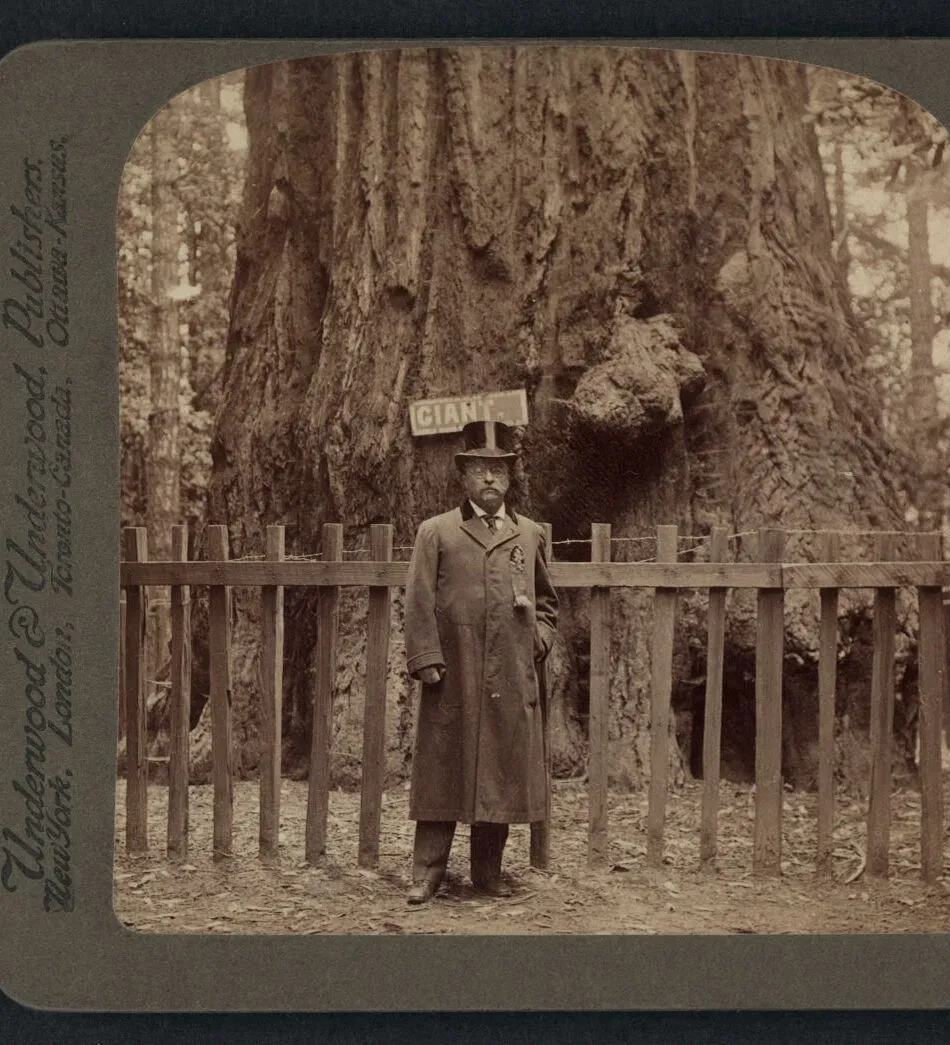
In March 1907 Roosevelt set aside some 16 million acres of national forest, the ‘Midnight Forests,’ before signing the bill that curbed his authority. (Underwood & Underwood)
Continue Reading
- Roosevelt's Presidency Overview — Seven and a half years that transformed America
- Conservation Legacy — 230 million acres protected for future generations
- Nobel Peace Prize — Peacemaker on the world stage
- The Panama Canal — Engineering triumph and imperial controversy
- Trust-Busting and Reform — Taking on the giants of American business
From the Archives
Explore original photographs, documents, and illustrations related to these facts in the Theodore Roosevelt Center Digital Library.
- Conservation photograph — Images of Roosevelt's protected lands and natural monuments
- Nobel Peace Prize documentation — Records of Roosevelt's diplomatic achievements
Recommended Reading
- Theodore Roosevelt: A Life, Nathan Miller, 2011, ISBN 978-0062078543