
First Annual Message to Congress (1901)
Blueprint for a Transformative Presidency
December 3, 1901. President Theodore Roosevelt delivered his first message to Congress—what we would now call the State of the Union address. The document was written rather than spoken, as was the custom of the era—the president did not personally deliver the State of the Union address to Congress until Woodrow Wilson broke that tradition. Yet the message was widely printed in newspapers and was clearly intended to reach the American public directly.
McKinley's assassination had thrust Roosevelt into the presidency only three months earlier. He was not supposed to be here. Republicans had put him on the ticket as vice president expecting him to be safely sidelined, to occupy an office with no power or influence. Instead, an assassin's bullet had made him the youngest president in American history at age forty-two. Republican leaders and conservative politicians worried about what this energetic, unpredictable New Yorker might do with the power of the presidency.
Now, with barely time to catch his breath and to understand the full scope of presidential authority, Roosevelt had to present a legislative program to Congress and the nation. He faced a delicate political situation. Some Republicans doubted him. Conservatives feared his radical instincts and his willingness to challenge corporate power. Democrats saw an opportunity to oppose him and to regain power. Yet Roosevelt approached the task with characteristic energy and vision. His first annual message was not merely a speech—it was a manifesto, outlining an entirely new conception of presidential power and federal responsibility.

Theodore Roosevelt became president in September 1901 and delivered his first Annual Message to Congress that December, laying out an ambitious national agenda (Library of Congress).

Roosevelt moved carefully at first, working within his inherited cabinet even as he prepared bolder action. Here he signs his 1902 Thanksgiving proclamation (Library of Congress).
The Political Context: Moving Carefully While Acting Boldly
Roosevelt understood that he was in a precarious political position. He had not been elected. He had not been nominated. He had inherited the presidency through tragedy. Some Republicans questioned whether he would honor the conservative orthodoxy of the party. Radical Republicans questioned whether he would be bold enough to challenge the Republican establishment. Roosevelt's first annual message had to balance these competing demands. He had to reassure Republicans that he was not a radical revolutionary who would overturn the established order. Yet he also had to signal that he intended to use presidential power actively to address the problems he saw.
His solution was to frame his agenda as conservative—as preservation of the American system through necessary reforms. Trusts had to be regulated not because the system was corrupt but because corruption was threatening to destroy the system. Conservation was necessary not as environmental sentiment but as practical stewardship of national resources. Labor unrest had to be addressed not through socialism but through fair dealing and justice. In this way, Roosevelt presented radical proposals in conservative language, changes that seemed necessary for the preservation of established institutions.
Trust-Busting and the Regulation of Corporations
The message confronted the question of trusts and monopolies head-on. Large combinations of capital had become a defining feature of American business. They promised efficiency but often produced exploitation, suppressed competition, and corrupted politics. Roosevelt did not believe in abolishing corporations—he understood they were inevitable in modern industry. But he believed they had to be regulated and controlled.
Characteristically, he balanced praise with warning—acknowledging what the builders of industry had achieved while insisting that the abuses be corrected. The distinction he drew between beneficial and harmful combinations would become contentious: Who decides which trusts are bad? By what standard? Yet the principle was clear: the federal government had a responsibility to police corporate power.
"The captains of industry who have driven the railway systems across this continent, who have built up our commerce, who have developed our manufactures, have on the whole done great good to our people. … [I]t is also true that there are real and grave evils, one of the chief being over-capitalization because of its many baleful consequences; and a resolute and practical effort must be made to correct these evils."
— First Annual Message to Congress, December 3, 1901
His first prescription was knowledge: "The first essential in determining how to deal with the great industrial combinations is knowledge of the facts—publicity." A more aggressive line often attributed to this message—"The great corporations which we have grown to speak of rather loosely as trusts are the creatures of the State, and the State not only has the right to control them, but it is in duty bound to control them wherever the need of such control is shown"—actually came eight months later, in Roosevelt's remarks at Providence, Rhode Island, on August 23, 1902. The principle was the same in both texts, and it would define his presidency: corporations derive their existence from the law, and the public, through its government, may hold them to account.

A period cartoon casts Roosevelt as a hunter taking aim at the "Beef Trust," reflecting his call for federal supervision of the great corporations and combinations (Library of Congress).

Roosevelt urged Congress to conserve the nation’s forests and natural resources. Here he stands with a party at the base of a giant sequoia in Yosemite (Harvard College Library, Theodore Roosevelt Collection).
Conservation and the Protection of Natural Resources
The annual message emphasized conservation as a fundamental national objective. America's forests were being devastated by unregulated logging. Minerals were being extracted with no thought to depletion. Rivers and waterways were being polluted. The nation had to act to preserve these resources for future generations.
Roosevelt outlined specific steps: protection of forest reserves, investigation and reclamation of arid lands through irrigation, improvement of waterways for commerce and power generation. These were not mere proposals; they were commitments that would be pursued relentlessly. The message essentially announced that the executive branch would use existing law and recommend new legislation to establish federal control over natural resources.
The Square Deal and Protection of Workers
The message promised fair treatment for all classes of citizens—the policy Roosevelt would soon make famous as the "Square Deal," a phrase he began using publicly in 1903. Capital had its rights and should be respected. But labor also had rights—to fair wages, safe conditions, reasonable hours. Government had a responsibility to ensure that the strong did not exploit the weak, that capital did not crush labor. This was justice, not socialism.
Roosevelt recommended federal action on child labor, workplace safety, and the regulation of working hours. These recommendations went beyond anything the federal government had previously attempted. They represented an enormous expansion of federal authority into labor relations. Yet Roosevelt framed them not as radical but as simple justice and prudent social policy.

Roosevelt’s emerging Square Deal promised fair treatment for working people. Powder men pose at a coal mine of the era (Harvard College Library, Theodore Roosevelt Collection).

Roosevelt pressed Congress to keep building a strong, modern Navy. Here he greets the fleet on its return from an around-the-world cruise (Harvard College Library, Theodore Roosevelt Collection).
A Strong National Navy and Military Preparedness
The message emphasized the need for a powerful navy and military. This was not warmongering—Roosevelt believed a strong military actually promoted peace by deterring aggression. A weak nation tempted ambitious rivals. A strong nation maintained stability. Roosevelt called for continued expansion of the Navy and for military readiness.
His stress on readiness reflected his belief that citizenship entailed responsibility, including the duty to be prepared to defend the nation. Physical vigor and military preparation were interconnected with the broader vision of national strength.
Civil Service Reform and Good Government
From his experience on the Civil Service Commission, Roosevelt deeply believed in merit-based government. The message called for expansion of civil service protections, ensuring that federal employees were hired and promoted on the basis of competence, not political patronage. This was less flashy than trust-busting, but equally important. Clean, efficient government was the foundation of reform.

Roosevelt championed civil service reform and honest, efficient government. He works here at his desk (Library of Congress).
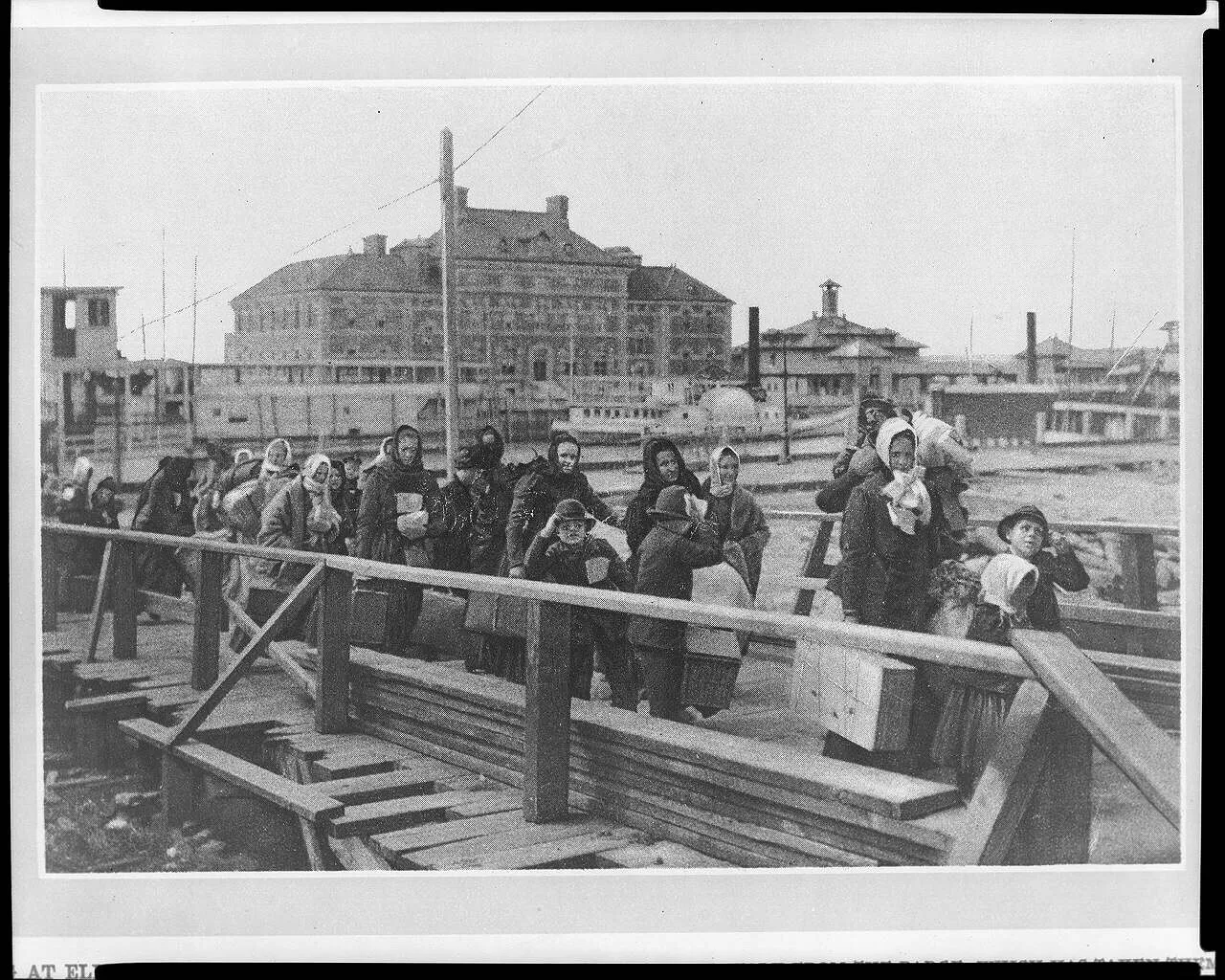
Roosevelt addressed immigration and national identity in his message, favoring newcomers who would become good citizens. New arrivals land at Ellis Island (Library of Congress).
Immigration, Race, and National Identity
The message also addressed immigration and national character. Roosevelt believed America should welcome immigrants, but they had to assimilate into American culture and values. Hyphenated identities—German-Americans, Italian-Americans—bothered him. He wanted Americans, period. This reflected both progressive and problematic elements of his thinking. He was inclusive in wanting to welcome newcomers but restrictive in demanding cultural conformity.
The Vision Unfolds
The first annual message is important because it laid out the agenda that would define Roosevelt's presidency. Trust-busting, conservation, labor protection, military strength, civil service reform, and expansion of federal power—all were announced in this single document. Some would succeed. Some would face fierce opposition. Some would take years to implement. But the vision was clear from the beginning.
Roosevelt was not making this up as he went along. He had a theory of government, a theory of national purpose, and a willingness to use presidential power to advance both. The first annual message was his declaration of intent.

Roosevelt used the bully pulpit to carry his vision to the public and build support for his agenda. He speaks here to a large gathering (Library of Congress).
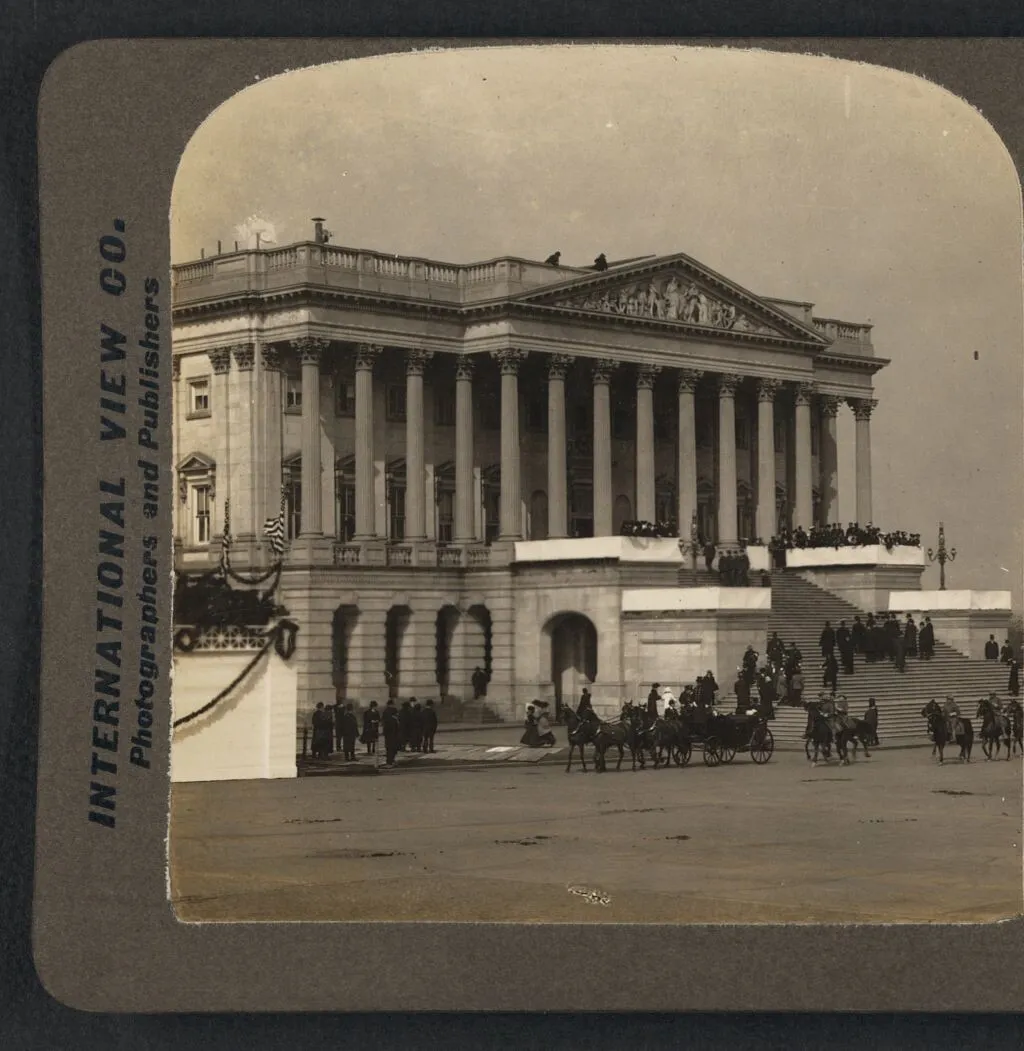
Roosevelt’s proposals alarmed conservatives in Congress, where much of his agenda would be debated and contested. The Senate wing of the Capitol (Library of Congress).
Reaction and Opposition: Conservative Alarm
The first annual message alarmed conservatives both in Congress and in the business community. The call for federal regulation of trusts was viewed as hostile to business and dangerously radical. The emphasis on conservation was seen as government overreach into private property rights. The call for federal involvement in labor matters was viewed as the first step toward socialism. Yet Roosevelt had framed his proposals carefully enough that outright opposition was politically difficult. He was not attacking capitalism or property rights. He was asking for the regulation and oversight of corporations that had become powerful enough to corrupt politics and exploit workers. How could one defend the right of corporations to exploit workers or to corrupt government?
Yet many Republicans were skeptical. They believed that Roosevelt would push his agenda too far, that he would alienate the business community, that his presidency would be chaotic and destabilizing. They did not anticipate the skill with which Roosevelt would navigate the political landscape—building public support for his agenda, using the presidency to shape national conversation, and ultimately winning overwhelming support in the 1904 election.
The Agenda Unfolds: Seven and a Half Years of Transformation
The first annual message announced an agenda that would shape the next seven and a half years of Roosevelt's presidency. Trust-busting began immediately, with the Northern Securities case filed in the first year of his presidency. Conservation efforts accelerated throughout his tenure—by the time he left office, he had set aside 230 million acres of public land, including national parks, national forests, and wildlife preserves. Labor disputes were addressed through mediation and through presidential intervention. Federal power expanded in ways that had been unthinkable before Roosevelt came to office.
Not all of Roosevelt's agenda succeeded. Some of his proposals were defeated in Congress. Some had to be modified or compromised. But the first annual message established the template: the president would use the full power of his office to advance a progressive agenda. Congress would be invited to cooperate, but the executive branch would not wait passively for congressional action. The presidency had become an active force for change.

Over seven and a half years, the agenda Roosevelt outlined in his first message unfolded into a transformative presidency at home and abroad. He sits here beside a globe (Library of Congress).
Legacy of the Message
Later presidents would cite Roosevelt's first annual message as a precedent for executive action and federal responsibility. The modern presidency—active, interventionist, defined by the president's agenda rather than Congress's—can trace its origins to Roosevelt's willingness to act decisively and his conviction that the president must act as "a steward of the people," as he later put it in his 1913 An Autobiography.
The message also established Roosevelt as an intellectual force in politics. He was not merely wielding power arbitrarily. He had a theory of government, a understanding of national purpose, and a vision of what America needed to become. The first annual message laid out that vision clearly and persuasively. It explained why the expansion of federal power was necessary, why regulation of corporations was justified, why conservation mattered. It was a philosophical argument as much as a political one.
The substance of many proposals in the first annual message has become taken for granted in modern American governance. Federal regulation of corporations is now routine. Conservation of natural resources is accepted policy. Federal involvement in labor disputes is normal. Yet in 1901, these were radical proposals that seemed to suggest a fundamental transformation of the American system. Roosevelt's first annual message was the declaration of that transformation.
Continue Reading
- Inaugural Address (1905) – Roosevelt's speech after winning his own election, outlining his vision for his second term
- Trust-Busting and Corporate Regulation – The antitrust policies Roosevelt announced in this message
- The Square Deal – Roosevelt's philosophy of fair dealing between capital and labor
- Conservation Legacy – The conservation efforts this message initiated
- Roosevelt on Leadership and Power – His views on executive authority and national purpose
- How Roosevelt Became President – The context of his unexpected ascension to the presidency
Primary Sources at the TR Center
Read Roosevelt's complete speeches and policy documents in the Theodore Roosevelt Center's Digital Library, where you can access his addresses alongside scholarly analysis of his presidency.
- Speeches Resource Collection – Access to Roosevelt's most important public addresses
- Politics and Government Encyclopedia – Articles on his policies and political philosophy
- Roosevelt's Complete Works – All of his published writing and speeches
- Reading and Writing Encyclopedia – Information about Roosevelt as a reader and intellectual
- Roosevelt Biography and Timeline – Comprehensive biographical information
From the Archives
Explore original photographs, documents, and illustrations related to this topic in the Theodore Roosevelt Center Digital Library.
- Theodore Roosevelt in the West — Roosevelt portrait
- Col. Roosevelt in Rough Riders uniform — Roosevelt portrait
Recommended Reading
- Theodore Rex by Edmund Morris (2001). ISBN: 978-0-307-77781-2
- The Bully Pulpit by Doris Kearns Goodwin (2013). ISBN: 978-1-4165-4786-0