
Inaugural Address (1905)
The Only Inaugural of the First Modern President
March 4, 1905. Theodore Roosevelt stood on the Capitol steps to deliver the only presidential inauguration speech of his presidency. He had assumed the presidency upon McKinley's assassination in September 1901, taking the oath of office in a brief ceremony at the Wilcox Mansion in Buffalo on September 14, 1901—but there had been no inaugural address. Now, after winning the 1904 election by a landslide that gave him an unprecedented personal mandate, he delivered an inaugural address that was relatively brief compared to many of his speeches, yet dense with meaning.
The context of the 1905 inauguration was significant. Roosevelt had served as president for more than three years—longer than most first-term presidents had served at the time of their inaugurations. He had already set his mark on the presidency. He had already broken up trusts, begun conservation efforts, intervened in labor disputes, expanded American naval power, and engineered the independence of Panama. Yet the 1904 election had given him something he deeply wanted: legitimacy derived from his own election, not from the accident of McKinley's death.
Roosevelt had won the 1904 election by the largest margin any president had yet achieved. He had received over 56 percent of the popular vote. He had carried every region outside the Solid South—the West, the Midwest, the Northeast, and border states such as Missouri. His victory was comprehensive and decisive. It was, he believed, a mandate from the American people to pursue his progressive vision with even greater vigor. At forty-six, he was the youngest man yet elected to the presidency. His inaugural reflected both the confidence of a president who had won decisively and awareness of the immense responsibilities ahead in a second term.

The Capitol, draped in bunting, during Theodore Roosevelt's inauguration for a term in his own right, March 4, 1905. (Library of Congress)

President Theodore Roosevelt around the time of his 1905 inauguration, when he spoke of America's new standing as a world power. (Library of Congress)
A President Conscious of American Power
The inaugural addressed America's new position in the world. The United States had emerged from the Spanish-American War as a great power with overseas territories and global responsibilities. Roosevelt acknowledged this without apology. America had to be strong—militarily, economically, morally. A weak nation could not protect its interests or fulfill its obligations. A strong nation had responsibilities that could not be shirked.
He emphasized the need for a strong navy and a strong military. These were not instruments of aggression but of peace. Nations that were weak were tempted to be adventurous, hoping to punch above their weight. Nations that were strong could afford to be measured and strategic. Power, properly wielded, produced stability.
"Much Has Been Given Us": The Keynote of Duty
"Much has been given us, and much will rightfully be expected from us. We have duties to others and duties to ourselves; and we can shirk neither."
— Inaugural Address, March 4, 1905
This was the keynote of the address: gratitude joined to obligation. At under a thousand words, the speech was among the shortest inaugural addresses ever delivered, and it named no specific program—no trusts, no tariff, and, contrary to a common misconception, no conservation agenda. Instead Roosevelt organized it around a single moral idea: a people to whom much has been given owes corresponding duties, at home and abroad, and "we can shirk neither."
The challenges he did invoke were the broad ones of the industrial age. "Modern life is both complex and intense," he told the crowd, "and the tremendous changes wrought by the extraordinary industrial development of the last half century are felt in every fiber of our social and political being." Self-government itself was the "formidable" experiment on trial; if Americans failed, "the cause of free self-government throughout the world will rock to its foundations."
One famous line is often mistakenly attached to this speech: "The conservation of our natural resources and their proper use constitute the fundamental problem which underlies almost every other problem of our national life." Roosevelt did say it—but in his Seventh Annual Message to Congress on December 3, 1907, not in the inaugural. Conservation was central to his second term, yet it went unmentioned on inauguration day.

President Roosevelt at work. His 1905 inaugural cast the nation’s growing strength as a shared, forward-looking obligation. (Library of Congress)

Theodore Roosevelt addresses a vast crowd during the 1905 inaugural festivities, invoking the duties of citizenship. (Library of Congress)
The Duties of Citizenship
Roosevelt did not separate national purpose from individual responsibility. Citizens had duties—to work, to be moral, to contribute to the common good. The nation could only be strong if its citizens were vigorous, honest, and engaged. This reflected his long-standing conviction that democracy could not survive among a people that were weak or corrupt or indifferent to public affairs.
This was the ethic of what he famously called the "Square Deal"—fair dealing among all classes of citizens, protection of the weak from exploitation, punishment of the corrupt and dishonest. He had used the phrase publicly since 1903, and though the inaugural address itself did not repeat it, the speech distilled the same creed of mutual obligation. This was not socialism or radical redistribution. It was a vision of capitalism reformed and moralized, where hard work was rewarded, fraud was punished, and the vulnerable were protected.
Themes of Balance and Responsibility
The inaugural reflected Roosevelt's belief in balanced action. The nation needed both strength and restraint, both protection of workers and encouragement of business, both strong executive action and respect for law. There was nothing radical in the message, yet everything was pointed toward greater federal responsibility and intervention.
Behind the address stood his conviction that the president must act as "a steward of the people"—the phrase he later used in his 1913 An Autobiography to describe his theory of the office. It was a significant claim at a time when many believed the presidency should be a limited office. Roosevelt believed the executive had both the right and the duty to act aggressively to protect the public interest, to conserve resources, to regulate business, and to advance national purposes.
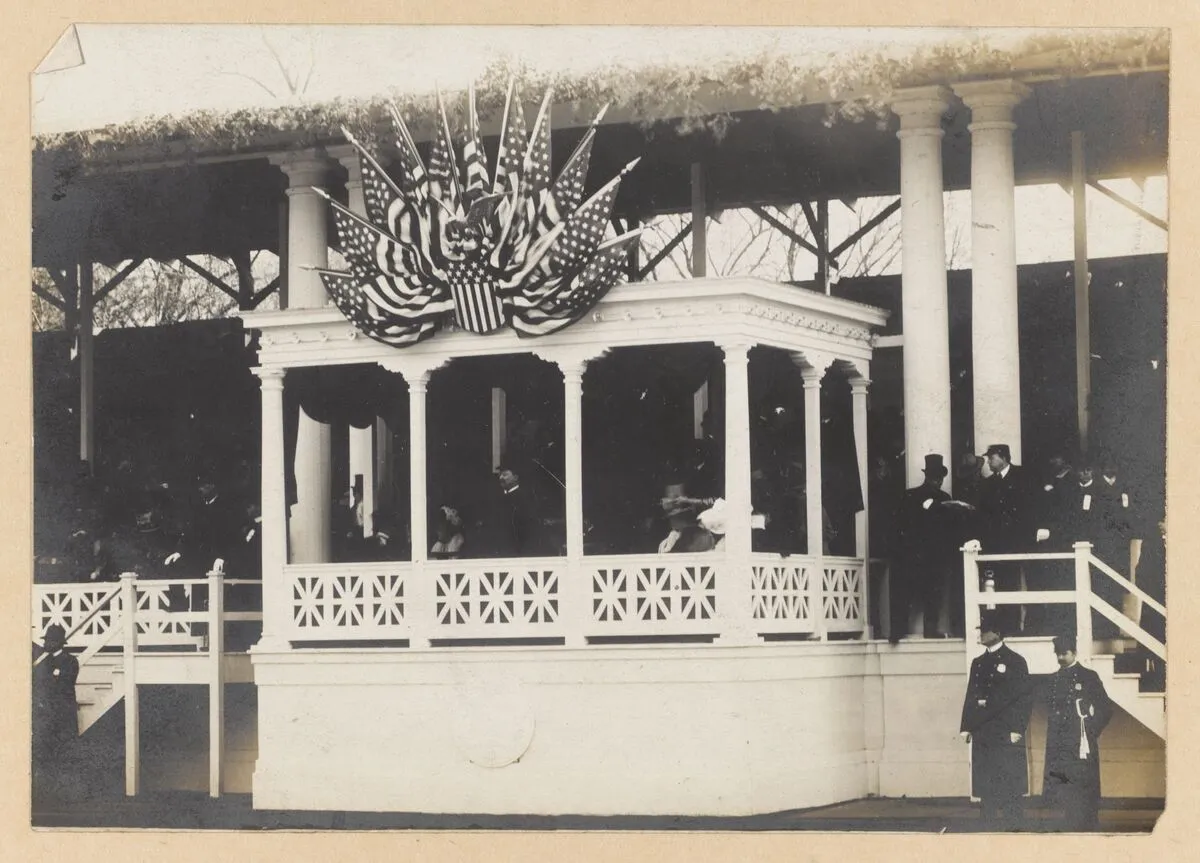
The flag-draped presidential reviewing stand erected for the 1905 inauguration, where Roosevelt watched the parade pass. (Library of Congress)

Pennsylvania Avenue, from the Treasury toward the Capitol, thronged for Roosevelt's 1905 inaugural procession. (Library of Congress)
Technological Modernity and Natural Reverence
Roosevelt rode to his inauguration in a horse-drawn carriage, as tradition dictated—the first president to ride to an inauguration by automobile would be Warren G. Harding in 1921. But Roosevelt had already made history as the first sitting president to ride publicly in an automobile, during a 1902 tour of Hartford, Connecticut. The pairing was fitting. Roosevelt embodied modernity—new technologies, new ideas, new methods—while also being deeply connected to nature and the past. He was not a backward-looking conservative trying to preserve a lost world. He was a modern man who believed that progress and conservation could coexist.
The Inauguration Day: Ceremony and Symbolism
The inauguration day blended ceremony and spectacle. Roosevelt rode to the Capitol in a horse-drawn carriage, escorted by cavalry and cheered by enormous crowds, and the parade that followed was among the most colorful yet staged—Rough Riders, cowboys, and American Indian leaders including Geronimo marched down Pennsylvania Avenue. Roosevelt embodied the modern presidency—energetic, forward-looking, embracing new technologies and new methods. Yet he was not a man who rejected the past. He valued tradition, history, and the continuity of American institutions. The mixture of modernity and tradition in the inauguration ceremony reflected the mixture in his presidency itself.
The ceremony drew enormous crowds to Washington. People lined the streets to see the president. The Capitol was packed with supporters and political leaders. Roosevelt's victory had been so comprehensive that even many Democrats seemed willing to acknowledge his triumph. The crowd sensed that history was being made, that a new era of American politics was being inaugurated along with the president.

The inauguration of President Roosevelt at the United States Capitol, with troops and spectators, March 4, 1905. (Library of Congress)

The inaugural parade moves along Pennsylvania Avenue after Roosevelt's swearing-in on March 4, 1905. (Library of Congress)
A Fateful Promise: The Pledge Not to Run Again
The inaugural address itself contained no such statement, but Roosevelt had already made a promise he would later regret: on election night, November 8, 1904, he declared that he regarded his three and a half years as a full term and would “under no circumstances” be a candidate for another nomination. The promise was made partly for political reasons—it was traditional for presidents not to seek more than two terms, though no constitutional requirement existed at that time. It was also made partly because Roosevelt believed that a president should not hold power too long, that rotation in office was healthier for the republic.
Yet the promise would haunt him. Over the next three years, as his presidency unfolded and his progressive vision became increasingly controversial, Roosevelt came to believe that his successor William Howard Taft did not share his commitment to progressive reform. By 1912, Roosevelt was convinced that Taft had betrayed the progressive cause and that he, Roosevelt, needed to return to power. But the promise he had made in 1904 made his return to politics complicated and controversial. He had pledged not to run again, yet now he was running again. The contradiction would dog him throughout the 1912 campaign and would contribute to his ultimate electoral defeat.
The Next Chapter: A President Empowered
The inaugural address essentially announced that Roosevelt would use the presidential office to its fullest in pursuit of his agenda. He had won election by a tremendous majority. The people had endorsed him. Now he would act. Over the next three and a half years, he would conserve 230 million acres of public land, build the Panama Canal, pursue more than forty antitrust suits against the great corporate combinations, arbitrate the Russo-Japanese War (earning the Nobel Peace Prize), and transform the presidency into the powerful, activist office it has remained ever since.
More importantly, the 1905 inaugural marked the beginning of his evolution toward full progressivism. The cautious reformer of his first years as president was being replaced by a more ambitious visionary. The second term would see Roosevelt pushing even harder for conservation, for labor protection, for regulation of corporate power. By the end of his presidency, he would be estranged from conservative Republicans and would be contemplating a run for president as a Progressive candidate in 1912.
The 1905 inaugural address was, in retrospect, the moment when Roosevelt was most fully endorsed by the American electorate and most confident in his mandate to pursue his vision. It was fitting that he marked that moment with a speech that combined his optimism about American progress with his warnings about the need for constant moral and political renewal.
Continue Reading
- First Annual Message to Congress (1901) – Roosevelt's blueprint for transformative presidential power
- Conservation and the National Parks – The legacy of Roosevelt's conservation efforts
- Roosevelt and Executive Power – His vision of presidential authority and responsibility
- Roosevelt on Leadership – His philosophy of what it means to lead
- The Roosevelt Presidency – Overview of his years in office
- Citizenship in a Republic – His 1910 speech on the duties of engaged citizenship
Primary Sources at the TR Center
Explore Roosevelt's inaugural address and other major speeches in the Theodore Roosevelt Center's Digital Library, with scholarly context and analysis.
- Speeches Archive – Access to all of Roosevelt's major addresses and State of the Union messages
- Roosevelt's Libraries and Reading – Insights into the intellectual foundation of his ideas
- Politics and Government Encyclopedia – Scholarly articles on his presidency and policies
- Theodore Roosevelt Timeline – His life and presidency in chronological context
- Roosevelt's Complete Writings – Comprehensive collection of his books, essays, and speeches
From the Archives
Explore original photographs, documents, and illustrations related to this topic in the Theodore Roosevelt Center Digital Library.
Recommended Reading
- Theodore Rex by Edmund Morris (2001). ISBN: 978-0-307-77781-2
- Theodore Roosevelt: A Strenuous Life by Kathleen Dalton (2007). ISBN: 978-0-307-42968-1