
Confession of Faith (1912)
The Convention Setting: Chicago and the Progressive Fervor
The Progressive Party Convention of August 1912 was unlike any political convention in American history. The delegates were not the typical party regulars or power brokers who dominated conventions. Instead, they were idealists, reformers, intellectuals, and ordinary citizens who believed that the Republican Party had been captured by conservative interests and that Roosevelt represented the best hope for progressive change. The energy in the convention hall was fervent, almost religious. Delegates sang hymns. They displayed signs and banners. They seemed to view the convention not as a political event but as a moral and spiritual crusade.
Roosevelt himself was energized by the atmosphere. He had been considering a third-party run for months, but the convention crystallized his commitment. He would not be a passive observer of Taft's conservative presidency. He would lead a movement to reclaim the Republican Party's progressive heritage. If the Republican Party would not follow him, he would build a new party—the Progressive or "Bull Moose" party—and make his stand there.

Theodore Roosevelt addresses a packed hall during the fervent 1912 Progressive campaign. (Library of Congress)

Roosevelt delivers a campaign speech at Yonkers, New York, on October 17, 1912, in the crusading style of the Progressive fight. (Library of Congress)
Standing at Armageddon for Progressive Reform
On August 6, 1912, Theodore Roosevelt stood before the Progressive Party Convention to accept the party's nomination for president. He was splitting the Republican Party—a party he had led and loved and built his career within. He was defying the conservative establishment. He was running on a platform that included women's suffrage, minimum wage laws, child labor prohibition, enhanced government regulation of industry, and direct democracy measures. He knew the odds were against him. He knew that splitting the Republican vote would likely result in the election of Woodrow Wilson, the Democratic candidate. But he was convinced of the righteousness of the cause. The stakes were too high for caution or calculation.
He closed his acceptance speech with words that had already become immortal in American political discourse—a line he had first delivered on June 17, 1912, addressing supporters in Chicago on the eve of the Republican convention:
"We stand at Armageddon, and we battle for the Lord."
— "A Confession of Faith," Progressive Party Convention, Chicago, August 6, 1912
The phrase came from the Bible, referencing the final apocalyptic battle between good and evil in the book of Revelation. Roosevelt was not claiming divine authority for his political program—but he was claiming moral seriousness. The fight for progressive reform was, in his mind, a fight for the soul of America. Compromise with conservative Republicans was impossible because the stakes were too high. This was not ordinary politics. This was a moral crusade.
The Progressive Platform and Its Radical Elements
The Progressive Party platform that Roosevelt championed was the most explicitly reformist platform ever adopted by a major American political movement to that point. It included:
- Women's suffrage—a radical position in 1912, embraced by Roosevelt despite the opposition of many allies
- Minimum wage and maximum working hours for workers, especially women
- Child labor prohibition—outlawing the use of children in factories and mines
- Workers' compensation—employers held financially responsible for worker injuries
- Social insurance—the ancestors of Social Security and unemployment insurance
- Income tax and progressive taxation to fund government social programs
- Trust-busting and regulation of monopolies
- Conservation of natural resources under federal control
- Direct democracy measures—initiative, referendum, recall of judges
This was a program of comprehensive social reform, far more ambitious than anything Roosevelt had proposed as president. It was also far more aligned with what would become the welfare state and modern liberal democracy. In many respects, Roosevelt in 1912 was articulating principles that would shape the next century of American politics.

Roosevelt makes the case for the Progressive platform from a flag-draped speaking stand during the 1912 campaign. (Theodore Roosevelt Collection, Harvard College Library)

Roosevelt exhorts a crowd at Hackensack, New Jersey, in 1912, the near-revivalist fervor of his Progressive campaign. (Library of Congress)
The Religious Dimension: Progressive Reform as Moral Crusade
Roosevelt's language was deliberately prophetic and moral. He was appealing not just to the intellect but to conscience. Progressive reformers included many clergy and people motivated by religious conviction—the Social Gospel movement was at its height in American Protestantism. They believed that Christian faith demanded social justice, protection of the vulnerable, and challenge to the wealthy and powerful who exploited workers. They believed that the Golden Rule and the command to love thy neighbor implied obligations to reshape society to protect the least fortunate.
Roosevelt was tapping into this religious current in American progressivism. The hymn-singing at the convention, the sense of moral seriousness, the conviction that higher principles were at stake—all of this drew on the religious language and sentiment that motivated many progressives. Roosevelt himself was not deeply religious in a doctrinal sense. He was an Episcopalian by tradition, but not by deep conviction. Yet he believed absolutely in the moral dimension of politics. Reform was not merely practical or efficient; it was righteous. Evil—in the form of child labor, exploitation, corruption, and the grinding poverty of industrial workers—had to be fought with the full force of righteous indignation. Good—in the form of justice, opportunity, and human dignity—had to be advanced with missionary zeal.
The Hymn-Singing Convention: Politics as Revival
At the Progressive Party Convention, delegates literally sang hymns. The convention had the character of a religious revival—not a political event in the ordinary sense. There was "Onward Christian Soldiers," adopted as a kind of campaign anthem. There was "Battle Hymn of the Republic," with its associations with the abolitionist movement and the struggle against slavery. The convention felt like a moral revival because, for the delegates present, it was. They believed they were fighting for the soul of the nation, just as the abolitionists had fought against slavery.
This religious fervor gave the Progressive movement a particular character. It was not cynical or calculating. It was not engaged in the ordinary compromises and horse-trading of politics. The delegates present genuinely believed they were engaged in a righteous cause. This conviction lent strength and courage to the movement. It also lent an absoluteness that made compromise and pragmatism difficult. If you believed you were fighting for the Lord, how could you compromise with the forces of evil?

Supporters distribute Bull Moose circulars on a city street in 1912, the grassroots enthusiasm behind the Progressive movement. (Library of Congress)
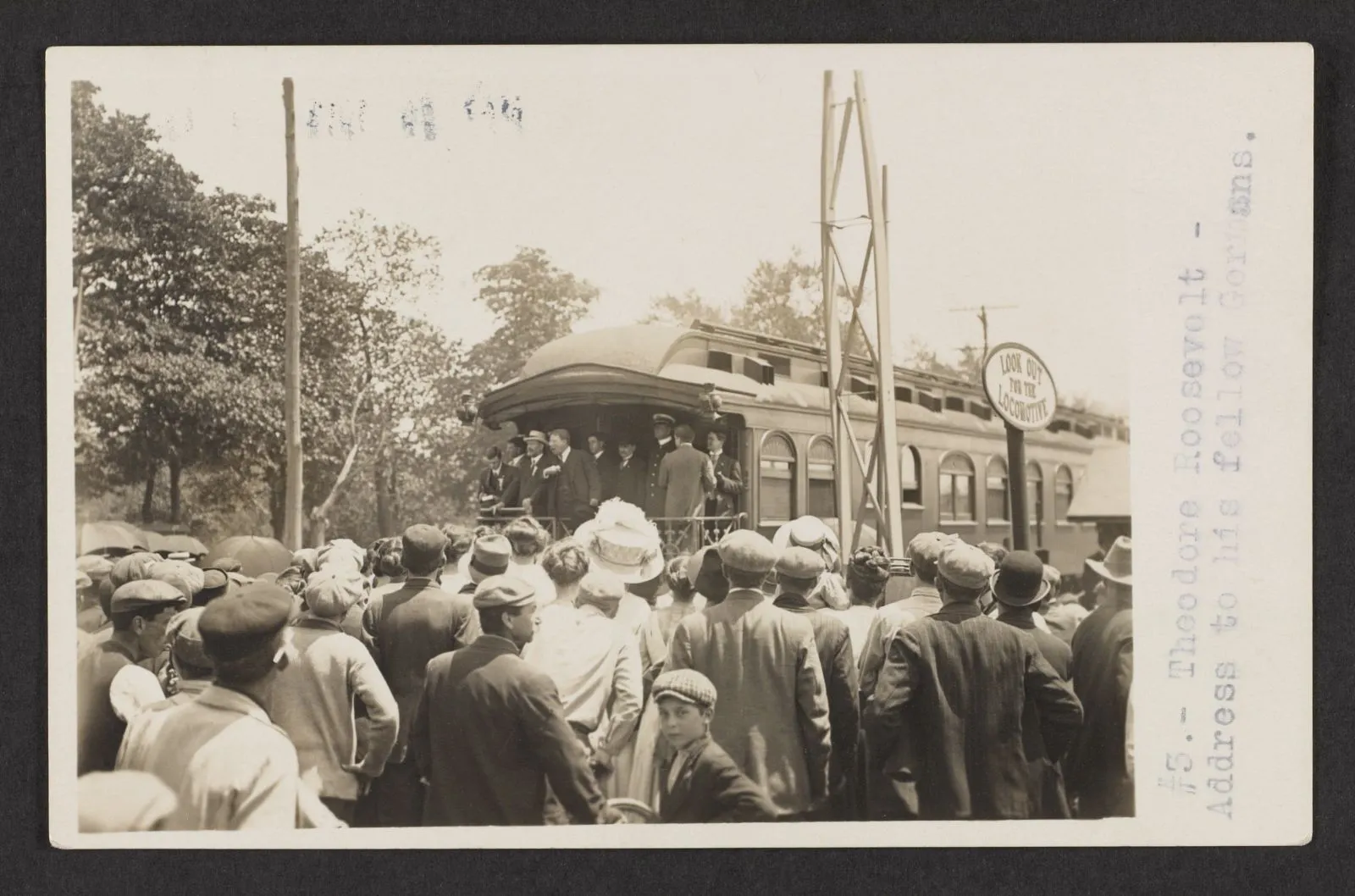
Roosevelt takes his case directly to the people in 1912, appealing over the party bosses and special interests he denounced. (Library of Congress)
Against Special Interests and Political Machines
Roosevelt identified the enemy clearly: the "special interests" and the political machines they controlled. Wealthy industrialists, corrupt politicians, and self-serving elites had captured the Republican Party and were blocking reform. The Democratic Party, while sometimes progressive, was also compromised by conservative Southern Democrats and urban machines. Only the Progressive Party, untainted by decades of power and corruption, could truly represent the people. This rhetoric resonated powerfully with middle-class reformers, intellectuals, union activists, and ordinary citizens who felt betrayed by both major parties.
The target was specific: President William Howard Taft and his Republican administration. Taft had succeeded Roosevelt and had disappointed progressive Republicans by taking a more cautious approach to conservation, to antitrust enforcement, and to executive power generally. Progressives believed that Taft had betrayed Roosevelt's legacy. They demanded that Roosevelt return to lead the movement for reform. When the Republican Party refused to renominate Roosevelt and instead selected Taft, progressive Republicans felt they had no choice but to bolt the party and form a new one. Roosevelt's willingness to lead this bolt—to split the Republican Party and run as a third-party candidate—was understood as the ultimate expression of his commitment to progressive principles. He would not compromise for party unity. The cause was more important than party loyalty.
The Electoral Outcome and Progressive Influence
Roosevelt lost the 1912 election. Woodrow Wilson won for the Democrats, but Roosevelt finished second with 27.4 percent of the popular vote and 88 electoral votes—the only time in American history a third-party candidate has outpolled a major party nominee. The Republican incumbent, William Howard Taft, came third with 23.2 percent and just 8 electoral votes. Roosevelt's split from the Republicans allowed Wilson—who had his own progressive agenda—to assume the presidency. Yet the Progressive movement's influence on American politics was profound. Many of the platform's proposals became law in subsequent years. Women won the vote in 1920. Child labor was eventually prohibited. Minimum wage and working hour laws spread. Social insurance became foundational to American policy.
Wilson, despite being a Democrat and a rival, adopted much of the progressive agenda. The New Deal under Franklin D. Roosevelt in the 1930s would make many of these proposals permanent parts of American law and government structure. In this sense, Roosevelt's "Confession of Faith" was a battle he lost electorally but won historically.

Roosevelt with his running mate, California Governor Hiram Johnson, after the Progressive Party nominated them in 1912. (Library of Congress)

A dignified portrait of Theodore Roosevelt from around the time of his 1912 Progressive campaign. (Library of Congress)
The Autobiographical Dimension
The speech was also autobiographical. Roosevelt had once been a young Republican, aligned with the party's conservative wing. He had learned through experience—through seeing poverty, witnessing labor struggles, studying the dynamics of industrial capitalism—that the old order could not endure. Change was necessary. Reform was necessary. His own journey from conservatism to progressivism was part of the speech's emotional power. He was not a radical who had always opposed the establishment; he was a reasonable, educated, accomplished man who had concluded that fundamental reform was unavoidable.
Words That Echoed into the Future
"We stand at Armageddon, and we battle for the Lord." The phrase haunted American progressivism for generations. It became a rallying cry. It also became a cautionary tale about the dangers of apocalyptic rhetoric in politics. Can political reform be pursued without invoking cosmic moral struggle? Roosevelt believed not. Others would later argue that his language inflamed passions and made compromise impossible. The debate continues.
Continue Reading
- The New Nationalism – Roosevelt's 1910 speech outlining his progressive philosophy and vision for reformed capitalism
- The Man in the Arena: Citizenship in a Republic – His 1910 Sorbonne lecture on the duties of civic engagement
- The Bull Moose Campaign – Roosevelt's third-party run and the movement that reshaped American politics
- Roosevelt's Autobiography – His account of his life and the forces that shaped his political philosophy
- Roosevelt on Leadership – His views on power, responsibility, and the duties of those in authority
- Roosevelt on Citizenship – His beliefs about what active citizenship demands from individuals
Primary Sources at the TR Center
Explore the full text of Roosevelt's speeches and writings in the Theodore Roosevelt Center's Digital Library, where you can read his words alongside scholarly analysis and historical context.
- New Nationalism Encyclopedia Article – TR Center scholarship on Roosevelt's progressive political vision
- TR's Complete Published Works – Access to all of Roosevelt's books, essays, and addresses
- Roosevelt Biography – Comprehensive biographical information and timeline
- Politics and Government Encyclopedia – Articles on Roosevelt's policies and political philosophy
- Theodore Roosevelt Quotes Archive – Verified quotations from his speeches and writings
From the Archives
Explore original photographs, documents, and illustrations related to this topic in the Theodore Roosevelt Center Digital Library.
Recommended Reading
- Colonel Roosevelt by Edmund Morris (2010). ISBN: 978-0-679-60415-0
- Theodore Roosevelt, the Progressive Party, and the Transformation of American Democracy by Sidney M. Milkis (2009). ISBN: 978-0-7006-1667-1
- Let the People Rule by Geoffrey Cowan (2016). ISBN: 978-0-393-24984-2