
Ten Facts About Theodore Roosevelt's Rise to Power
1. Walked Midnight Beats Through NYC Slums with Photojournalist Jacob Riis
Police Commissioner and Urban Reform
Returning to New York in 1887, Theodore established himself as a reformer and writer. His books about the frontier had established his reputation as a serious observer of American life. In 1895, he was appointed Police Commissioner of New York City, a position that gave him authority to combat corruption in the police force and to confront the urban poverty and exploitation that characterized Manhattan's immigrant neighborhoods. Rather than remaining in his office, Roosevelt took to the streets himself, walking the midnight beats through the tenement districts of the Lower East Side alongside police officers and the pioneering photojournalist Jacob Riis. Riis, a Danish immigrant who had himself lived through poverty, used the revolutionary new technology of flash photography to document the conditions in which immigrant families lived and worked. Roosevelt and Riis formed an unlikely alliance: the wealthy reformer and the immigrant journalist, walking the dangerous streets at midnight, photographing and documenting the reality of urban poverty. These expeditions were not merely acts of charity or condescension; they were Roosevelt's attempt to see the actual conditions with his own eyes, to understand the scale and nature of the problem. His willingness to walk the streets himself, to put himself in situations of potential danger, to engage directly with the people and the problems rather than simply reading reports in an office—this revealed his character and established him as a leader who was willing to engage directly with reality.

As police commissioner, Roosevelt walked midnight beats through the city's slums, often alongside crusading reporter Jacob Riis (Library of Congress).

The Rough Riders drew cowboys, Ivy League athletes, Native Americans, and even a former Dodge City marshal into a single volunteer cavalry regiment (Library of Congress).
2. The Rough Riders Included Cowboys, Ivy Leaguers, Native Americans, and a Former Dodge City Marshal
A Regiment of American Types
When the Spanish-American War broke out in 1898, Theodore Roosevelt resigned his position as Assistant Secretary of the Navy to organize and lead a volunteer cavalry regiment that would become legendary in American military history: the 1st Volunteer Cavalry, popularly known as the "Rough Riders." The regiment was remarkable not for its military discipline or its professional training, but for the diversity of men who composed it. Roosevelt recruited cowboys from the Dakota Badlands and Texas, Ivy League athletes and Harvard friends, Native Americans from Indian Territory, former sheriffs and marshals, miners and hunters. The regiment represented a cross-section of American manhood as Roosevelt understood it: men of courage and physical capability, regardless of their background or social standing. The list of officers included men like Bucky O'Neill, a former mayor of Prescott, Arizona, and legendary lawman. The enlisted men included Harvard athletes, cowboys from the frontier, American Indians, and adventurers seeking to prove themselves. The regiment was, in some sense, a physical embodiment of Roosevelt's philosophy of American democracy: that rank and achievement should depend on capability and courage, not on inherited status or social position. A cowboy and an Ivy Leaguer served side by side, and both were valued for what they could do in combat. The Rough Riders became iconic in American imagination—the volunteer regiment composed of the nation's diverse types, united by courage and the desire to serve.
3. His Famous Charge Was Actually Up Kettle Hill, Not San Juan Hill
The Reality of Heroic Legend
The most famous military action of Theodore Roosevelt's life occurred on July 1, 1898, in Cuba, when he led a charge that became legendary in American memory. Popular history remembers this as the "Charge up San Juan Hill," a phrase that has echoed through American consciousness for over a century. The reality, however, was more complicated. The actual terrain that Roosevelt charged was Kettle Hill, a smaller elevation nearby San Juan Hill, not the better-known San Juan Hill itself. Roosevelt, mounted on his horse while his men advanced on foot, led a charge of Rough Riders and dismounted regular Army cavalry up the hill against Spanish defensive positions. The charge was successful; the American forces took the position and advanced. Roosevelt was not seriously wounded, though he was under heavy fire and came within seconds of being hit by Spanish bullets. The military significance of the charge has been debated by historians: it was a local tactical victory, but the larger battle was already being decided by other American units and by the overwhelming naval superiority that made Spanish defeat inevitable. What mattered was not the strict military significance but the impact on American imagination. Roosevelt, the young police reformer from New York, the rancher from the Dakota Badlands, had led a cavalry charge in combat. He had demonstrated physical courage under fire. He had proven that his words about the strenuous life and the need for American men to test themselves were not merely rhetoric; they were beliefs he was willing to enact with his own body. The charge up Kettle Hill—whatever its actual military significance—made Theodore Roosevelt a national hero and put him on the path to the presidency.

Roosevelt's famous charge actually crested Kettle Hill during the larger San Juan Heights battle, photographed by William Dinwiddie in 1898 (Library of Congress).
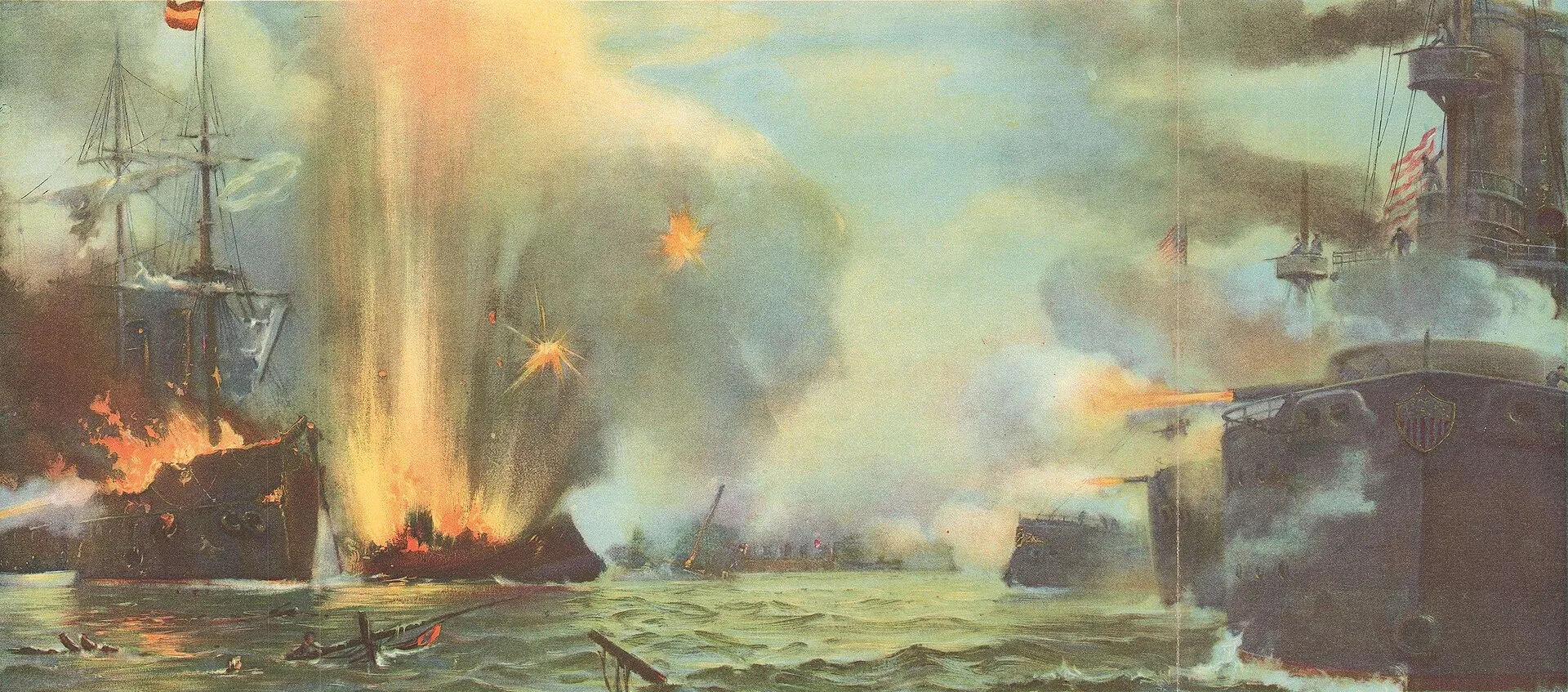
As Assistant Secretary of the Navy, Roosevelt cabled Commodore George Dewey the orders that set the Battle of Manila Bay in motion, depicted here by James Gale Tyler (Wikimedia Commons).
4. He Sent the Cable to Commodore Dewey That Launched the Battle of Manila Bay
Administrative Power and Military Strategy
Before Roosevelt became famous for the Rough Riders and the charge at Kettle Hill, he had already played a crucial role in determining the strategic direction of the Spanish-American War through his position as Assistant Secretary of the Navy. In February 1898, when Secretary of the Navy John D. Long was absent from his office, Roosevelt had the authority to issue orders to the Navy. Recognizing that war with Spain was imminent, Roosevelt sent a series of cables to Commodore George Dewey, commander of the Asiatic Squadron, instructing him to position his fleet near the Spanish Philippines and to be ready for immediate offensive action if war was declared. Roosevelt's strategic vision was bold and unconventional: rather than remaining on the defensive, waiting for Spanish forces to attack American territory, Dewey should immediately strike at Spanish power in the Pacific. When war was declared and Dewey received Roosevelt's orders, he sailed his fleet into Manila Bay and decisively defeated the Spanish squadron in a battle that lasted only a few hours. The Battle of Manila Bay was a stunning American victory, and it had been set in motion by cables sent by Roosevelt while serving as Assistant Secretary. This cable demonstrated Roosevelt's understanding that in modern warfare, strategic positioning and the willingness to take the offensive could determine entire campaigns. He was not content to wait passively for events to unfold; he was determined to shape events through bold action and clear orders.
5. Party Leaders "Kicked Him Upstairs" to Vice President to Get Him Out of New York Politics
An Escape Route to Power
After the Spanish-American War, Theodore Roosevelt returned to New York a genuine war hero. He was elected Governor of New York in 1898 and served with characteristic vigor, pursuing reform and antagonizing corrupt party bosses. But his independence and his tendency to act without consulting party leadership began to worry the Republican establishment in New York. New York's Republican boss, Senator Thomas Platt, saw Roosevelt as a loose cannon—too popular to simply remove from politics, but too independent and unpredictable to control. When Vice President Garret Hobart died in November 1899, Platt and his allies saw an opportunity. They could "kick Roosevelt upstairs" to the vice presidency, a position that would remove him from New York politics but would seem like a promotion. Vice President was historically a dead-end job that offered little real power. Mark Hanna, the Republican National Chairman and President McKinley's closest ally, opposed the scheme, warning against putting so unpredictable a man a heartbeat from the presidency. The strategy was transparent: elevate Roosevelt to a position of honor but with no actual authority. Roosevelt himself was initially reluctant, recognizing that the vice presidency offered little opportunity for the kind of active leadership he preferred. But party pressure was intense, and Roosevelt eventually accepted. He was elected Vice President in 1900. Few realized that within a year, an assassin's bullet would transform the vice presidency into the presidency, and the young man whom party leaders had tried to sideline would become the youngest president in American history.

Party leaders 'kicked Roosevelt upstairs' onto the 1900 McKinley ticket as vice president to move him out of New York politics (Wikimedia Commons).

Roosevelt became president at age forty-two, sworn in at this Buffalo home after President McKinley's assassination in September 1901 (Library of Congress).
6. Became President at Age Forty-Two When McKinley Was Assassinated
Death and Succession
On September 6, 1901, President William McKinley was shot by an anarchist assassin named Leon Czolgosz. McKinley lingered for eight days, and his condition seemed to improve, raising hopes that he might recover. Vice President Roosevelt, who had been in Vermont when the shooting occurred, rushed to Buffalo, then, reassured by the doctors, left to join his family in the Adirondacks. On September 13, McKinley's condition suddenly deteriorated. Roosevelt raced back through the night, and on September 14, 1901, at the age of forty-two years and ten months, he became the youngest man ever to assume the presidency of the United States. He was not a distant politician elevated to power through political maneuvering; he was a man of energy and action who had proven himself through his own deeds. His ascension to the presidency was met with shock and concern in some quarters. Mark Hanna famously said: "That damned cowboy is president." The concern was understandable: this was a man who had challenged Republican party leadership, who had advocated for aggressive trust-busting and reform, who seemed likely to use the presidency as an instrument for vigorous executive action. The traditionalists in the party feared change. What they did not recognize was that American political history was about to be reshaped by a president who understood that the executive office was not a ceremonial position but a center of power that could be used to advance broad national purposes.
7. Mark Hanna Said "That Damned Cowboy Is President"
Conservative Shock at Roosevelt's Ascension
Mark Hanna's reaction to Theodore Roosevelt's assumption of the presidency captured the anxiety of the Republican establishment. Hanna, who had orchestrated McKinley's elections and controlled much of the party's patronage apparatus, saw in Roosevelt a threat to the orderly, business-friendly Republican politics he had constructed. Hanna believed in protecting established wealth, in minimal government interference in business, in the proper subordination of the executive to the party leadership. Roosevelt represented something entirely different: an executive who believed the presidency was an instrument for pursuing broad national purposes, who was willing to challenge powerful business interests, who intended to use the power of the federal government to enforce laws and regulate monopolies. Hanna's phrase—"that damned cowboy"—was not merely an insult; it was an accurate expression of his alarm. Roosevelt had come from outside the conventional channels of Republican politics. He had lived on the frontier, had worked with his hands, had established himself through his own achievements rather than through patient cultivation of party machinery. To Hanna and others of his generation, he seemed reckless, uncontrollable, dangerous. Hanna did not live long to see the full extent of Roosevelt's presidency; he died in February 1904, before most of Roosevelt's major legislative and conservation achievements had been realized. But his original instinct was correct: Roosevelt would indeed transform the presidency and the Republican Party in ways that shocked the old guard.

Political boss Mark Hanna reportedly groaned that 'that damned cowboy is President'; Roosevelt had posed in Dakota buckskin like this in 1885 (Library of Congress).

Roosevelt married his childhood friend Edith Kermit Carow in London in December 1886 (Wikimedia Commons).
8. Married Edith Kermit Carow in London
Love and Remarriage
Theodore Roosevelt had been a widower for barely two years after Alice's death in 1884. During his time as a rancher he had maintained that he would never remarry, that Alice had been his great love and that no other woman could replace her. But in the fall of 1885, on a visit to New York, he unexpectedly encountered Edith Kermit Carow, a childhood friend and the closest companion of his sister Corinne. Edith was a woman of education, intelligence, and dignity. She was not Alice; she would never replace Alice. But she was capable of building a life with Theodore and of supporting his extraordinary ambitions. They became quietly engaged in November 1885 and kept the engagement secret for nearly a year. On December 2, 1886, they were married in a small ceremony at St George's Church, Hanover Square, in London. The wedding was quiet and private, reflecting his discomfort at remarrying less than three years after Alice's death. Edith proved to be an excellent First Lady—intelligent, politically astute, and capable of managing the chaos that Theodore's energetic presidency created. She bore him five additional children, and their marriage was long and apparently genuinely affectionate, if not with the overwhelming passion that had characterized his first marriage.
9. Co-Founded the Boone and Crockett Club with George Bird Grinnell
Early Conservation Leadership
Before becoming president, Theodore Roosevelt had already established himself as a serious advocate for wildlife conservation and the preservation of wild places. In 1887, while still returning from his Dakota years, he co-founded the Boone and Crockett Club with the conservationist George Bird Grinnell. The club was named for the historical frontier figures Daniel Boone and Davy Crockett, but it represented a radically modern conservation ethic. Rather than simply hunting wild animals to extinction, the club advocated for the protection of wildlife, the preservation of habitat, and the idea that hunting should be conducted according to ethical standards. The club's motto was "fair chase"—the principle that hunting should be a contest between the hunter's skill and the animal's wariness, not simply the slaughter of helpless creatures. The Boone and Crockett Club represented Roosevelt's emerging conservation philosophy: that wild America was not infinite, that animals and wild places were worth preserving not merely for hunting purposes but for their own sake, that a civilization could be measured by how it treated nature and wildlife. The club's work during Roosevelt's career—advocating for the establishment of wildlife refuges, supporting the creation of the National Zoo, promoting the idea of game preserves—helped establish the intellectual foundation for Roosevelt's later conservation achievements as president.

Roosevelt co-founded the Boone and Crockett Club in 1887 with naturalist George Bird Grinnell to champion big-game conservation (Wikimedia Commons).
10. His Rise from Rancher to President in Less Than Twenty Years
Meteoric Ascent
The trajectory of Theodore Roosevelt's rise to power was extraordinary by any standard. In 1883, he was a young assemblyman from New York, known locally for his reform efforts but not nationally prominent. By 1887, he was a rancher in the Dakota Badlands, seemingly removed from politics entirely. By 1895, he was back in New York, rebuilding his political career. By 1898, he was a war hero with national prominence. By 1901, at age forty-two, he was president of the United States. This was not a slow, patient accumulation of political power through traditional channels. This was a meteoric rise that reflected both Roosevelt's extraordinary capabilities and the way his life experiences—ranching, writing, military service, police reform—had captured American imagination. He had proven himself in multiple domains: as a successful author, as a capable rancher, as a courageous soldier, as a reform-minded administrator. Each of these achievements had built his reputation and prepared him for the next challenge. Most remarkably, he had achieved all this through his own efforts and his own distinctive vision, not through patient cultivation of party machinery or deference to party leadership. He had challenged corruption, pursued reforms, and advocated for positions that made him enemies among the Republican establishment. Yet his popularity with the American public was undeniable. When McKinley was assassinated, Roosevelt's succession seemed almost inevitable—not because party leaders wanted him, but because the American people had already recognized him as a leader of exceptional capability and unusual promise.
Continue Reading
- The Rough Riders Regiment — The legendary volunteer cavalry unit
- The Battle of San Juan Hill — The charge that made him a national hero
- NYC Police Commissioner — His reform work in New York government
- The Reluctant Vice President — The position that led to the presidency
- Rise to Power Timeline — Complete chronology 1886–1901
From the Archives
Explore original photographs, documents, and illustrations related to this topic in the Theodore Roosevelt Center Digital Library.
- Roosevelt and Rough Riders atop San Juan Hill — Iconic photograph from the Spanish-American War
- President McKinley Will Live Newspaper — News coverage from September 1901
- Roosevelt Inaugural Ball Program — Official program from his presidential inauguration
- Theodore Roosevelt Life Timeline — Complete chronology of his life and accomplishments
Recommended Reading
- The Rise of Theodore Roosevelt by Edmund Morris (1979). ISBN: 978-0-307-77782-9
- Theodore Roosevelt: A Life by Nathan Miller (1992). ISBN: 978-0-688-04693-2
- The Crowded Hour: Theodore Roosevelt, the Rough Riders, and Lessons of Leadership by Clay Risen (2019). ISBN: 978-0-385-54582-3