
Ten Facts About Theodore Roosevelt's Post-Presidency
1. The African Safari Collected 11,000+ Animal Specimens for the Smithsonian
Naturalist to the End
After leaving the presidency in March 1909, Roosevelt did not retreat into the quiet life that most former presidents chose. Instead, he embarked on an ambitious hunting expedition to Africa, financing the expedition through contracts with the Smithsonian Institution and various publications. Between 1909 and 1910, he traveled through Kenya, Uganda, and the Sudan, hunting, collecting specimens, and observing the African wildlife. The expedition was extraordinarily ambitious in scope. Roosevelt and his team collected approximately 11,000 animal specimens—everything from large game animals to birds and insects. These specimens were preserved and shipped back to the United States, where they formed the basis of major exhibits at the American Museum of Natural History and the Smithsonian Institution. The expedition was not merely recreational hunting; it was a serious scientific undertaking conducted in collaboration with the Smithsonian's curators and naturalists. Roosevelt kept meticulous records, wrote detailed descriptions of the animals he encountered, and approached the work with the systematic dedication he had brought to everything in his life. The African safari revealed that Roosevelt had not abandoned the naturalist who had filled his bedroom with preserved specimens as a boy. He had simply expanded the scope of his collecting to continental dimensions. The specimens brought back from Africa were studied by scientists for decades, contributing to scientific understanding of African wildlife and ecology.
Ten Facts Post-Presidency - African Safari

Roosevelt and members of the Smithsonian-Roosevelt African Expedition with a bull elephant taken at Meru, 1909-1910. The expedition sent more than 11,000 natural-history specimens to the Smithsonian. (Library of Congress)
Ten Facts Post-Presidency - Man in the Arena
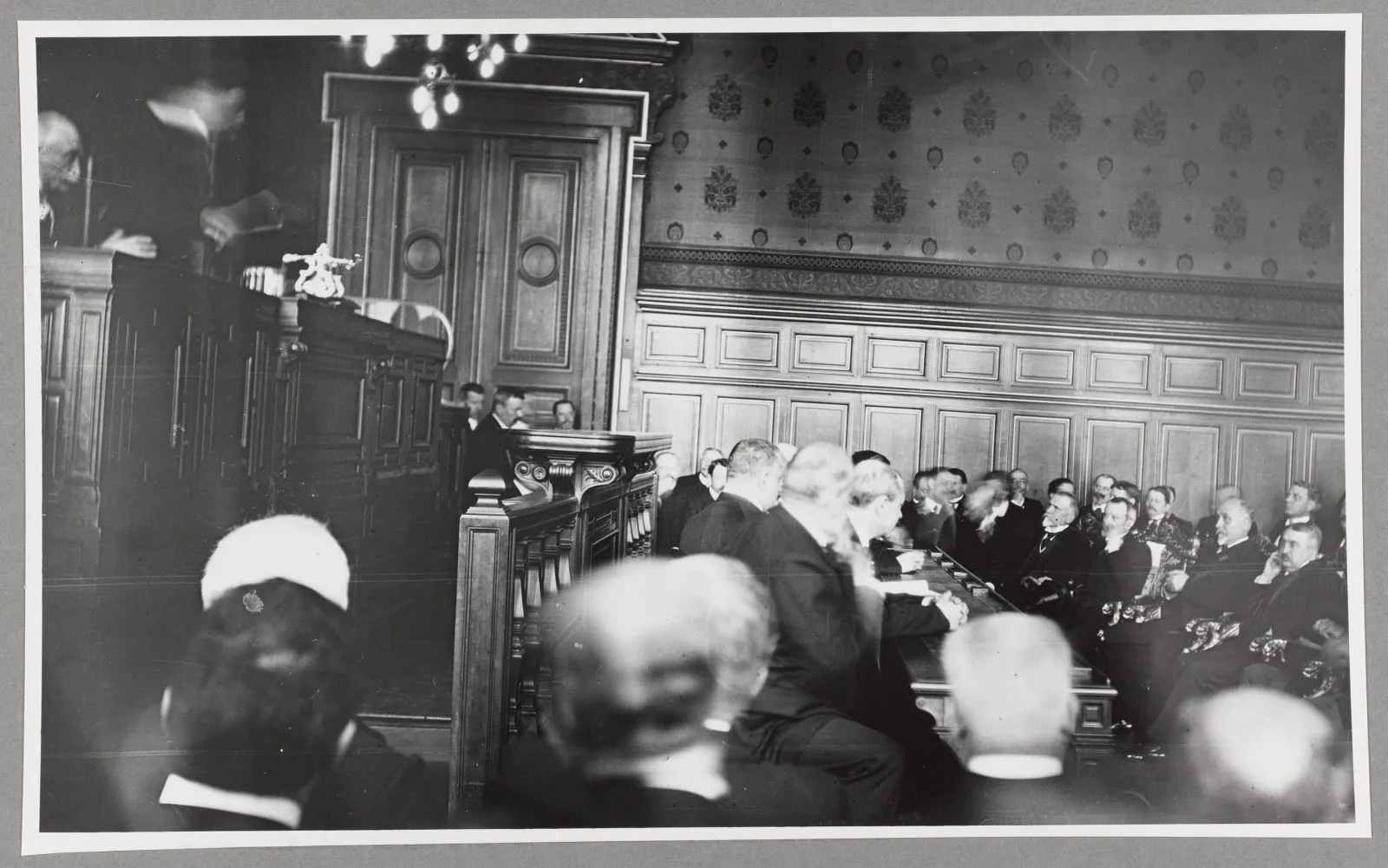
Roosevelt honored at the Hotel de Ville in Paris in April 1910, during the trip on which he delivered his famous 'Citizenship in a Republic' - the 'Man in the Arena' - address at the Sorbonne. (Library of Congress)
2. Delivered the "Man in the Arena" Speech at the Sorbonne—The Most Quoted Passage in American Oratory
The Philosophy of Effort
On April 23, 1910, at the Sorbonne in Paris, Theodore Roosevelt delivered a speech titled "Citizenship in a Republic" that became one of the most quoted and influential speeches in American history. In it, he articulated his philosophy of the strenuous life, of effort and action, of the necessity for men to test themselves. The most famous passage from this speech, known as the "Man in the Arena" section, has been quoted innumerable times in American political speeches, motivational literature, and popular culture. In this passage, Roosevelt contrasted the "man in the arena" who "is actually in the arena, whose face is marred by dust and sweat and blood" with the "cold and timid souls" who critique from the sidelines. "It is not the critic who counts," Roosevelt declared; "the credit belongs to the man who is actually in the arena." For decades afterward, Americans quoted this passage when arguing for the importance of engagement over criticism, of action over passive complaint, of the person willing to try and fail over the person safely critiquing from a distance. The speech articulated in philosophical terms the beliefs that had animated Roosevelt's entire life: that struggle and effort were ennobling, that a man should test himself, that the critic who never risked anything was less important than the person willing to risk failure in pursuit of a worthy goal. The "Man in the Arena" speech stands as Roosevelt's most important expression of his personal philosophy, and it remains influential in American thought.
3. Ran the Most Ambitious Third-Party Campaign in U.S. History: The Bull Moose Party
Split in the Republican Party
When Roosevelt returned from Africa in 1910, he expected to remain relatively quiet as a former president. But he found the policies of his successor, William Howard Taft, increasingly troubling. Taft had proved more conservative than Roosevelt expected and less aggressive in pursuing conservation and trust-busting. By 1912, Roosevelt determined that he should challenge Taft for the Republican nomination. When Taft and the Republican establishment blocked Roosevelt's nomination at the Republican convention, Roosevelt formed a new party: the Progressive Party, popularly known as the Bull Moose Party. The 1912 campaign became the most remarkable third-party campaign in American history. Roosevelt ran as an explicitly progressive candidate, advocating for women's suffrage, expanded worker protections, and aggressive trust-busting. He campaigned with characteristic vigor, delivering speeches across the country. The split between Roosevelt (Progressive) and Taft (Republican) divided the Republican vote, allowing Democrat Woodrow Wilson to win the presidency with a plurality of the popular vote. Roosevelt came in second nationally, ahead of Taft. It was the strongest showing by a third-party candidate in American history. Though Roosevelt ultimately lost the presidency, his Bull Moose campaign moved American politics decisively in a progressive direction. The issues he championed—labor protections, conservation, trust-busting, social reform—became central to the political agenda for the next several decades.
Ten Facts Post-Presidency - Bull Moose Party

Theodore Roosevelt and running mate Hiram Johnson after their nomination as the Progressive (Bull Moose) Party ticket in 1912, the most ambitious third-party campaign in U.S. history. (Library of Congress)
Ten Facts Post-Presidency - Milwaukee Shooting

Roosevelt speaks from a car in Milwaukee on October 14, 1912, the day a would-be assassin shot him in the chest; he went on to deliver a 90-minute speech before seeking treatment. (Milwaukee Journal Sentinel via Wikimedia Commons)
4. Took a Bullet in Milwaukee and Spoke for 90 Minutes With It in His Chest
Courage Under Fire
On October 14, 1912, while campaigning in Milwaukee, Wisconsin, Theodore Roosevelt was shot by an assassin named John Schrank. The bullet struck Roosevelt in the chest, passing through his metal eyeglass case and the speech folded in his vest pocket before lodging in his chest, dangerously close to vital organs. Roosevelt collapsed momentarily but quickly recovered. He determined that he would continue with his scheduled speech, unwilling to let the assassination attempt interrupt his campaign. Despite bleeding internally, despite the fact that the bullet remained in his chest, Roosevelt was driven to the auditorium where he was scheduled to speak. He took the stage and delivered a 90-minute speech, pausing occasionally to acknowledge his wound but refusing to leave the platform. "I have just been shot," he told his startled audience, "but it takes more than that to kill a Bull Moose." He continued speaking, his voice growing weaker as he lost blood, but his determination undiminished. Only after completing his speech did he agree to be taken to the hospital. The assassination attempt and Roosevelt's response became legendary in American political history. He had proven, once again, that he was willing to subject his body to severe tests in pursuit of what he believed to be important. The bullet remained in his chest for the rest of his life; doctors determined that removing it would be more dangerous than leaving it. Roosevelt carried it for the remaining six years of his life, until his death in 1919.
5. His Folded Speech and Steel Eyeglass Case Literally Saved His Life
Fortune and Fortitude
The assassination attempt in Milwaukee was inches away from being fatal. John Schrank's bullet had been traveling at lethal velocity when it struck Roosevelt. The folded speech in Roosevelt's vest pocket and his steel eyeglass case acted as a barrier, slowing and deflecting the bullet. Roosevelt's steel eyeglass case has become legendary in American history as the object that saved the former president's life. The bullet passed through the 50-page speech and the eyeglass case before becoming lodged in Roosevelt's chest. Historians and ballistics experts have debated whether the eyeglass case alone would have stopped the bullet; most conclude that the combination of the thick speech and the metal case significantly slowed the projectile, reducing its force and enabling Roosevelt's survival. The image of the deflected bullet, the folded speech, the steel eyeglass case, all combined to suggest a kind of providential protection. Roosevelt himself viewed it this way: his survival seemed miraculous, a sign that he was intended to survive and continue his work. The eyeglass case and the damaged speech were preserved and displayed in museums. They became powerful symbols of Roosevelt's apparent invulnerability, of his strange fortune in surviving dangers that would have killed ordinary men.
Ten Facts Post-Presidency - Bullet-Pierced Speech

Aide Elbert Martin holds the folded 50-page speech that, with a steel eyeglass case, slowed the assassin's bullet and helped save Roosevelt's life in Milwaukee, 1912. (Library of Congress)
Ten Facts Post-Presidency - River of Doubt

Roosevelt's party in a dugout canoe during the Roosevelt-Rondon Scientific Expedition on Brazil's uncharted River of Doubt, 1913-1914, a journey that left him gravely ill. (Library of Congress)
6. Nearly Died on the "River of Doubt" in the Amazon After Losing the 1912 Election
The Final Great Adventure
After losing the 1912 election to Woodrow Wilson, Theodore Roosevelt embarked on yet another extraordinary adventure. In December 1913, at age fifty-five, he undertook an expedition down an unmapped river in the Amazon rainforest, a river that had been christened the Rio da Dúvida (River of Doubt) because its course and destination were unknown. Roosevelt, accompanied by his son Kermit and a small team of naturalists and guides, set out to explore and document this unknown river. The expedition nearly killed him. The party contracted malaria, dysentery, and other tropical diseases. They nearly starved when they were unable to find food. They were shadowed through the forest by the indigenous Cinta Larga, who watched the intruders but never attacked. One man was murdered. Roosevelt himself became so ill with fever that at one point his companions believed he would not survive. He lay in a dugout canoe, delirious with fever, urging his son to leave him behind rather than jeopardize the entire expedition. "Cherrie, I want you and Kermit to go on," the expedition's naturalist George Cherrie remembered him saying. "You can get out. I will stop here." But Roosevelt survived. The expedition eventually reached the mouth of the river, which was then renamed Rio Roosevelt by the Brazilian government in honor of the former American president. Roosevelt emerged from the Amazon thinner, grayer, permanently damaged by the ordeal—but alive, with yet another extraordinary story to tell. The River of Doubt expedition demonstrated, yet again, that Roosevelt was willing to risk his life in pursuit of adventure and discovery.
7. The Amazon River Was Renamed Rio Roosevelt in His Honor
Geographic Legacy
When Theodore Roosevelt emerged from the Amazon after exploring the unknown Rio da Dúvida, the Brazilian government formally renamed the river Rio Roosevelt (Roosevelt River) as a tribute to his accomplishment. It was a remarkable honor: few geographical features in South America had been named after American citizens, and the renaming represented Brazil's appreciation for Roosevelt's courage in exploring the previously unknown river. The Rio Roosevelt exists on maps to this day, a permanent geographical reminder of Roosevelt's final great adventure. It is fitting that Roosevelt's name adorns a river, given his lifelong relationship with water and exploration. His early travels on the Nile as a boy had inspired his love of exploration. The rivers of the Dakota Badlands had provided solace during his grief. Now, in the final chapter of his active life, a major South American river bore his name. The renaming of the Rio da Dúvida to Rio Roosevelt was among the highest honors that could have been given to a foreign explorer.
Ten Facts Post-Presidency - Rio Roosevelt

Roosevelt points to a map of South America marking the river his expedition charted; Brazil renamed it the Rio Roosevelt in his honor. Photograph, 1913. (Library of Congress)
Ten Facts Post-Presidency - Quentin Roosevelt

Quentin Roosevelt in his airplane in France, 1918. All four Roosevelt sons served in World War I; Quentin, the youngest, was killed in aerial combat at age twenty. (Harvard College Library, Theodore Roosevelt Collection)
8. All Four of His Sons Served in World War I; His Youngest Son Quentin Was Killed at Age Twenty
Family and Sacrifice
When the United States entered World War I in 1917, Theodore Roosevelt, now in his late fifties, could not participate directly in combat. But his four sons—Theodore Jr., Kermit, Archibald, and Quentin—all served in the American Expeditionary Force in France. Roosevelt was immensely proud of his sons' service, yet deeply anxious about their safety. His worst fears were realized when his youngest son, Quentin, was killed in aerial combat over France in July 1918. Quentin had been serving as a pilot, and he was shot down and killed at age twenty. The death devastated Roosevelt. He had lived a life of vigorous action and had always assumed that he would be protected by his own strength and determination. But he could not protect his son from the hazards of war. Quentin's death was a blow from which Roosevelt never fully recovered. It revealed, painfully, the limits of even Roosevelt's will and determination to control events. He could not remake his son's body through exercise, could not will his son to survive through sheer force of character. The death of Quentin accelerated Roosevelt's own decline. He had always lived with intensity, had driven his body relentlessly, had assumed his strength was unlimited. The loss of his son seemed to break something in him. He died the following year, in January 1919.
9. Vice President Marshall Said "Death Had to Take Him Sleeping, for if Roosevelt Had Been Awake There Would Have Been a Fight"
A Final Eulogy
When Theodore Roosevelt died on January 6, 1919, at age sixty, the nation mourned. Vice President Thomas Marshall, commenting on Roosevelt's death, articulated a view that was widely shared: "Death had to take him sleeping, for if Roosevelt had been awake there would have been a fight." The comment captured the essence of how Roosevelt had been perceived: as a man so vital, so full of energy and determination, that death would have had to overcome him by stealth rather than through direct confrontation. Roosevelt had always been the man in the arena, testing himself, fighting for what he believed was right. Even in death, the image of him persisted: fighting, struggling, refusing to yield. Marshall's comment was both humorous and deeply respectful. It acknowledged that Roosevelt had lived with an intensity and a commitment to struggle that extended even to his final moments. He had never learned to be passive, never learned to accept limitation without resistance. Death, when it came, came by stealth and disease—not through any failure of Roosevelt's will, but through the simple biological limits that even his extraordinary body could not overcome.
Ten Facts Post-Presidency - Roosevelt Death
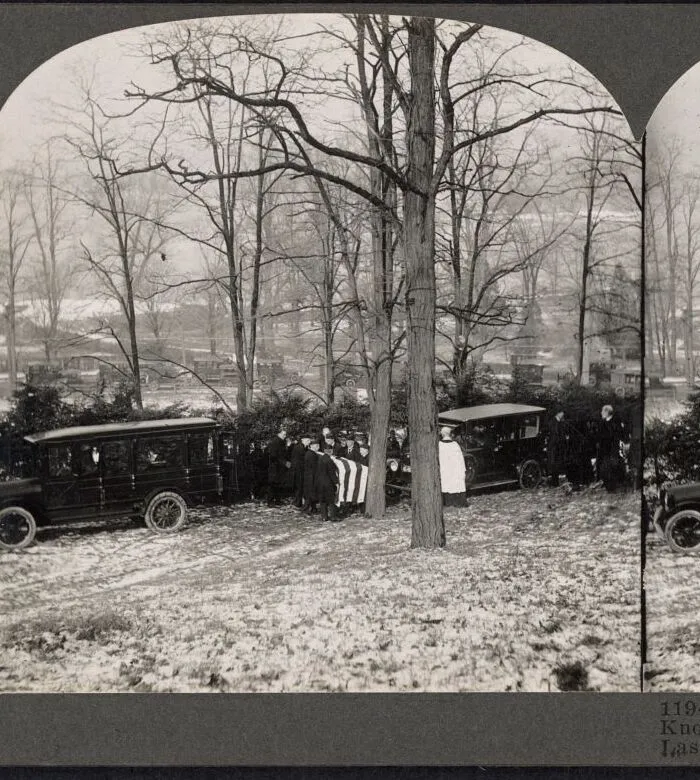
Roosevelt's funeral procession at Young's Memorial Cemetery in Oyster Bay, New York, January 1919. Vice President Marshall said death had to take him sleeping, for awake there would have been a fight. (Library of Congress)
10. His Influence on Subsequent Presidents and American Political Culture Was Profound and Lasting
Legacy and Legend
Theodore Roosevelt's influence on American politics and American culture extended far beyond his death in 1919. Subsequent presidents, from Harry Truman to John F. Kennedy to Ronald Reagan, invoked Roosevelt's example and quoted his philosophy. The conservation ethic that he had championed became central to American environmental policy. The idea of vigorous executive action, of a president willing to challenge established interests and pursue what he believed to be right, became a model for future presidents. The "strenuous life" that he had advocated—physical activity, moral seriousness, willingness to test oneself—influenced American culture for generations. His books, written across his lifetime, remain widely read. His speeches are quoted in contexts he never could have anticipated. The teddy bear bearing his name has remained one of the most beloved toys in American childhood. Roosevelt's influence on American political culture was so profound that it is difficult to imagine twentieth-century American history without him. He had expanded the powers of the presidency beyond what previous holders of the office had attempted. He had made conservation a central political concern. He had demonstrated that a man of intellectual accomplishment could also be a man of physical vigor and moral courage. He had shown that politics could be conducted with energy and moral seriousness. For better and for worse, Theodore Roosevelt shaped the twentieth century, and his influence continued throughout the twenty-first century as well. Few figures in American history have had a more lasting impact on how Americans understand leadership, courage, and the relationship between thought and action.
Theodore Roosevelt - Biography (video)
Continue Reading
- Post-Presidency Overview — Roosevelt's remarkable decade after leaving the White House.
- The New Nationalism — His evolved political philosophy calling for federal power to address social injustice.
- The Bull Moose Campaign of 1912 — His third-party progressive campaign and political insurgency.
From the Archives
Explore original photographs, documents, and illustrations related to this topic in the Theodore Roosevelt Center Digital Library.
- Post-Presidency Photographs — Images from Roosevelt's expeditions, speeches, and campaigns
- Historical Documents and Letters — Correspondence and records from Roosevelt's post-presidency years
Recommended Reading
- Colonel Roosevelt by Edmund Morris (2010). ISBN: 978-0-679-60415-0